
Laundry Business GST & Compliance Guide for 2026 [Complete]
Running a laundry or dry-cleaning business in India means dealing with GST, billing rules, and compliance deadlines. Many shop owners struggle with incorrect invoices, missed filings, or confusion about which GST rate applies to their services. This guide covers everything you need to know about GST for laundry businesses, how to stay compliant, and how modern billing software can simplify the process. Whether you're just starting out or looking to fix existing issues, this is for you.
Understanding GST Rates for Laundry Services
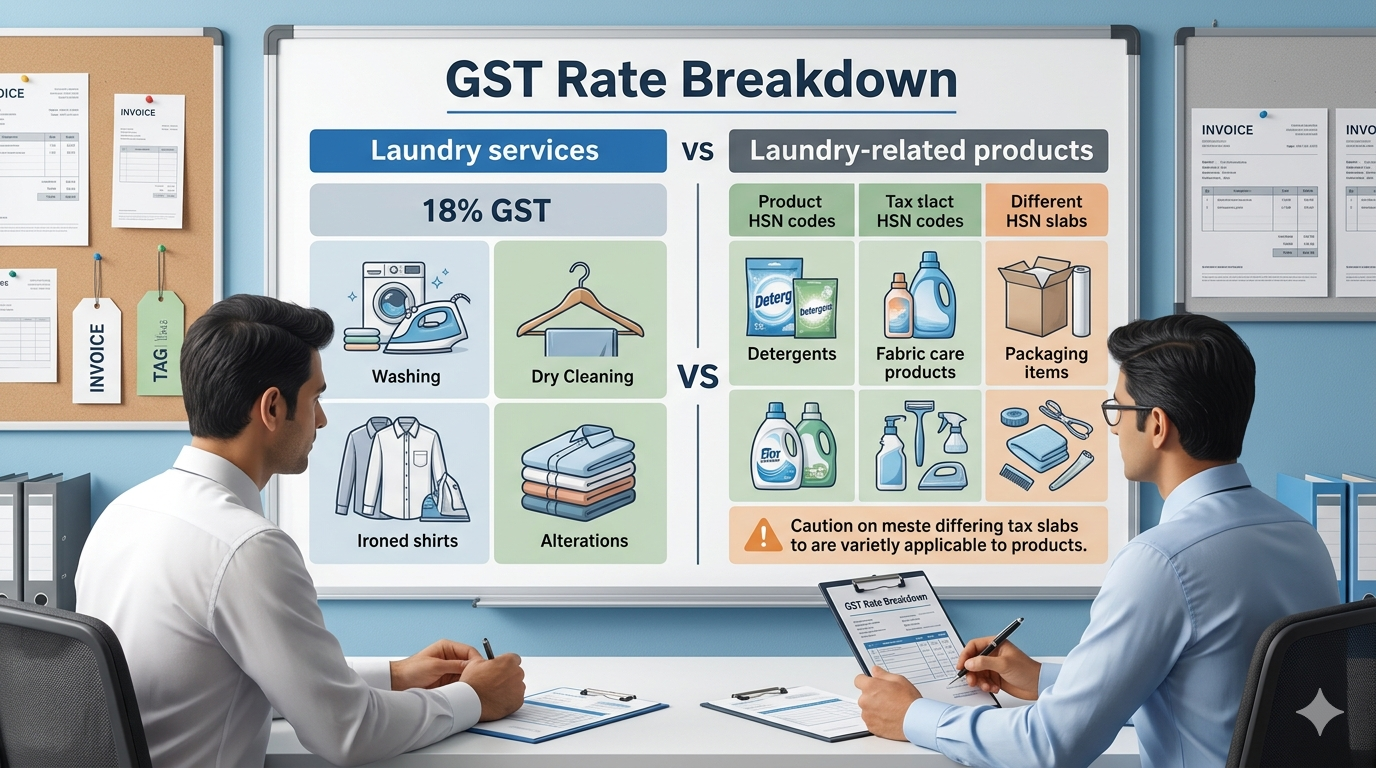
The GST rate for laundry and dry-cleaning services in India is 18%. This applies to most standard services like washing, ironing, dry cleaning, and alterations. There's no confusion here if you're operating a typical laundry shop.
However, things get slightly different if you're running multiple service types. For example, if you sell detergent or laundry products alongside your services, those products may fall under different HSN codes and tax slabs. Most laundry owners don't need to worry about this unless they're running a hybrid retail-service model.
One common mistake I've seen is shop owners charging the wrong GST rate because they assume all services are taxed at 12%. That's not the case. Always verify your service classification before printing invoices.
Do You Need GST Registration for Your Laundry Business?
GST registration becomes mandatory if your annual turnover crosses ₹20 lakhs (₹10 lakhs for special category states). But here's what most small laundry owners miss: even if your turnover is below this threshold, voluntary registration can be beneficial.
Why? Because registered businesses can claim input tax credit on purchases like machinery, detergents, packaging materials, and even rent in some cases. If you're buying a commercial washing machine worth ₹2 lakhs, the GST component is significant. Without registration, you can't recover that.
On the flip side, registration brings compliance responsibilities. You'll need to file monthly or quarterly returns, maintain proper books, and issue GST-compliant invoices for every transaction. Many small shops avoid registration to skip the paperwork, but that limits their ability to work with corporate clients or bulk orders, which almost always require GST bills.
If you're planning to scale or take on B2B contracts (hotels, hospitals, gyms), get registered early. The compliance burden is manageable with the right system in place.
How to Generate GST-Compliant Bills for Laundry Orders
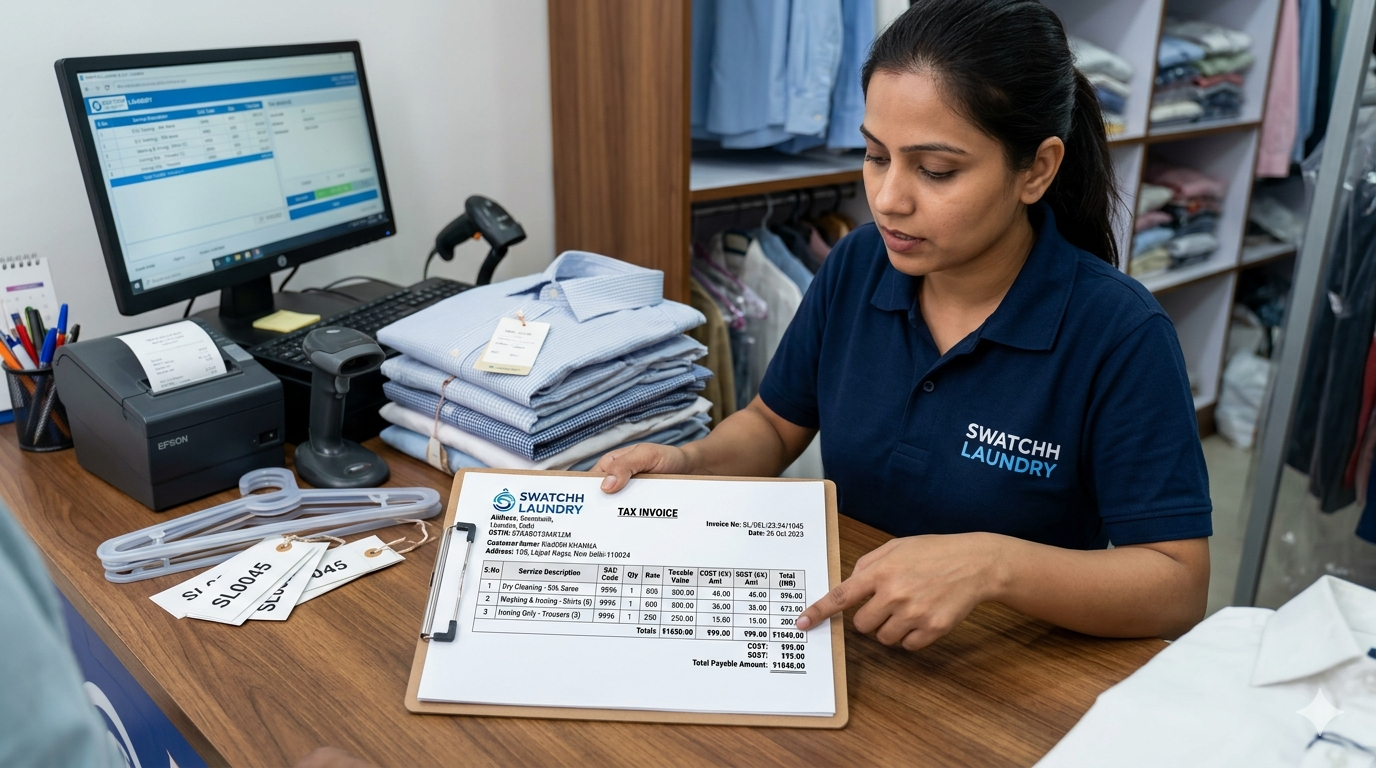
A valid GST invoice must include specific details. Missing even one can make your bill non-compliant, which creates problems during audits or if a customer requests a credit note.
Here's what every laundry invoice needs:
- Invoice number (sequential, no gaps)
- Invoice date
- Customer name and address
- GSTIN (if the customer is registered)
- Description of services (be specific: "Dry cleaning - 3 shirts" not just "laundry")
- HSN/SAC code (9996 for laundry services)
- Taxable value
- GST rate and amount (CGST + SGST or IGST)
- Total amount payable
Most billing errors happen because shop owners use generic bill books or handwritten receipts. These don't meet GST standards. You need either a GST-ready billing software or printed invoice formats that include all mandatory fields.
Another issue: consolidated bills. Some laundry shops give customers one bill for multiple orders over a week or month. That's fine, but each line item must still be dated and described properly. If you're consolidating bills, your software should automatically track and merge order details without losing transaction-level data.
Common GST Compliance Mistakes Laundry Owners Make
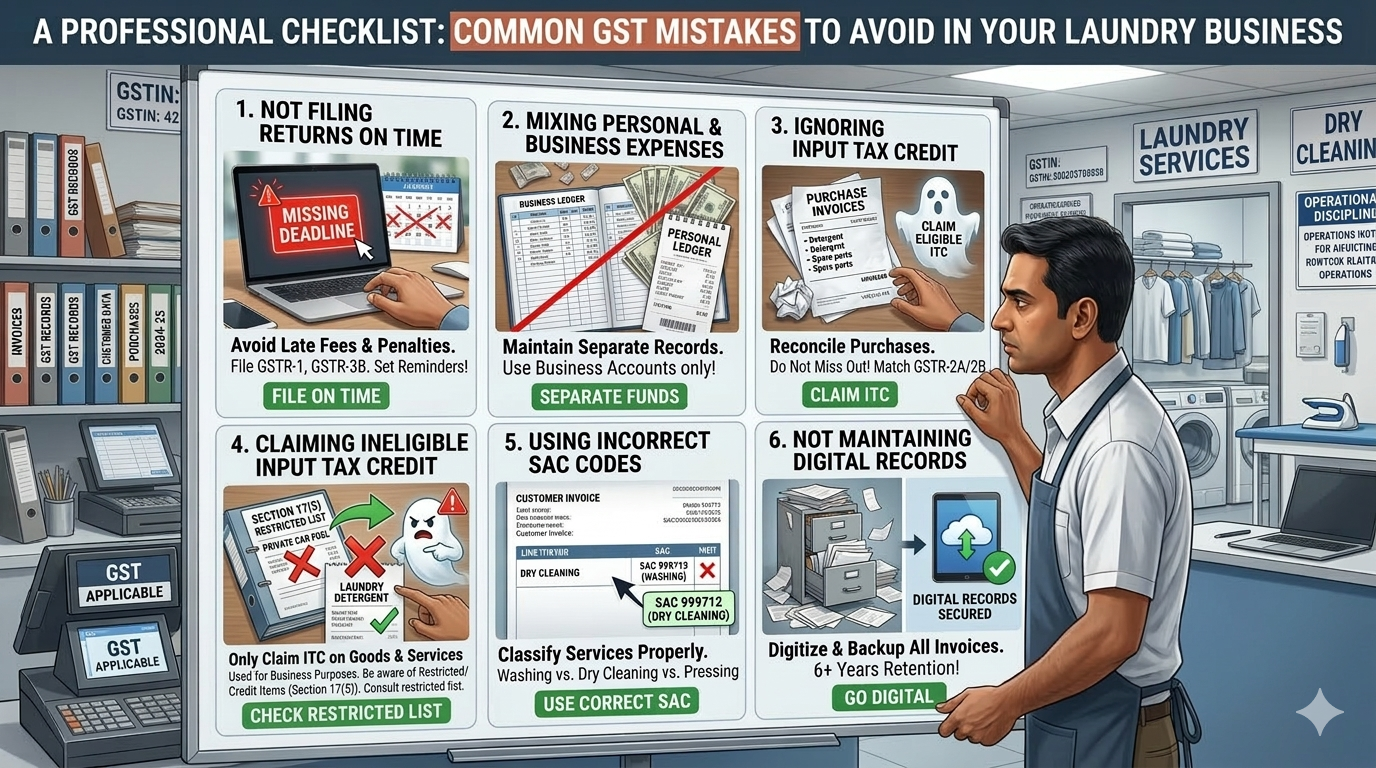
I've worked with dozens of laundry businesses, and the same mistakes keep showing up.
Not filing returns on time. GSTR-1 and GSTR-3B are monthly obligations for most businesses. Missing deadlines means late fees (₹50 per day per return) and potential interest on unpaid tax. Even if you had zero sales in a month, you still need to file a nil return.
Mixing personal and business expenses. Using the same bank account for shop revenue and household spending makes reconciliation nearly impossible. During audits, unexplained cash deposits can trigger notices.
Ignoring input tax credit. Many shop owners don't claim ITC on legitimate business expenses because they don't keep purchase invoices. Every vendor bill, equipment purchase, and service contract should be filed and recorded.
Incorrect SAC codes. Some owners use the wrong service code, which can lead to tax rate mismatches. Always use SAC 9996 for laundry services.
Not maintaining digital records. GST compliance increasingly relies on e-invoicing and digital tracking. Paper records alone won't cut it if the tax department asks for detailed transaction logs.
GST Return Filing Process for Laundry Businesses
If your turnover is below ₹5 crores, you're likely eligible for the QRMP (Quarterly Return Monthly Payment) scheme. This means you file detailed returns quarterly but pay tax monthly.
Here's the typical filing cycle:
Monthly (if applicable):
- Pay GST liability using Form PMT-06 or through challan
Quarterly:
- File GSTR-1 (outward supply details) by the 13th of the month following the quarter
- File GSTR-3B (summary return and tax payment) by the 22nd/24th
For most small laundry businesses, this is manageable. The real challenge is keeping daily records accurate so that when filing time comes, you're not scrambling through handwritten notes trying to reconstruct sales data.
I recommend reconciling your books weekly. Match your billing software reports with bank deposits. Flag any discrepancies immediately. Waiting until the last day of the month to sort out three weeks of transactions is where errors creep in.
If you're using manual methods, invest in at least a basic GST software or work with a CA who can file on your behalf. The cost is far lower than the penalties and stress of non-compliance.
How Laundry POS Software Simplifies GST Billing
This is where technology becomes less of a luxury and more of a necessity. A dedicated laundry POS system built for GST compliance can eliminate most of the manual work and errors.
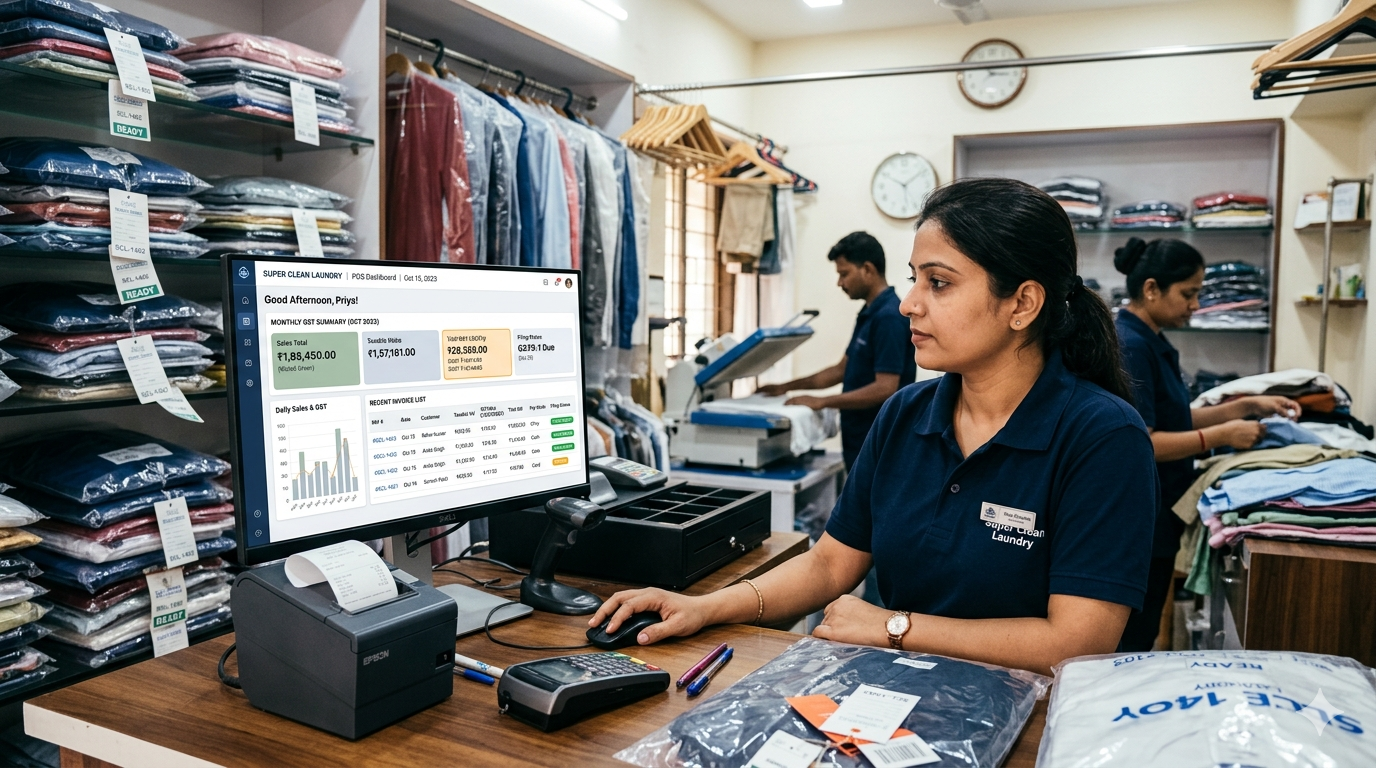
Here's how it works in practice. When a customer drops off clothes, the software generates an order with service details, pricing, and applicable GST. The invoice is auto-numbered, dated, and stored digitally. When the order is completed and paid, the system logs the transaction, updates inventory (if you track consumables), and feeds the data directly into your GST reports.
Ezer Laundry POS Software, for example, handles GST billing automatically. You don't need to calculate tax rates or worry about invoice formatting. The system knows the correct SAC code, applies 18% GST, and generates compliant bills in seconds. For businesses juggling dozens of orders daily, this saves hours of manual work.
The bigger advantage is consolidated reporting. At month-end, the software can generate GSTR-1 and GSTR-3B-ready data. You export the file, upload it to the GST portal, and you're done. No spreadsheet wrangling, no missing invoices, no math errors.
If you have multiple branches, cloud-based software syncs everything centrally. You can monitor compliance across locations from one dashboard.
Managing Cash vs Digital Payments for GST Tracking
Cash is still king in many laundry businesses, but it complicates GST compliance. The tax department prefers digital trails. If most of your revenue is cash and you can't explain deposits, you're inviting scrutiny.
Here's a practical approach: encourage digital payments (UPI, cards) by offering small discounts or loyalty points. Even a ₹5 incentive can shift behavior. Digital payments automatically create a transaction record, which makes reconciliation easier.
For cash transactions, issue proper receipts immediately and log them in your software the same day. Don't let cash sales pile up in a drawer to be "entered later." That's how discrepancies start.
Some laundry shops maintain a cash book separately and a digital ledger for GST. This works only if you're disciplined about daily reconciliation. Otherwise, you end up with two sets of numbers that don't match.
A good POS system allows mixed payment modes. A customer can pay ₹500 in cash and ₹300 by UPI for the same order. The system records both, reconciles the total, and keeps your books clean.
Ezer Laundry POS System
Streamline your laundry business with our comprehensive POS system. Features include smart billing, garment tracking, WhatsApp notifications, and cloud backup.
Consolidating Bills for Regular Customers
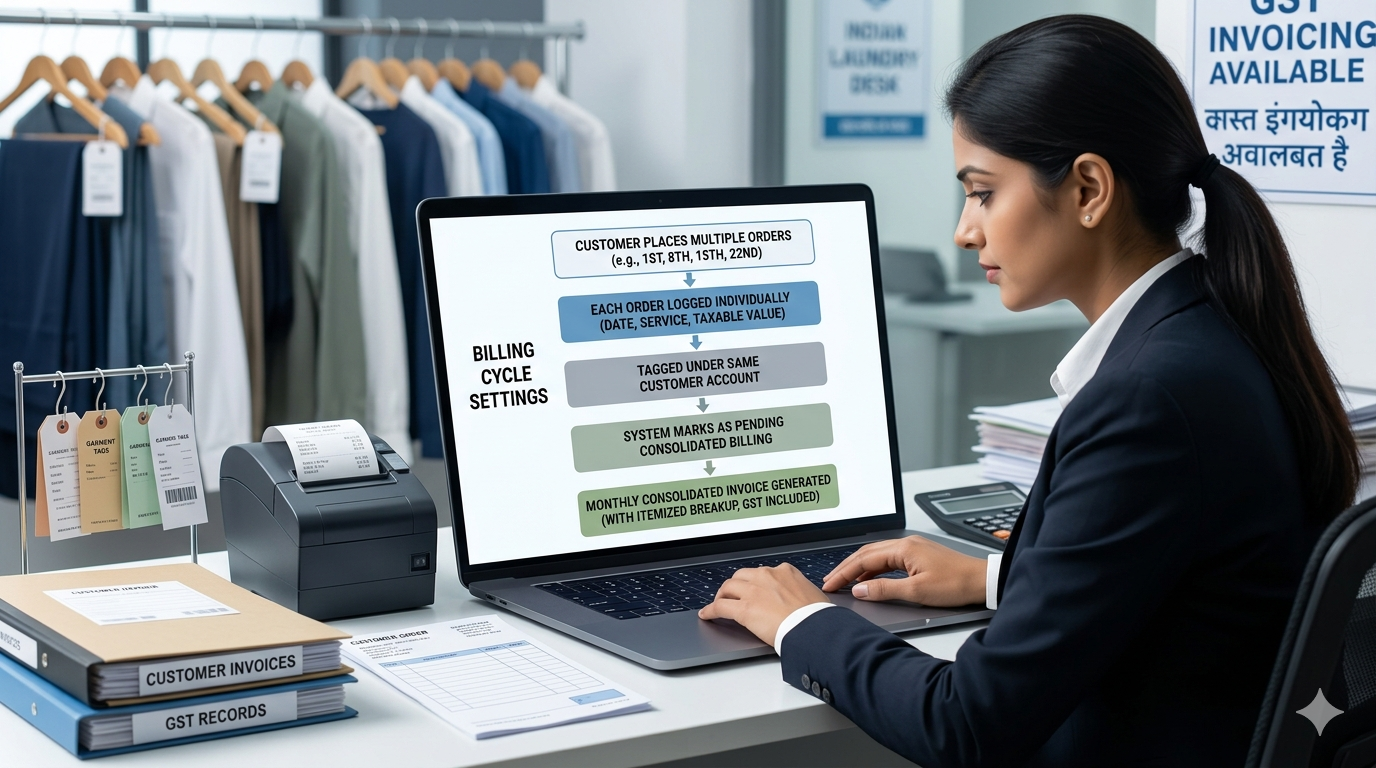
Many laundry businesses serve regular customers—apartment complexes, corporate clients, or individuals who send clothes weekly. Instead of issuing separate invoices for each pickup, you might consolidate bills monthly.
This is allowed under GST, but you need to maintain proper records. Each transaction (individual order) must still be logged with its date, service details, and taxable value. At month-end, you issue a consolidated invoice summarizing all orders.
The challenge is ensuring nothing falls through the cracks. If you're doing this manually, one missed order or incorrect date can throw off your entire GST filing.
Modern laundry software handles this automatically. It tracks every order under a customer's account, tags them as pending billing, and generates a consolidated invoice on demand. The invoice includes a detailed breakup of each transaction, which satisfies GST requirements and keeps customers informed.
Ezer Laundry POS Software offers this feature for bulk and corporate clients. You can configure billing cycles (weekly, bi-weekly, monthly), and the system auto-generates invoices. This is particularly useful for B2B contracts where consolidated bills are the norm.
Record Keeping and Audit Preparedness
GST audits can happen, especially if your turnover crosses certain thresholds or if there are discrepancies in your filings. Being prepared means maintaining clear, accessible records.
You need:
- All sales invoices (digitally backed up)
- Purchase invoices for ITC claims
- Bank statements matching your declared turnover
- Reconciliation reports (sales vs filings)
- Proof of tax payments (challans, acknowledgments)
Store these for at least six years. Don't rely on paper alone. Physical records can be damaged, lost, or misplaced. Cloud storage or digital backups are essential.
If you're using a POS system, most of this is automatic. The software keeps a timestamped log of every transaction, which can be exported as reports during audits. You can generate year-wise summaries, customer-wise sales data, or tax-wise breakdowns in minutes.
Auditors also check for consistency. If your GSTR-1 shows ₹10 lakhs in sales but your bank account reflects ₹8 lakhs in deposits, you'll need to explain the gap. Ensure your billing, banking, and GST filings are aligned.
Handling Customer Refunds and Credit Notes
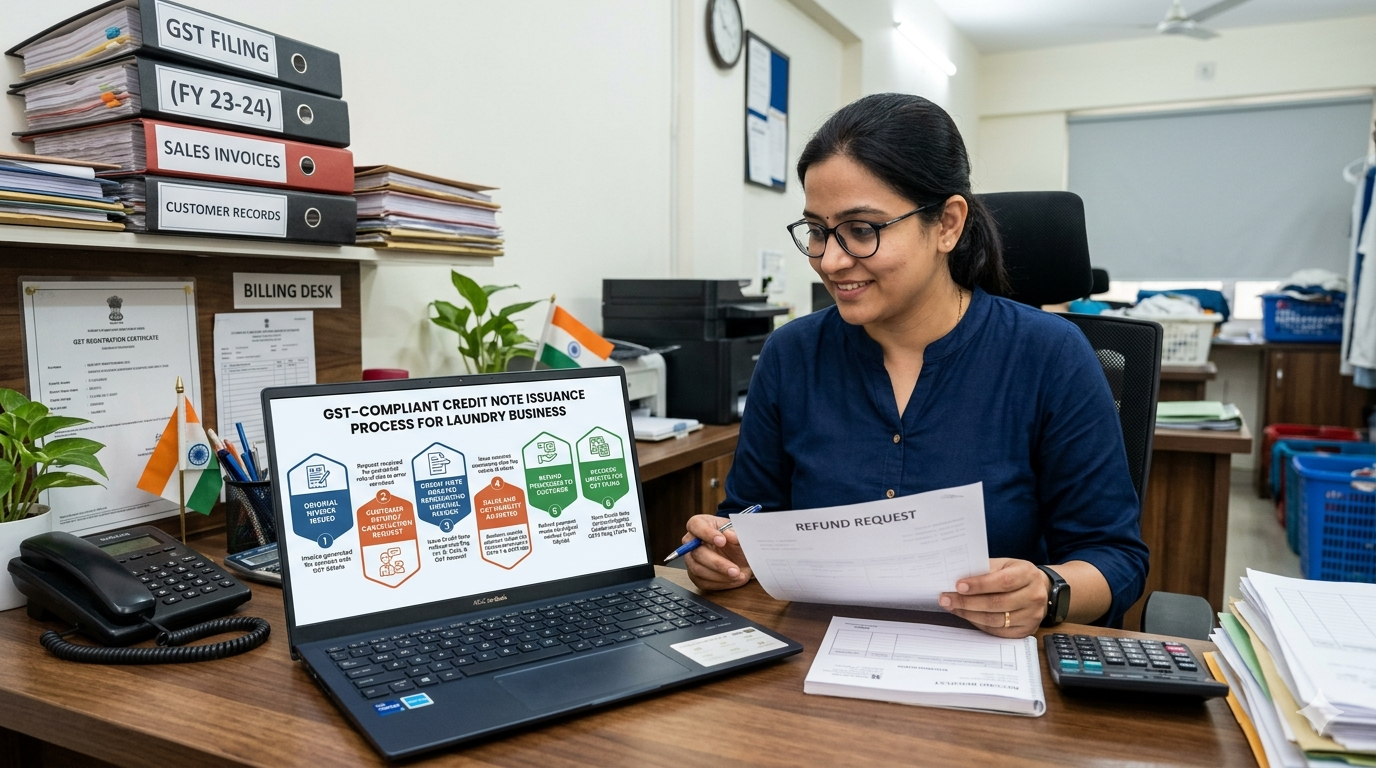
Refunds and cancellations happen. A customer might dispute charges, return an item, or cancel an order after billing. Under GST, you can't simply reverse the invoice and move on. You need to issue a credit note.
A credit note reduces your taxable turnover and adjusts the GST liability for the period. It must reference the original invoice number, explain the reason for adjustment, and be recorded in your books.
Many small laundry owners skip this step, thinking it's unnecessary for small amounts. But if you're audited, unaccounted refunds look like revenue suppression.
Here's the right process:
- Issue a credit note referencing the original invoice
- Adjust your GSTR-1 to reflect the credit note
- Reduce your tax liability accordingly
- Refund the customer (if applicable)
POS software automates this. You initiate a return or refund, and the system generates a compliant credit note. It updates your sales reports and GST filings automatically.
GST for Multi-Branch Laundry Businesses
If you operate multiple outlets, GST compliance gets more complex. Each branch might have its own sales, expenses, and inventory. You need to consolidate everything under one GSTIN and file unified returns.
The practical issue is coordination. If Branch A issues invoice #101 and Branch B also issues #101, you have a conflict. Invoice numbering must be centralized or branch-specific with prefixes (e.g., A-101, B-101).
Similarly, stock transfers between branches need proper documentation. Moving detergent from one location to another isn't a sale, but it needs a delivery challan to avoid questions during audits.
Cloud-based POS systems solve this by centralizing data. All branches connect to the same database. Invoice numbering is automatic and sequential. You can run consolidated reports or branch-specific reports as needed. At filing time, you have one clean dataset covering all locations.
This also helps with ITC claims. If you purchase equipment for Branch B, the input credit is claimed under the main GSTIN. The software tracks which expenses belong to which branch for internal accounting, but GST filings remain unified.
FAQs
What is the GST rate for laundry and dry-cleaning services in India?
The GST rate for laundry and dry-cleaning services is 18%. This applies to washing, ironing, dry cleaning, and alteration services. If you sell products like detergent alongside services, those may fall under different tax slabs depending on the product category.
Do I need GST registration if my laundry business turnover is below ₹20 lakhs?
GST registration is mandatory if your annual turnover exceeds ₹20 lakhs (₹10 lakhs in special category states). However, voluntary registration is beneficial if you want to claim input tax credit on equipment, supplies, or if you plan to serve corporate clients who require GST invoices.
Can I issue consolidated bills for regular customers under GST?
Yes, you can issue consolidated monthly bills for regular customers. However, each individual transaction must be logged separately with its date, service description, and taxable value. The consolidated invoice should provide a detailed breakup of all included transactions to remain GST-compliant.
How does laundry POS software help with GST compliance?
Laundry POS software like Ezer automates GST invoice generation with correct tax rates, SAC codes, and mandatory fields. It maintains digital records of all transactions, generates GSTR-1 and GSTR-3B-ready reports, and eliminates manual calculation errors. This saves time and reduces compliance risks significantly.
What happens if I miss a GST return filing deadline?
Missing GST return deadlines results in late fees of ₹50 per day per return (GSTR-1 and GSTR-3B), up to a maximum of ₹10,000. You may also face interest charges on unpaid tax. Even if you had zero sales, you must file a nil return to avoid penalties.
How should I handle cash payments for GST tracking?
Issue proper receipts for all cash transactions and log them in your billing system immediately. Encourage digital payments (UPI, cards) by offering small incentives to create automatic transaction trails. Reconcile cash collections with your GST filings daily to avoid discrepancies during audits.
What records do I need to keep for GST audits?
Maintain all sales invoices, purchase bills for ITC claims, bank statements, tax payment receipts, and reconciliation reports for at least six years. Store both physical and digital copies. Cloud-based POS systems automatically backup transaction logs, making audit preparation much simpler.
Conclusion
GST compliance doesn't have to be complicated for laundry businesses. The key is understanding your obligations, maintaining accurate daily records, and using the right tools to automate repetitive tasks. Whether you're handling a single shop or multiple branches, investing in a GST-ready billing system eliminates most compliance headaches and lets you focus on serving customers.
If you're still managing GST manually or struggling with filing errors, it's worth exploring how modern laundry management software can streamline your operations. Ezer Laundry POS Software offers built-in GST billing, consolidated invoice features, and automated reporting designed specifically for Indian laundry businesses. Book a free demo to see how it works for your business.