
Laundry Software Pricing in 2026: What Should You Actually Pay?
You're running a laundry business. Bills pile up, delivery boys mess up orders, and you're still using that register book from 2018. A friend mentions "laundry software," and suddenly you're staring at prices that range from ₹3,000 to ₹50,000. What's the actual difference? More importantly, what should you pay without getting ripped off?
This guide breaks down laundry software pricing—what drives costs, what features matter, and how to pick something that doesn't drain your margins. If you're running a dry-cleaning shop, a laundry chain, or planning your first outlet, this is for you.
Why Laundry Software Pricing Confuses Most Owners
Here's the thing. Unlike buying a mixer or a press machine, software doesn't have a fixed "market rate." One vendor charges ₹5,000/month. Another offers ₹15,000 one-time. A third one is "free" but locks you into expensive hardware.
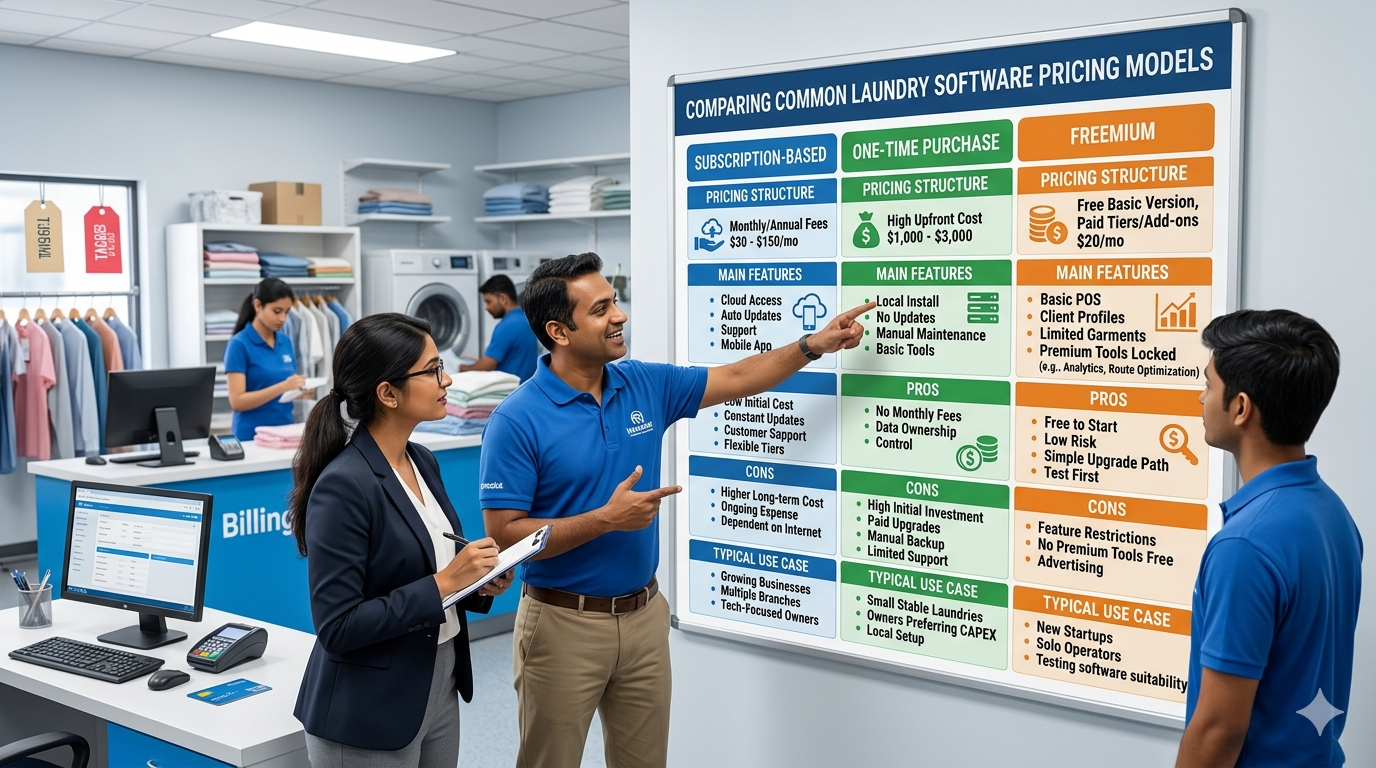
The confusion happens because pricing models vary wildly:
Subscription-based: Monthly or yearly fees. Usually cloud-hosted, which means updates and support are included. You pay ₹2,000–₹8,000/month depending on features and scale.
One-time purchase: Pay once, own forever. Sounds great until you realize updates cost extra, or the software stops working after a Windows update. Typical range: ₹10,000–₹40,000.
Freemium models: Basic features are free. Want SMS notifications or multi-branch support? That'll be ₹3,000/month extra.
None of these are inherently bad. The problem is when shop owners compare a ₹5,000 one-time deal with a ₹4,000/month subscription and think the first one is cheaper. Six months later, they're manually entering data because the "cheap" option doesn't sync across devices.
What Actually Drives Laundry Software Costs?
Let's get practical. Why does one system cost ₹3,000 while another demands ₹25,000? It's not random.
Cloud vs Local Installation
Cloud-based systems cost more monthly but save you from buying servers or worrying about backups. Your data lives online. You can check orders from home, the delivery guy updates statuses from his phone, and if your laptop crashes, nothing is lost.
Local installation is cheaper upfront but you're responsible for everything. One power surge, one hard drive failure—your entire customer database could vanish. I've seen shops lose 3 years of records this way.
Feature Complexity
Basic billing software? ₹2,000–₹5,000 range. Add pickup-delivery tracking, SMS automation, customer apps, and GST-compliant invoicing? You're looking at ₹8,000–₹15,000/month.
Some features sound fancy but don't move the needle. A loyalty points system is useless if you're a neighborhood shop with 50 regular customers who already know you. But automatic delivery slot booking? That directly reduces phone calls and staff workload.
Number of Users and Branches
Single shop, one billing counter? Lower tier pricing works fine. Running three outlets with five staff members accessing the system simultaneously? You'll need multi-user licenses and multi-branch management. That pushes costs up by 40–60%.
Support and Updates
Cheap software often means zero support. Your billing stops working during Diwali rush, and the vendor's "customer care" is a WhatsApp number that never responds. Premium options include phone support, on-site training, and regular feature updates. That's worth paying for if your business depends on it.
Breaking Down Real-World Pricing Tiers
Let's talk actual numbers you'll encounter.
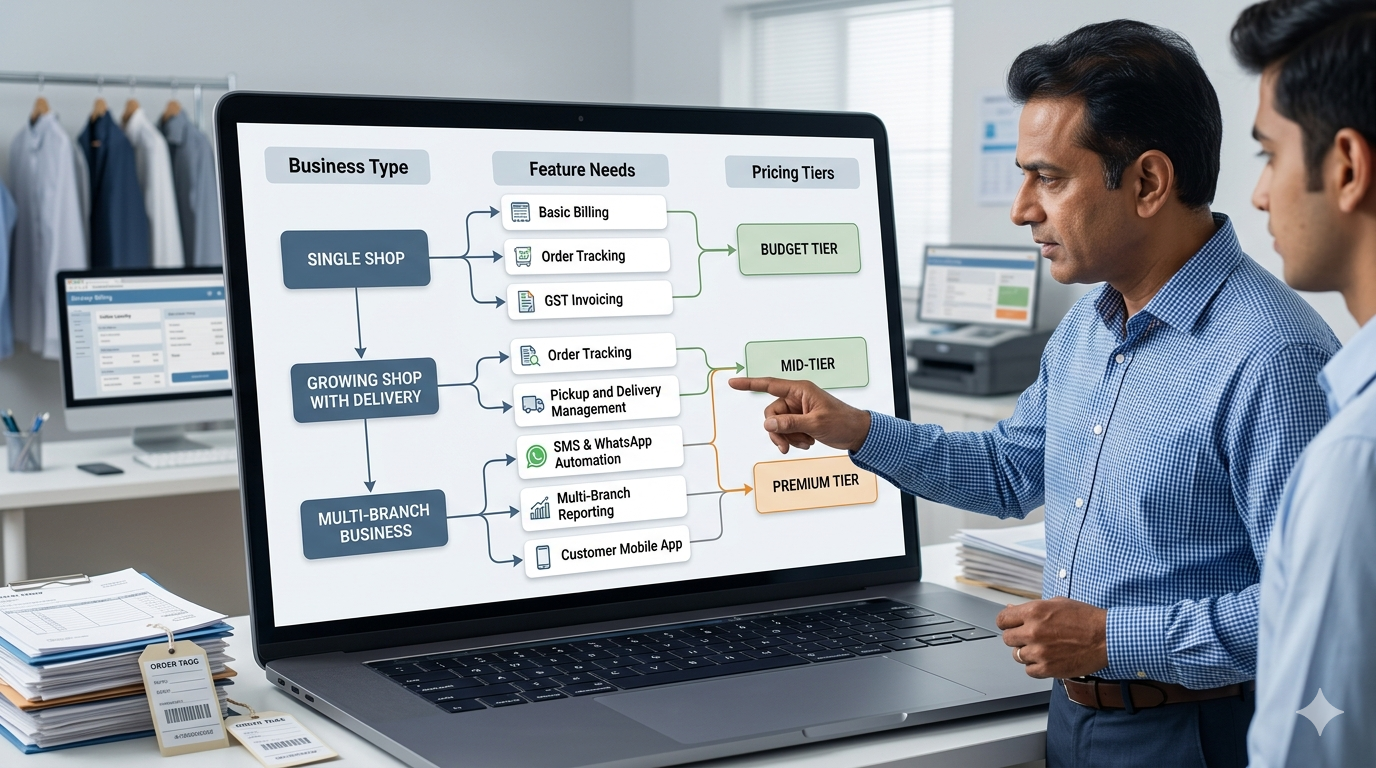
Budget Tier: ₹2,000 – ₹5,000/month (or ₹10,000–₹15,000 one-time)
This gets you basic billing and customer records. GST invoices, some order tracking, maybe a simple mobile app. Good enough if you're a single-shop operation doing 20–40 orders daily.
What's missing? Usually multi-branch support, advanced reporting, automated SMS/WhatsApp, and integration with delivery management. Customer support is often limited to email with 24–48 hour response times.
Honest take: Fine for starting out. You'll outgrow it within a year if your business picks up.
Mid-Tier: ₹6,000 – ₹12,000/month
This is where most established shops land. You get proper order tracking, pickup-delivery management, customer mobile apps, SMS automation, and multi-location support. Reporting improves significantly—you can actually see which services make money and which don't.
Support gets better. Phone assistance, training videos, and regular updates. The Ezer POS Laundry Management cost effective solution typically falls here, offering cloud-based access with mobile apps and full GST compliance without the premium pricing of international brands.
Most shops with 2–3 outlets and 100+ daily orders find this tier covers everything they need.
Premium Tier: ₹15,000 – ₹30,000+/month
Enterprise features. Deep integration with accounting software, advanced inventory management for consumables, custom branding on customer apps, API access for third-party integrations, and dedicated account managers.
Unless you're running 5+ branches or processing 500+ orders daily, you probably don't need this. I've seen 4-outlet chains run perfectly fine on mid-tier plans.
Hidden Costs Nobody Mentions
The sticker price isn't everything. Watch for these add-ons that vendors spring on you later.
Hardware Requirements
Some software is "free" but requires you to buy their branded tablets, barcode scanners, or thermal printers. Suddenly your ₹3,000/month plan needs ₹40,000 in hardware.
Ask upfront: Can I use my existing devices? What's the minimum hardware spec?
Transaction or Order Fees
A few platforms charge per transaction. Looks cheap at first—₹2,000 base fee plus ₹5 per order. Great if you're doing 50 orders monthly. Terrible when you're processing 1,000 orders and suddenly owe ₹7,000 instead of ₹2,000.
SMS and Communication Costs
Automated SMS notifications are brilliant for customer experience. But they cost money. Some vendors include a monthly quota (say, 1,000 SMS). Others charge separately. WhatsApp Business API integration? That's usually extra too.
Factor in ₹1,000–₹3,000/month for communication if you want to keep customers updated automatically.
Setup and Training
Enterprise vendors often charge ₹10,000–₹25,000 for initial setup, data migration, and staff training. Smaller vendors might do it free or for ₹2,000–₹5,000. Ask before signing.
How Software Actually Solves Real Laundry Business Problems
Let's be direct. Software isn't magic. But it does fix specific, expensive problems.
The Billing Error Problem
Manual billing leads to mistakes. Customer says they gave 5 shirts; your staff wrote down 3. Now there's an argument, maybe a lost customer. Software creates digital records the moment items are checked in, with photos if needed. Disputes drop significantly.
The "Where's My Order?" Problem
You've gotten this call 50 times today. Customers calling to check order status. Each call takes 2–3 minutes. That's hours of staff time wasted. With proper software, customers check order status themselves via SMS or app. Calls reduce by 60–70%.
The Delivery Chaos
Your delivery person forgot to collect payment from three customers. Or delivered the wrong order. Or can't remember which pin code areas they already covered today. Delivery management features assign orders, track completion, and flag unpaid bills automatically.
The Staff Dependency
When your best billing person takes a day off, chaos ensues. Only they know which customer has pending orders, who gets a discount, or how to apply that specific service rate. Centralized systems mean anyone can handle any customer. Your business isn't held hostage by one employee's memory.
These aren't theoretical benefits. They're everyday time-savers that pay for the software within months.
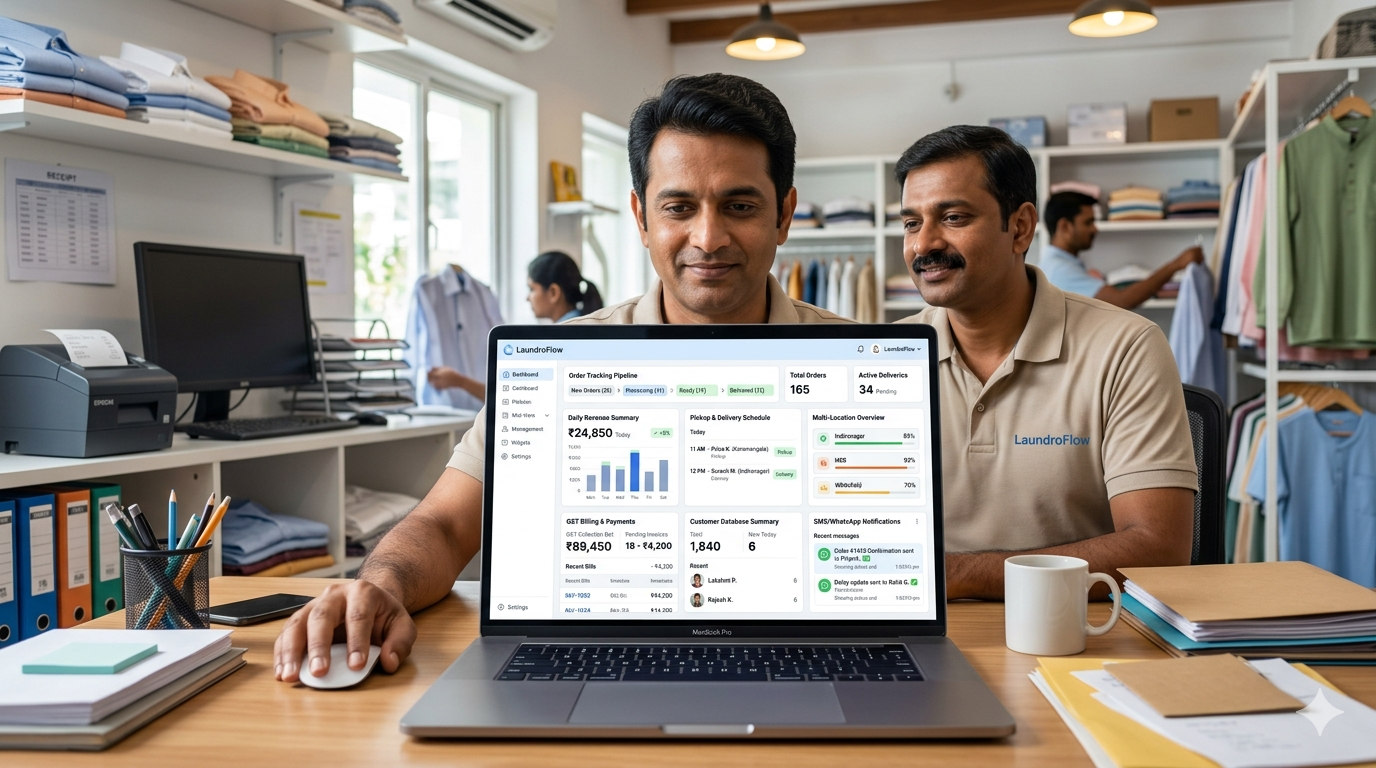
Ezer Laundry POS System
Streamline your laundry business with our comprehensive POS system. Features include smart billing, garment tracking, WhatsApp notifications, and cloud backup.
What Features Justify Higher Pricing?
Not all features are created equal. Some are worth paying extra for. Others are vendor padding.
Worth the Extra Cost:
- Cloud-based access with mobile apps (essential if you check business from home)
- Multi-branch management with centralized reporting (critical for expansion)
- Automated pickup-delivery scheduling (saves massive staff time)
- Customer mobile app with order tracking (reduces support calls dramatically)
- GST-compliant billing with auto-calculations (non-negotiable for legal compliance)
- WhatsApp/SMS integration (massive customer experience upgrade)
Often Overpriced Fluff:
- "AI-powered" anything (usually basic automation rebranded)
- Fancy dashboard graphics that don't offer actionable insights
- Social media integration (how often do laundry customers book via Facebook?)
- Advanced inventory management (unless you're also running a retail outlet)
Before paying premium prices, ask yourself: Does this feature save time, reduce errors, or improve customer retention? If not, skip it.
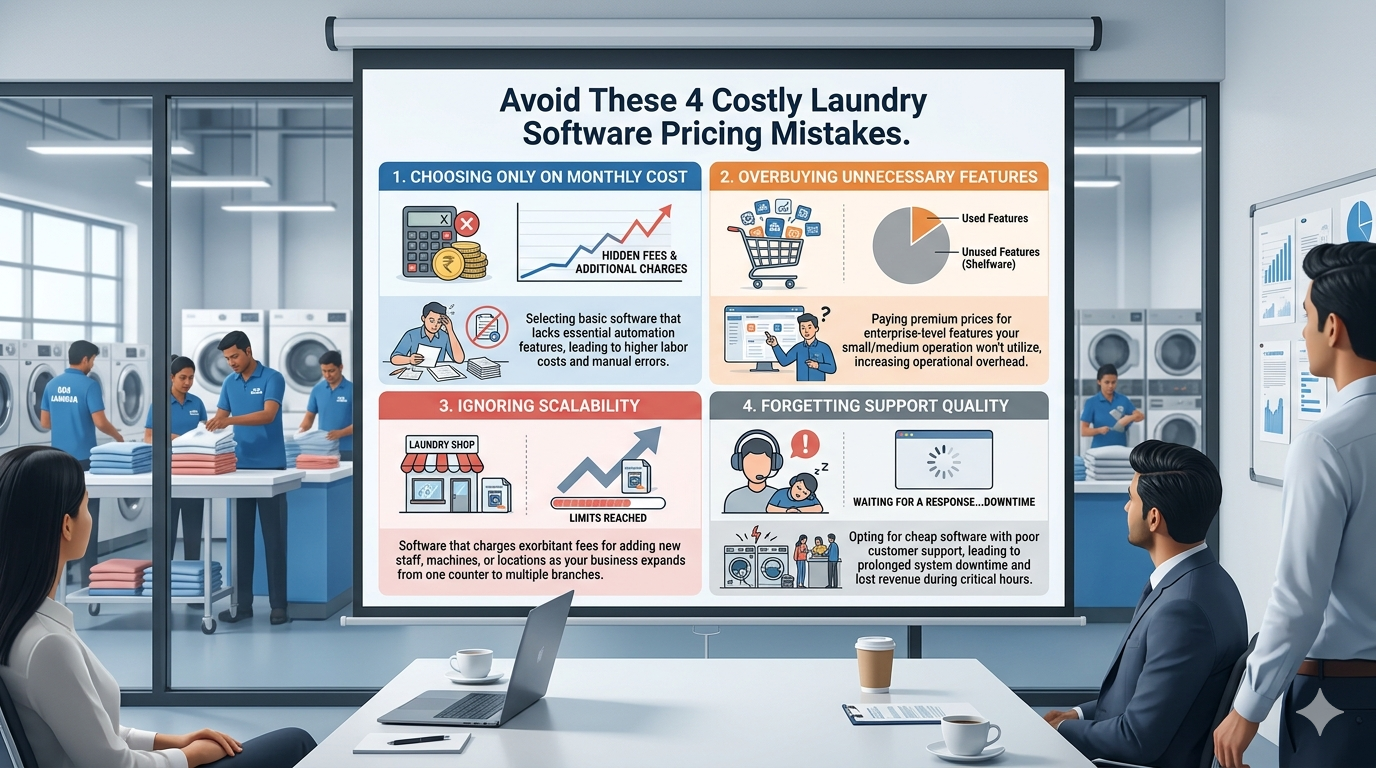
Common Pricing Mistakes Laundry Owners Make
Mistake #1: Choosing Based Only on Monthly Cost
A ₹3,000/month plan sounds cheaper than ₹7,000/month. But if the cheaper one requires manual SMS, lacks delivery tracking, and provides no support, you'll waste 10+ hours monthly on workarounds. Your time has value. Sometimes paying ₹4,000 more saves ₹15,000 in operational headaches.
Mistake #2: Overbuying Features
You don't need enterprise-grade analytics if you're running two shops. Vendors love upselling. Politely decline the "advanced retail POS integration" if you only do laundry services.
Mistake #3: Ignoring Scalability
Your business will grow. Choosing ultra-basic software means switching systems in 18 months—migrating data, retraining staff, dealing with downtime. Pick something that can scale from 1 to 3–4 outlets without requiring a complete change.
Mistake #4: Forgetting About Support Quality
Cheap software with zero support is expensive when it breaks. You're stuck, customers are waiting, and nobody's answering your emails. Pay a bit more for vendors who actually pick up the phone.
How to Evaluate If You're Paying Fair Price
Here's a quick framework.
Step 1: Calculate Your Order Volume
Small shop (20–50 orders/day): ₹2,000–₹5,000/month is reasonable
Medium shop (50–150 orders/day): ₹5,000–₹10,000/month makes sense
Multi-branch (150+ orders/day): ₹10,000–₹20,000/month is standard
Step 2: List Must-Have Features
Write down what you actually need. Not what sounds cool. Most shops need: billing, order tracking, customer database, pickup-delivery management, GST invoices, and SMS notifications. That's it.
Step 3: Get 3–4 Quotes
Don't settle on the first option. Compare features, support quality, and total cost including hidden fees.
Step 4: Ask About These Specifics
- What happens if I want to cancel? (Lock-in periods, data export)
- Is training included?
- What's your typical response time for support issues?
- Can I upgrade/downgrade my plan easily?
- Are there any transaction limits or per-order charges?
Step 5: Trial Before Committing
Most decent vendors offer 7–30 day free trials. Use them. Test with real orders, real customers, real staff. If the vendor refuses a trial, that's a red flag.
When Free or Ultra-Cheap Software Makes Sense
Sometimes budget options work fine.
If you're testing a laundry business idea and aren't sure you'll continue, a free or ₹1,000/month basic plan is smart. No point investing heavily before validating demand.
If you're running a tiny operation (1 shop, 10–20 orders/day, no delivery service), basic software handles your needs. You're not losing much operational efficiency.
But the moment you add a second location, hire delivery staff, or cross 50+ daily orders, cheap software becomes expensive. The time you waste on workarounds costs more than upgrading to proper systems.
The Real Cost-to-Value Equation
Here's how to think about it differently.
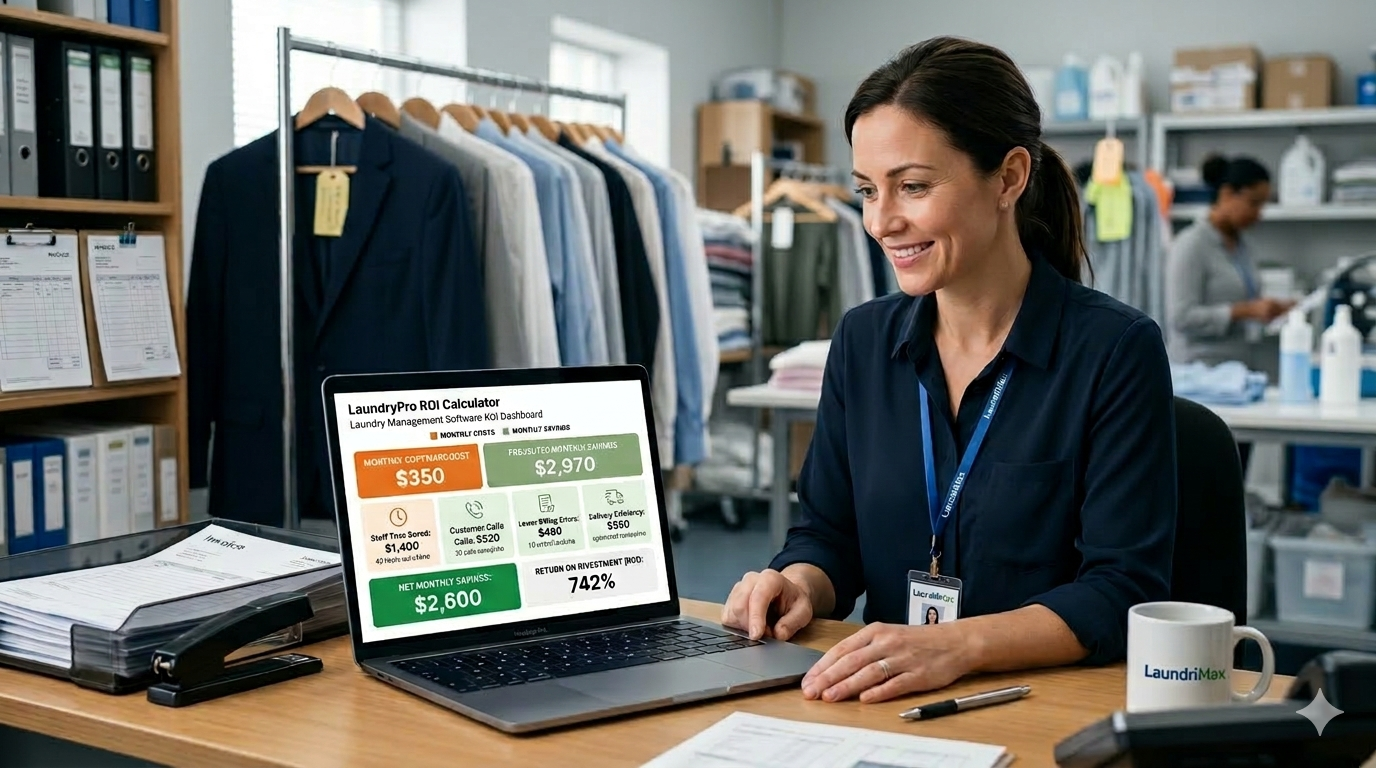
Say you're paying ₹8,000/month for solid laundry management software. That's ₹96,000/year. Sounds like a lot.
But consider what it replaces:
- 1–2 hours daily of manual order tracking = ₹15,000/month in staff time
- 30–40 fewer customer calls about order status = 5 hours/week saved
- Reduced billing errors = fewer refunds and disputes (₹5,000–₹10,000/month easily)
- Better delivery management = less fuel waste, fewer missed deliveries (₹3,000–₹5,000/month)
Suddenly ₹8,000 for software that saves ₹20,000+ in operational costs looks like a bargain.
Don't think "software cost." Think "what this software eliminates."
What About Ezer POS and Similar Solutions?
Let's address this directly since you're probably evaluating options.
Modern cloud-based systems like Ezer POS Laundry Management cost effective solution typically sit in that ₹6,000–₹10,000/month range. You get mobile apps for customers and staff, pickup-delivery tracking, GST billing, multi-branch support, and ongoing updates.
The main advantage of these mid-tier cloud solutions? They're built specifically for Indian laundry businesses. That means auto-calculated GST, integration with local payment gateways, and support teams that understand your actual challenges—not generic software adapted from US dry-cleaning shops.
They're not the cheapest. But they're priced reasonably for what they deliver. And critically, they scale. Start with one shop, expand to five without changing systems.
Should you pick this exact option? Maybe. But the principle applies broadly: avoid ultra-cheap if you're serious about growth, avoid ultra-premium unless you're running a large chain, and focus on the middle ground where features match real business needs.
FAQs
How much should a small laundry shop spend on software monthly?
For a single-location shop processing 30–80 orders daily, budget ₹3,000–₹6,000/month for decent cloud-based software with billing, customer management, and basic delivery tracking. This covers most operational needs without overpaying for enterprise features you won't use. One-time purchase options exist for ₹10,000–₹20,000 but lack cloud benefits and ongoing support.
Is subscription pricing better than one-time purchase?
Subscription works better for most laundry businesses. You get automatic updates, cloud backup, and included support. One-time purchase seems cheaper initially but often excludes critical features like mobile apps, multi-device access, and regular updates. Plus, if the software breaks, you're stuck. Subscriptions spread costs predictably and include ongoing vendor support.
What hidden costs should I watch for in laundry software?
Setup fees (₹5,000–₹25,000), hardware requirements (tablets, printers, scanners), per-transaction charges, SMS/WhatsApp communication costs (₹1,000–₹3,000/month), and data migration fees. Always ask for total cost breakdown including these extras. Some vendors advertise low base prices but pile on mandatory add-ons that double your actual monthly spend.
Can I start with cheap software and upgrade later?
Yes, but plan for migration headaches. Moving customer data, retraining staff, and system downtime costs time and money. If you're genuinely testing a business idea, start cheap. But if you're committed to growing beyond one shop, invest in scalable software from the start. Switching systems a year later wastes more than the initial savings.
How do I know if I'm overpaying for laundry software?
Compare your monthly cost to order volume. Paying ₹15,000/month for 40 daily orders? Probably overpaying. Paying ₹6,000/month for 200 orders across 3 branches? That's reasonable. Also check what percentage of revenue goes to software—keeping it under 2–3% of monthly revenue is a healthy benchmark for most service businesses.
Does expensive software guarantee better support?
Not always, but there's correlation. Premium vendors usually offer phone support, training, and faster response times. Budget options often limit you to email with 48+ hour delays. Before buying, test their support—ask a pre-sale question and see how quickly and helpfully they respond. That's your preview of future service quality.
What features actually save money in laundry software?
Automated customer notifications (reduces phone calls by 60–70%), delivery route optimization (saves fuel and time), digital order tracking (eliminates billing disputes), and multi-branch reporting (highlights profit/loss by location). Fancy dashboards and social media integration rarely deliver tangible ROI. Focus on features that directly reduce staff time or customer complaints.
Conclusion
Laundry software pricing doesn't need to be confusing. Most established shops should budget ₹5,000–₹10,000 monthly for solid cloud-based systems with core features. Less than that and you'll hit limitations quickly. More than that and you're probably paying for features you don't need.
The real question isn't "what's the cheapest option" but "what solves my actual business problems without wasting money on fluff." Get clear on your must-have features, compare 3–4 vendors properly, and don't skip the trial period.
Want to see how modern laundry management actually works in practice? Check out Ezer Laundry POS for a demo that shows real features without the sales pitch. Or keep researching—just don't stay stuck in manual systems while your competitors automate and scale.