
What to Check Before Buying Laundry POS Software in 2026
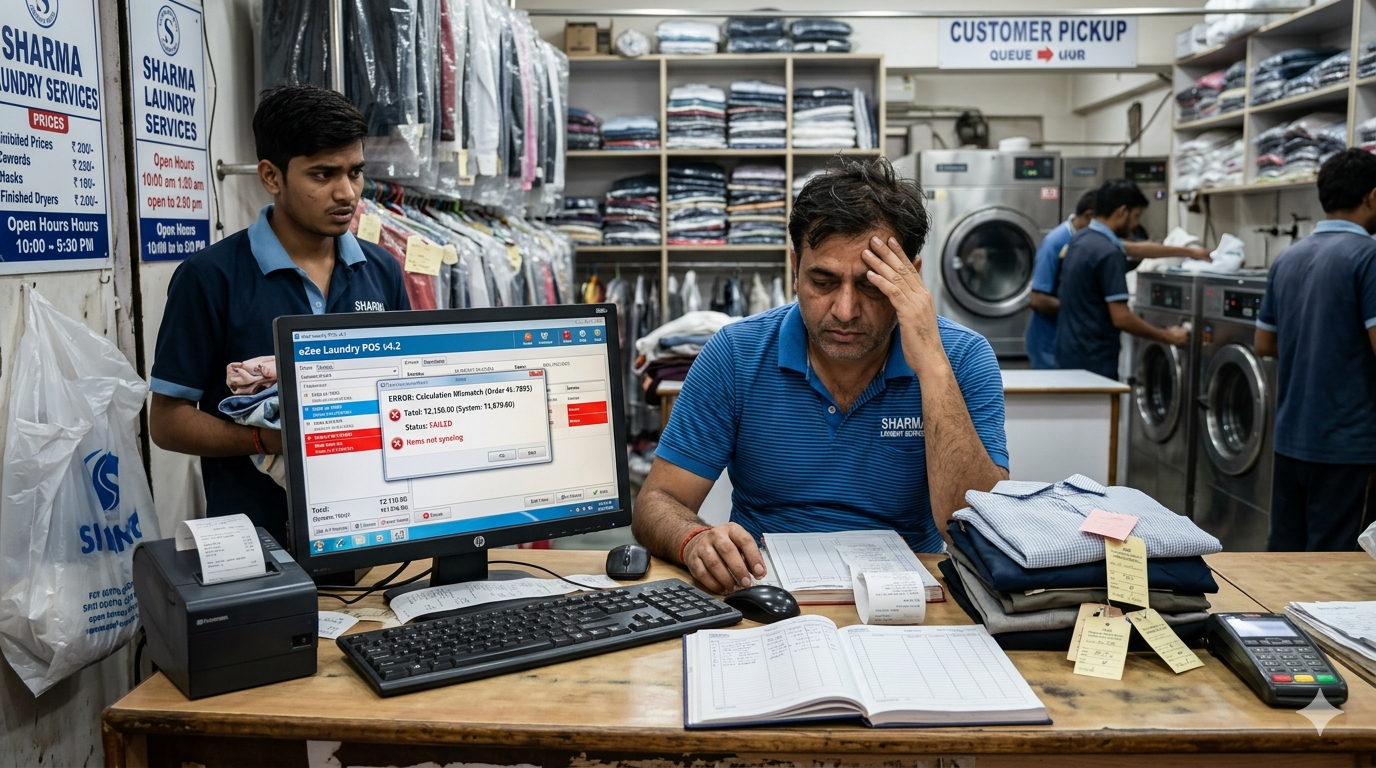
Buying the wrong POS system can cost you more than just money. I've seen laundry owners struggle with software that crashes during peak hours, doesn't sync between branches, or requires a degree in computer science to operate. Your staff ends up maintaining manual registers anyway, defeating the entire purpose.
This guide walks you through exactly what to check before buying laundry POS software. We'll cover the practical stuff that actually matters when you're running a business—not just the features listed on a sales page.
Why Most Laundry Owners Choose the Wrong Software
The problem starts with how these systems are sold. Vendors show you impressive dashboards and long feature lists. But they won't tell you that the "mobile app" only works on WiFi, or that the "customer management" module can't handle bulk SMS without third-party integration.
Here's what happens: You buy based on price or a single feature you need urgently. Three months later, you're dealing with billing errors, lost orders, and customers complaining about delayed delivery notifications. The software company says "it works fine for our other clients"—which doesn't help you at all.
The real cost isn't the subscription fee. It's the time your staff wastes working around limitations, the customers you lose due to operational issues, and the mental bandwidth you spend managing problems instead of growing your business.
Start With Your Current Pain Points
Don't shop for software based on what sounds good. List your actual problems first.
Are customers calling every day asking "where's my order?" That's a tracking problem. Do you manually note down pickup addresses? That's a delivery management gap. Are your monthly GST calculations a nightmare? You need better billing automation.
Write down the top five issues that waste your time or cost you customers. Then verify that any software you consider actually solves these specific problems—not just claims to, but actually does in their demo or trial.
I've met shop owners who bought "complete laundry management systems" that couldn't handle express orders differently from regular ones. They needed that feature desperately, but never checked before purchasing.
Cloud-Based vs Desktop: What Actually Matters
The sales pitch makes cloud software sound essential. The reality is more nuanced.
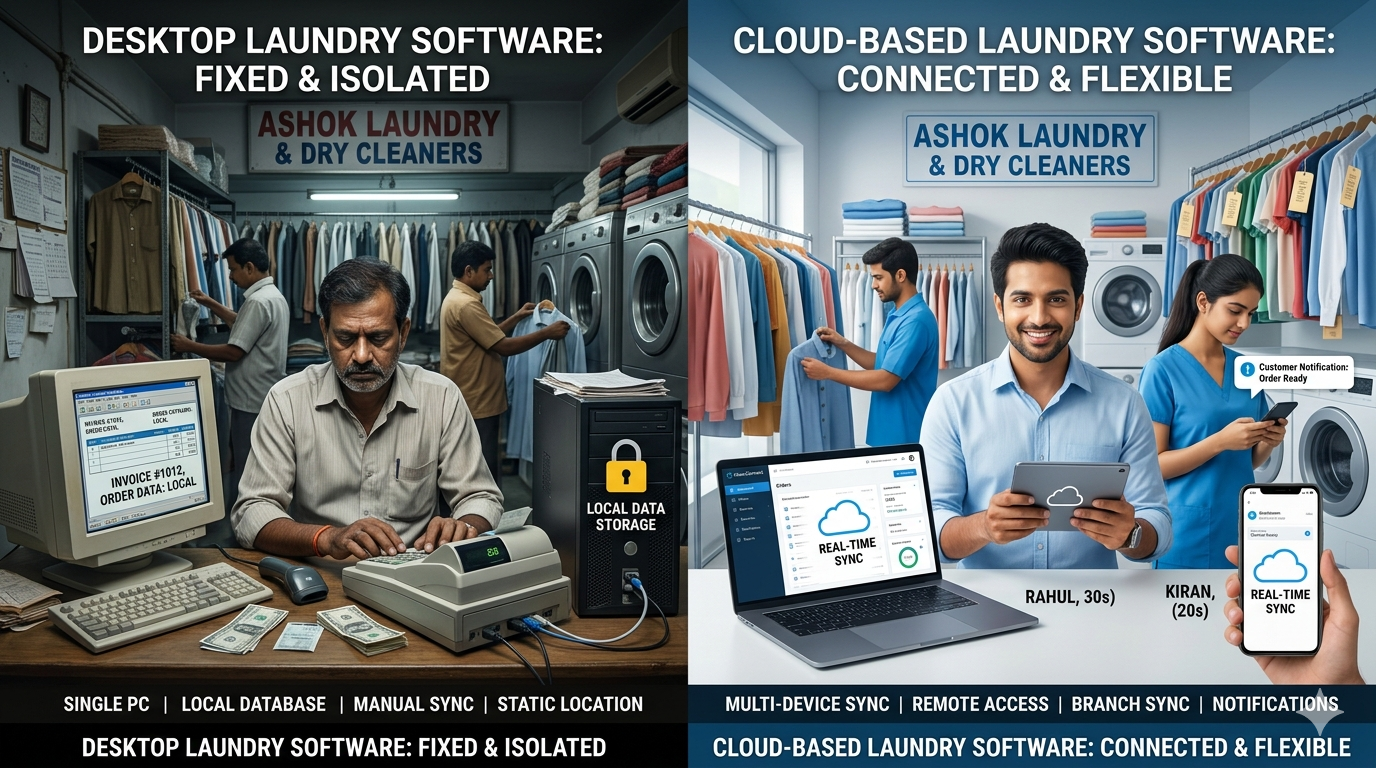
Cloud-based systems let you check business data from anywhere, sync across branches automatically, and don't require backup maintenance. But they need stable internet. If your area has connectivity issues, you'll face problems during busy periods.
Desktop systems work offline and often feel faster for billing. The downside? Your data lives on one computer. If it crashes or gets stolen, you might lose everything unless you're disciplined about backups. And forget about checking today's revenue from home.
For most laundry businesses in 2026, cloud makes sense—but only if your internet is reliable at least 95% of the time. Some modern systems offer hybrid models: cloud-based with offline billing capability that syncs when connection returns.
Billing Features That Actually Reduce Errors
Generic billing isn't enough. Laundry billing has specific requirements that trip up basic POS systems.
You need per-piece pricing for some items and per-kg for others. Rush orders should charge differently. Corporate contracts might have negotiated rates. Your software should handle all this without manual calculation each time.
GST compliance matters more than most vendors admit. The system should auto-calculate tax based on service type, generate proper invoices with HSN codes, and create GST-ready reports. I've seen businesses face audit issues because their POS couldn't separate taxable and non-taxable services properly.
Payment tracking is where money leaks happen. Check if the software handles partial payments, advance deposits, and pending balances clearly. Can customers pay half now, half on delivery? Does it track cash vs digital payments separately? These aren't advanced features—they're basic requirements.
Order Tracking and Customer Communication
Your customers don't care about your internal processes. They want to know when their clothes will be ready.
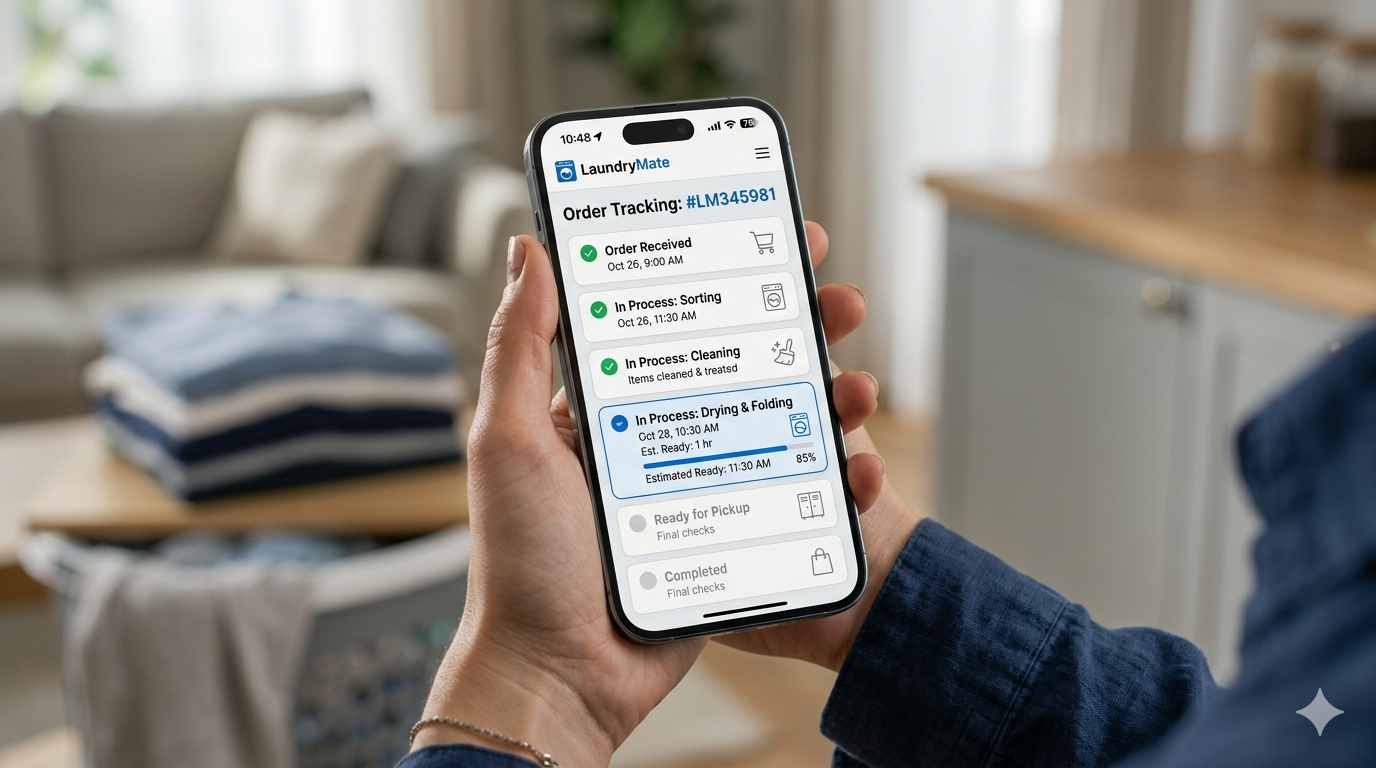
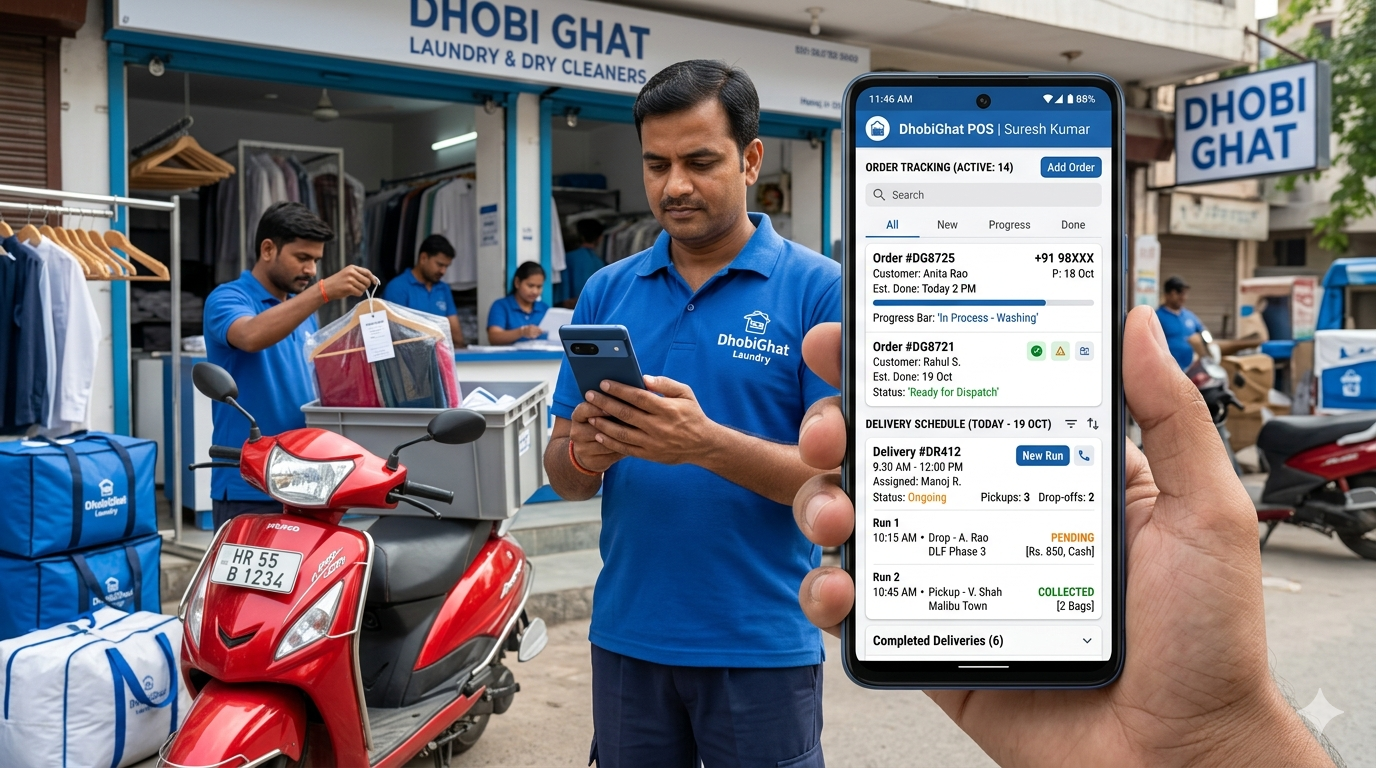
A proper tracking system should show order status in real-time: received, in process, ready for delivery, out for delivery, completed. Both you and your customers should be able to check this. If your staff has to manually update status or customers have to call to ask, the system isn't working.
Automated notifications save hours of phone calls. When an order is ready, the customer gets an SMS or WhatsApp message. When it's out for delivery, another notification. This isn't a luxury feature anymore—customers expect it.
But here's what vendors don't mention: notification systems cost money per message. Some POS providers bundle this, others charge separately. And the "WhatsApp integration" they promise might just be a manual template, not true automation. Verify this in the demo.
Pickup and Delivery Management
If you handle home pickup and delivery, this module can make or break your operations.
The software should let you schedule pickups, assign them to delivery staff, optimize routes if possible, and mark completion with proof of delivery. Your delivery person should have a mobile app where they can see their schedule, mark pickups/deliveries, and collect payments if needed.
GPS tracking sounds great but consider if you really need it. For small operations with 2-3 delivery people, it might be overkill. For larger operations or areas where delivery staff reliability is an issue, it's valuable.
Route optimization is genuinely useful. Instead of your delivery person zigzagging across the city, the software suggests efficient routes. This saves fuel and time. But check if the feature actually works with Indian addresses and pin codes—some international software struggles with our address formats.
Customer Management Beyond Just Names
Storing customer phone numbers and addresses is basic. Real customer management helps you increase business.
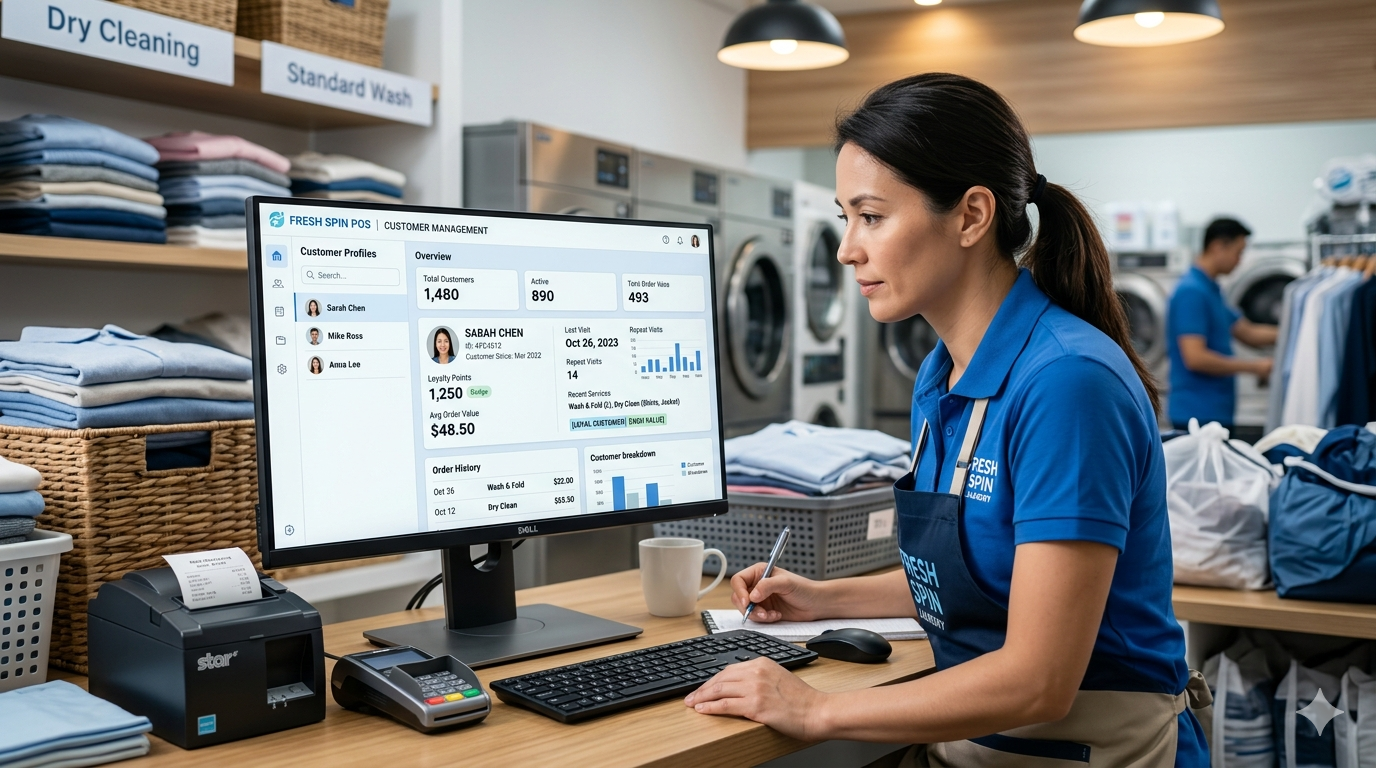
The system should track customer history: what they order regularly, their average ticket size, last visit date. This lets you identify your best customers and reach out when they haven't ordered in a while.
Loyalty programs work if they're simple. Points per order, discount after 10 visits—customers understand this. But if your POS makes loyalty tracking complicated, neither your staff nor your customers will use it.
Bulk communication is where you actually see ROI. Before festivals or wedding season, you can send targeted offers to customers who haven't ordered recently. For this to work, the system needs segmentation—not just one message to everyone.
Multi-Branch and Staff Management
If you're running more than one location or planning to expand, this becomes critical.
Multi-branch support should mean real-time data sync. Order placed at Branch A can be processed at Branch B if needed. You should see combined reports and individual branch performance. Inventory at different locations should be tracked separately.
Staff management includes login permissions, activity tracking, and commission calculation if relevant. Your billing person shouldn't access financial reports. Your delivery staff only needs the delivery module. This prevents both accidental errors and intentional issues.
Commission tracking matters for businesses that pay staff based on performance. The software should automatically calculate based on rules you set—X% on express orders, Y% on corporate contracts. Manual commission calculation leads to disputes and errors.
Mobile App: Essential or Optional?
Every vendor offers a mobile app now. The question is whether it's actually useful.
For you as the owner, a mobile app makes sense. Check revenue, monitor orders, get alerts for important events—all from your phone. This is genuinely convenient.
For customers, an app is useful only if you have high repeat usage. A customer who sends laundry twice a month probably won't keep your app installed. But corporate clients or hostel contracts who order weekly will appreciate easy reordering and status tracking.
The delivery staff app is where mobile becomes essential. They need to see their delivery schedule, mark completion, collect payment, and get next delivery info—all on the go. If this app is clunky or requires constant internet, your delivery operations will suffer.
Reporting and Analytics You'll Actually Use
Detailed reports look impressive in demos. But ask yourself: will you actually look at 47 different report types?
Focus on reports that drive decisions. Daily sales summary. Best-selling services. Customer retention rates. Peak hours. Pending payments. These help you make business decisions.
The software should make report generation simple. You shouldn't need to export to Excel and create pivot tables to see basic trends. And reports should be accurate—I've seen systems where the sales report doesn't match the payment report due to poor database design.
Tax reports matter during GST filing. Your CA should be able to work with whatever format the software exports. Some systems have direct Tally integration or GST portal compatibility, which saves time.
Integration Capabilities
Your POS doesn't operate in isolation. It needs to work with other tools you use.
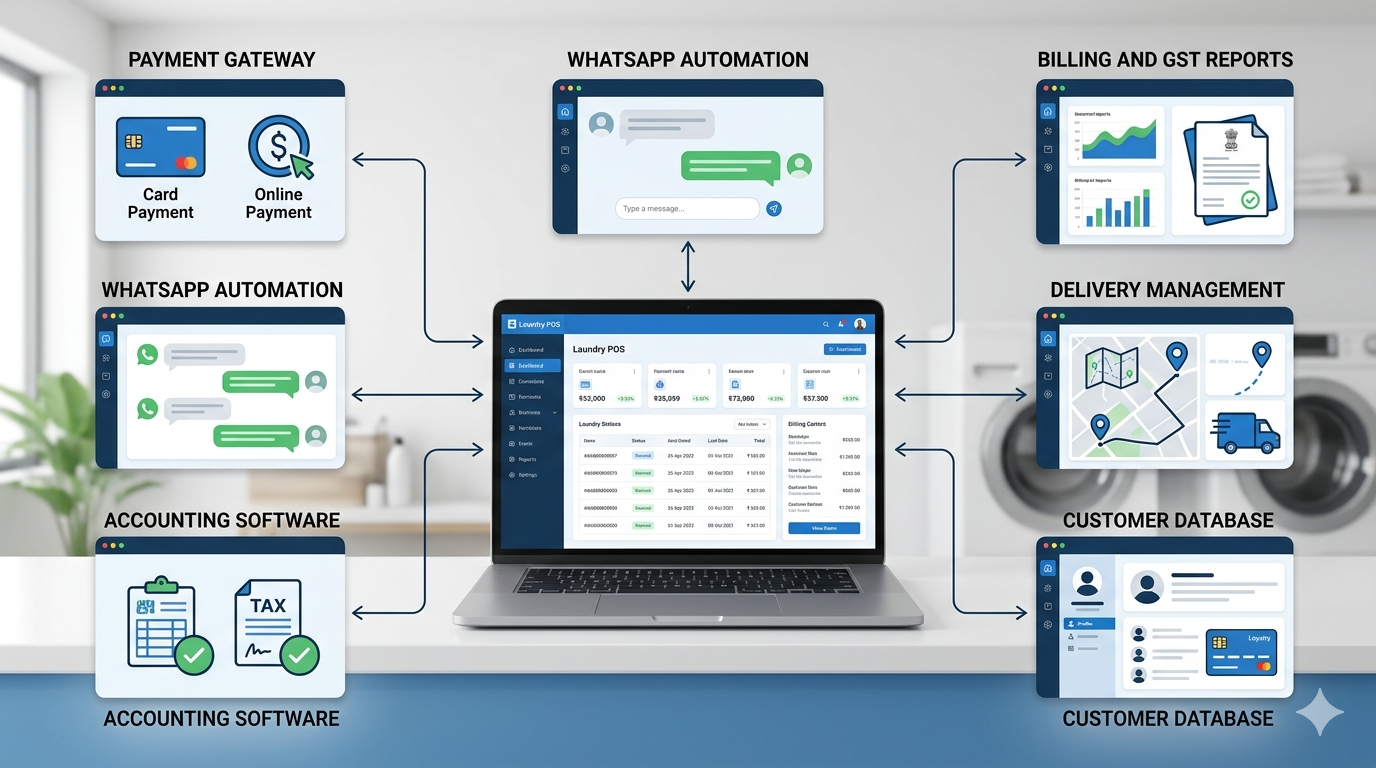
Payment gateway integration for online payments. Accounting software integration if you use Tally or similar systems. WhatsApp Business API for automated communication. These integrations eliminate double entry and reduce errors.
But here's the catch: integrations often cost extra or require developer support. A vendor might claim "we integrate with everything" but implementation requires their technical team and additional charges. Get this clear before committing.
Some modern systems offer Zapier or API access, letting you connect to hundreds of other tools without vendor dependency. This flexibility is valuable as your business needs evolve.
Pricing Models and Hidden Costs
Software pricing isn't just the monthly subscription.
One-time license fees sound attractive, but you'll pay separately for updates, support, and additional users. Subscription models include updates but you're locked into monthly payments forever.
Hidden costs appear everywhere. SMS charges for notifications. Extra fees per user or per branch. Implementation and training costs. Annual maintenance charges. Payment gateway transaction fees if the vendor processes payments through their system.
Calculate total cost of ownership for at least 12 months. Include subscription, expected SMS usage, any integration fees, and support costs. Compare this across options—sometimes a higher monthly fee with everything included costs less than a cheap option with multiple add-ons.
Technical Support and Training
When something breaks at 6 PM on Saturday, can you reach support?
Check support availability: phone, email, chat, and their actual response times. "24/7 support" often means chatbot responses, with human help only during business hours.
Training matters more than vendors admit. Your staff needs to learn the system, and they'll have questions after launch. Some companies provide comprehensive training, others give you a PDF manual and wish you luck.
System updates can cause issues. Does the vendor test updates before rolling out, or are you the beta tester? Can you control when updates happen, or do they push changes that might disrupt your operations during busy periods?
Data Security and Backup
Your customer data and business records are valuable. Losing them could destroy your business.
Cloud systems should encrypt data and maintain regular backups. But where is that data stored? Indian servers offer better data security compliance. Some vendors store data internationally, which creates legal ambiguity.
Backup policies matter. Daily automatic backups are standard, but can you download your data? If you decide to switch software, can you export everything or are you locked in?
Access control prevents internal issues. Staff should only access what they need for their role. Audit logs showing who did what and when help track errors and prevent fraud.
Trial Period: What to Actually Test
Never buy without testing. But don't waste the trial doing random clicks.
Create a test scenario matching your real workflow. Add typical customers, create various order types, process payments, schedule deliveries, generate reports. See if the software handles your actual business smoothly.
Test edge cases: express orders during peak hours, partial payments, order cancellations, discount application, GST calculation on mixed services. These are where problems appear.
Involve your staff. They'll use this daily, so their comfort matters. If your billing person says the interface is confusing, believe them. You won't be there to help during every transaction.
How Ezer POS Laundry Management Covers Everything
Modern laundry POS systems like Ezer bring together all these elements in one platform. Instead of juggling multiple tools or accepting compromises, you get comprehensive functionality designed specifically for laundry and dry-cleaning businesses.
The system handles complex billing scenarios with ease—per-piece and per-kg pricing, express charges, corporate rates, complete GST compliance with proper documentation. Order tracking keeps customers informed automatically through SMS and WhatsApp notifications, reducing inquiry calls.
Pickup and delivery management includes mobile apps for delivery staff with route optimization and proof of delivery. Customer data helps you identify loyal clients and run targeted campaigns. Multi-branch businesses can manage all locations from one dashboard while maintaining individual branch control.
What makes this approach effective is integration. Billing connects to inventory, inventory connects to orders, orders connect to customer history—everything syncs automatically. Your delivery person marks an order complete, the customer gets notified, the account gets updated, and revenue reports reflect the change. No manual updates, no data mismatches.
Ezer Laundry POS System
Streamline your laundry business with our comprehensive POS system. Features include smart billing, garment tracking, WhatsApp notifications, and cloud backup.
FAQs
What's the minimum cost for decent laundry POS software?
Expect ₹2,000-5,000 monthly for cloud-based solutions with basic features like billing, order tracking, and customer management. One-time license fees range from ₹25,000-75,000 but may have additional annual charges. Very cheap options (under ₹1,000/month) often lack critical features or have poor support. Factor in SMS costs, which typically run ₹2-5 per message, adding up if you send many customer notifications.
Can I switch from my current POS to a new one without losing data?
Most modern systems offer data migration support, though complexity varies. Your existing customer database, pending orders, and payment history can typically be imported. Historical transaction data might need manual export and formatting. Plan the switch during a slower business period, run both systems parallel for a week, and verify all critical data transferred correctly before fully committing to the new platform.
Do I need different software for laundry vs dry cleaning?
Not necessarily. Good laundry POS software handles both through configurable service types and pricing. The key is flexible item categorization—wash-and-fold, dry cleaning, pressing, stain treatment should all be separate billable services. Some businesses use specialized dry-cleaning software if they handle complex garment tracking (tags, special care instructions), but most modern unified systems manage both adequately.
How long does implementation typically take?
Basic setup takes 1-3 days: adding services, pricing, staff accounts, and initial customer data. Full implementation including staff training, workflow optimization, and integration with payment gateways might need 1-2 weeks. The learning curve for daily operations is usually 3-5 days for staff to become comfortable. Plan for at least two weeks from purchase to full smooth operation, though simple operations can go live faster.
Is offline billing capability important for cloud-based systems?
If your area experiences frequent internet outages lasting more than 15-20 minutes, yes. Offline mode lets you continue billing during connectivity issues, syncing data once internet returns. However, purely offline systems miss real-time updates across branches and remote monitoring. Hybrid systems offering offline billing with cloud sync provide the best balance for most Indian laundry businesses where internet reliability varies.
Should I choose software with built-in payment gateway or integrate separately?
Built-in payment processing is convenient—customers can pay online, you get instant confirmation, settlement happens automatically. But you're locked into their gateway and fee structure. Separate integration with Razorpay, PayU, or others gives you flexibility to negotiate rates and switch providers. For businesses processing significant online payments (₹50,000+ monthly), separate integration often saves money. Smaller operations benefit from built-in simplicity.
What happens if the software company shuts down?
With cloud-based systems, this is a real risk. Choose established vendors with multiple clients and stable operations. Verify you can export your complete data at any time—customer details, order history, financial records. Some contracts include data access guarantees even after service termination. One-time license software stored locally eliminates this risk but creates others like backup responsibility and update dependency.
Conclusion
Choosing laundry POS software isn't about finding the cheapest option or the one with the longest feature list. It's about finding a system that solves your specific operational problems without creating new ones.
Start by listing your actual pain points. Test thoroughly during the trial period with real workflows, not just demo scenarios. Calculate total costs including hidden fees. Verify support quality and data security measures.
The right software should feel like it disappears into your operations—billing happens smoothly, customers stay informed, staff doesn't struggle, and you get clear visibility into your business. If you're constantly working around the software instead of with it, keep looking.
Want to see how a properly integrated laundry management system handles real business operations? Check out Ezer Laundry POS for a demonstration tailored to your specific business needs.