
Digital Payments & GST Billing for Laundry Shops: Complete Guide
Running a laundry shop in 2026 means dealing with more than just stains and fabrics. Between managing cash, issuing GST-compliant bills, and keeping customers happy, many owners find themselves stuck with manual processes that slow everything down. This guide walks you through setting up digital payments and proper GST billing—two things that can actually make your business easier to run while keeping you compliant with tax laws.
Whether you're opening your first shop or managing multiple locations, getting these basics right saves time and reduces mistakes that cost money.
Why Digital Payments Matter for Laundry Businesses
Cash handling takes up more time than most owners realize. You're counting notes at the end of the day, managing change, making bank deposits, and hoping your cashier didn't make errors in the register.
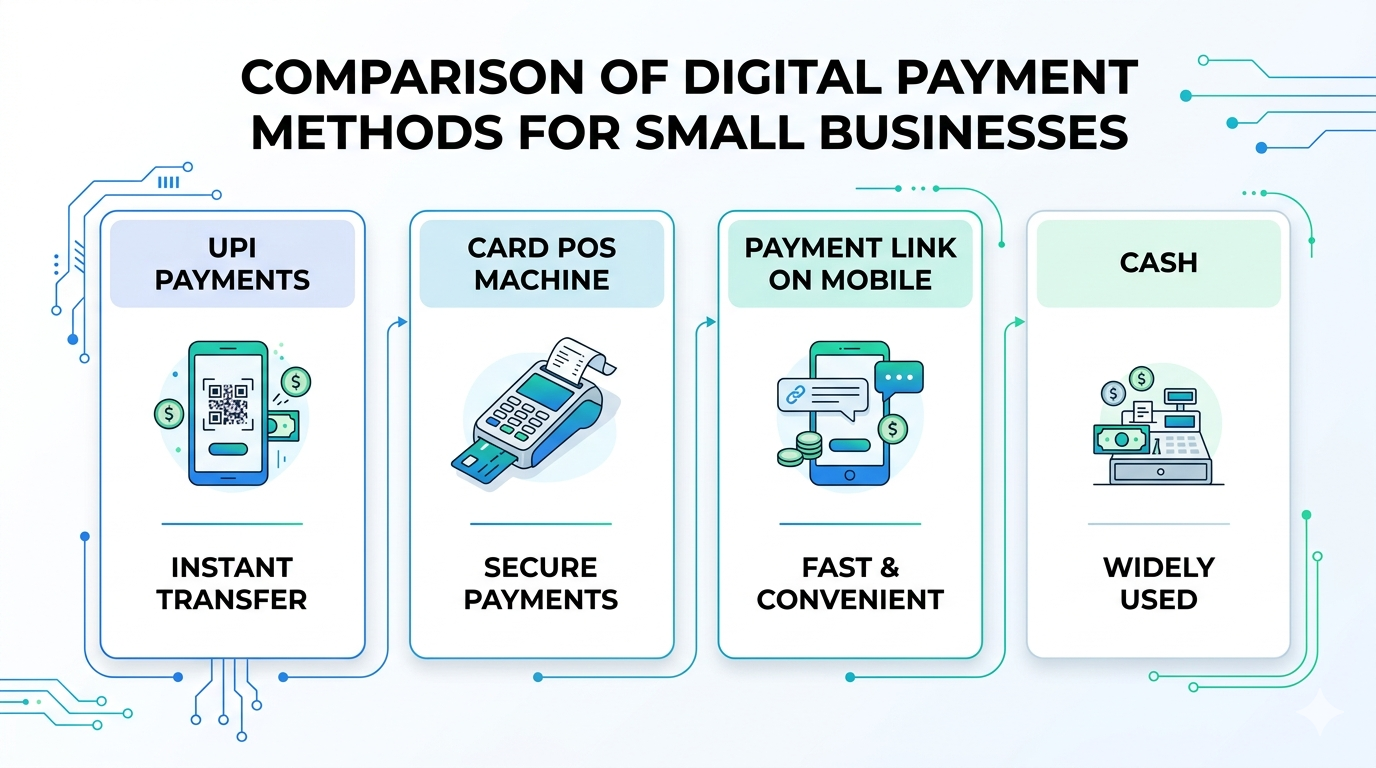
Digital payments solve most of this. UPI transactions are instant. Card payments provide automatic records. Your customers prefer it—most people don't carry much cash anymore, especially in cities.
Here's what changes when you go digital:
- No more daily cash counting sessions
- Customers can pay even if they forgot their wallet
- Your revenue tracking becomes automatic
- Staff can't pocket money as easily (it happens)
- Bank reconciliation takes minutes instead of hours
The adoption rate varies by location. In metro areas, 70-80% of laundry payments now happen digitally. Smaller towns are catching up fast.
Understanding GST Requirements for Laundry Services
GST registration is mandatory if your annual turnover crosses ₹40 lakhs (₹20 lakhs for special category states). Most established laundry shops hit this threshold within their first year of operation.
Laundry and dry-cleaning services fall under SAC code 9988, taxed at 18% GST. This isn't optional—you need to charge it, collect it, and file returns.
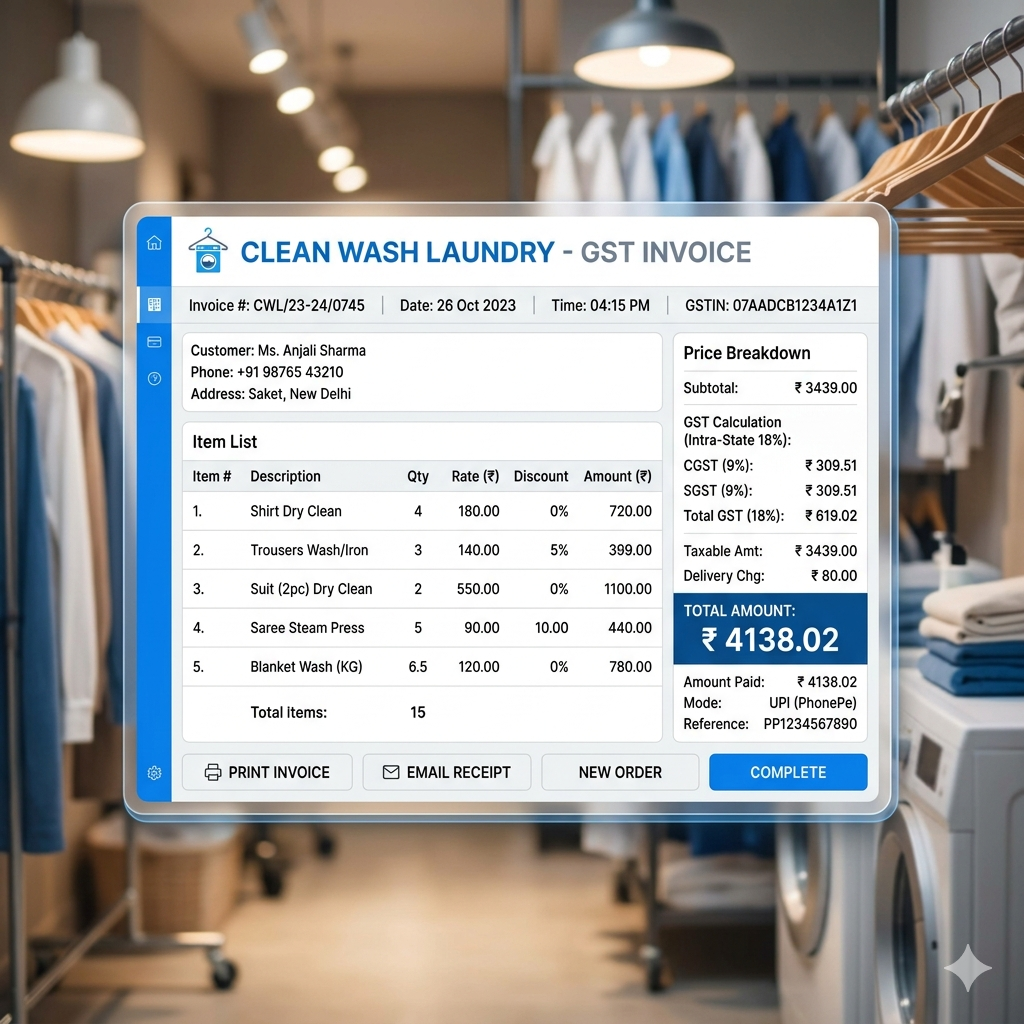
What many owners miss: you can't just add 18% to your price and call it done. Your invoice needs specific details:
- Your GSTIN number
- Customer details (optional for B2C, but recommended)
- SAC code
- Taxable amount
- CGST and SGST breakdown (or IGST for inter-state)
- Invoice number and date
Missing any of these during a tax audit means penalties. I've seen shops get notices for invoices that didn't separate CGST and SGST properly.
The filing schedule depends on your turnover. Most laundry businesses file GSTR-1 monthly and GSTR-3B by the 20th of the following month. Miss these deadlines and you face late fees—₹50 per day for nil returns, more if you have tax liability.
Setting Up Digital Payment Systems
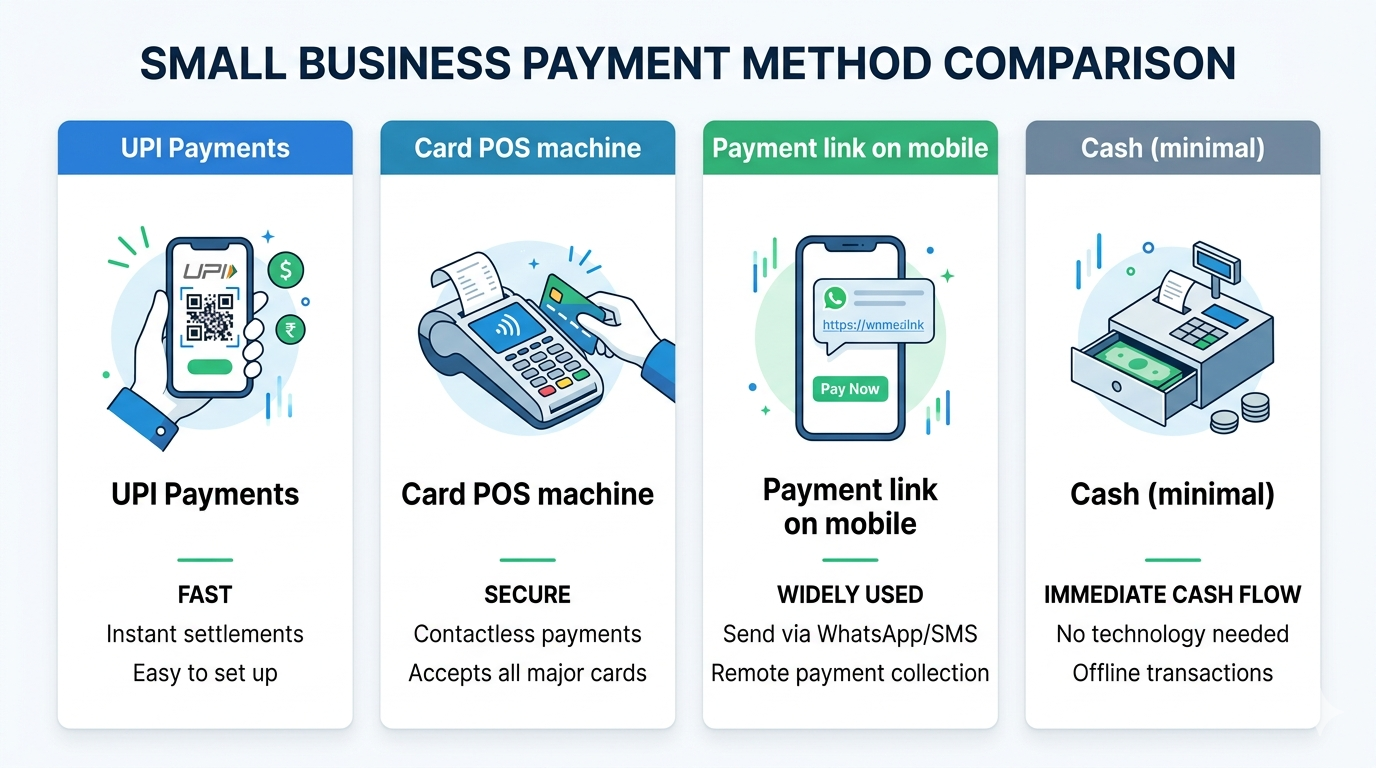
Start with the basics: UPI. Get a QR code from your bank—it's free. Print it, laminate it, stick it at the counter. That covers 60% of digital transactions right there.
For card payments, you need a POS machine. Banks offer these, but compare:
- Rental fees (₹100-300/month)
- Transaction charges (usually 1-2%)
- Settlement time (same day vs next day)
- Support quality
Payment aggregators like Razorpay, Paytm for Business, and PhonePe Business offer better rates sometimes. They also integrate with billing software more easily than bank POS machines.
What about payment links? Useful for home delivery orders. Customer books service, you send a payment link, they pay before you even pick up the clothes. Reduces failed collections.
One practical issue: internet connectivity. If your shop has weak internet, keep a backup. Mobile hotspot, dual broadband connections, or even a basic feature phone that can generate UPI collect requests.
How Laundry POS Software Simplifies Billing
Manual billing works until it doesn't. You write receipts by hand, calculate GST with a calculator, maintain a register, and hope you didn't transpose any numbers.
Modern laundry POS software handles this automatically. You select the service (shirt wash, dry clean suit, curtain cleaning), enter the quantity, and the system generates a GST invoice instantly.
The real value shows up in these situations:
Multiple price lists: Different rates for express service, membership customers, bulk orders. The software applies the right price without your staff needing to remember everything.
Order tracking: Customer calls asking when their clothes will be ready. Instead of searching through paper receipts, your staff checks the system in 5 seconds.
Customer history: Repeat customer walks in. You see their past orders, preferred services, payment history. Builds better relationships.
Automated reports: Monthly revenue, service-wise breakdown, pending deliveries, GST liability—all generated automatically. No more Excel sheets.
The shift from manual to digital billing typically takes 2-3 days of adjustment. Staff need training, but most systems are designed for non-technical users.
Common GST Billing Mistakes to Avoid
I've reviewed billing processes at dozens of laundry shops. Same mistakes keep appearing:
Wrong tax rates: Some shops charge 12% or 5% GST on laundry services. It's 18%. Using the wrong rate creates mismatches in your returns.
Missing invoice numbers: Each invoice needs a unique sequential number. Gaps raise red flags during audits. Your system should auto-generate these.
Incorrect customer details: For B2B clients (hotels, hospitals, corporate contracts), you need their GSTIN on the invoice. Skipping this means you can't claim input tax credit in your returns, and your client can't claim it either.
Not maintaining e-way bills: If you're transporting goods worth over ₹50,000, you need an e-way bill. Rare for most laundry shops, but corporate contracts sometimes hit this threshold.
HSN/SAC code errors: Double-check you're using SAC 9988 for laundry services. Using product codes instead of service codes is a common error.
Manual billing makes these mistakes more likely. Automated systems prevent most of them by design.
Integration Between Payments and Accounting
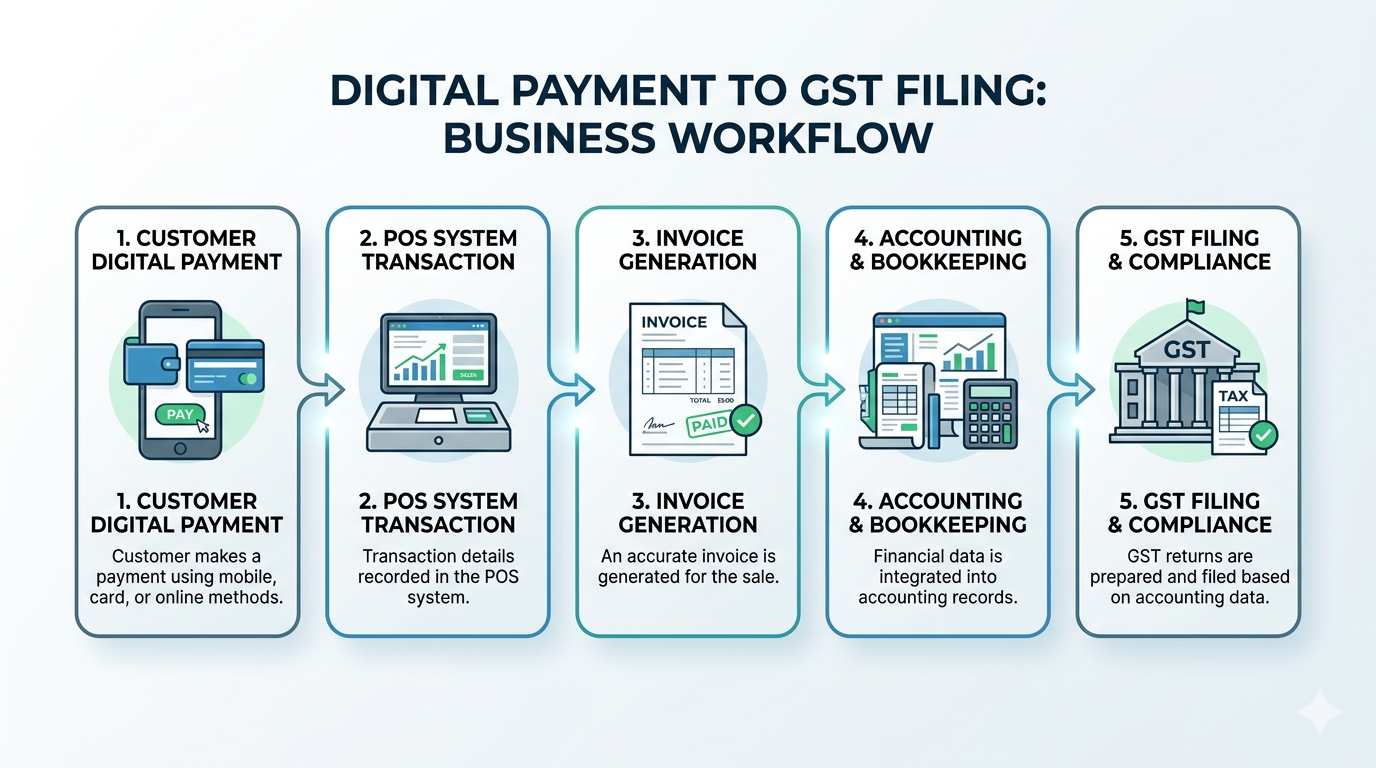
Your payment systems and accounting should talk to each other. Otherwise you're doing double work.
When a customer pays via UPI, that transaction should automatically update your accounts. Same with card payments. Same with cash (though you'll enter that manually).
This integration matters for:
Bank reconciliation: Your accounting software should match payment gateway settlements with bank deposits automatically. Discrepancies show up immediately, not during month-end chaos.
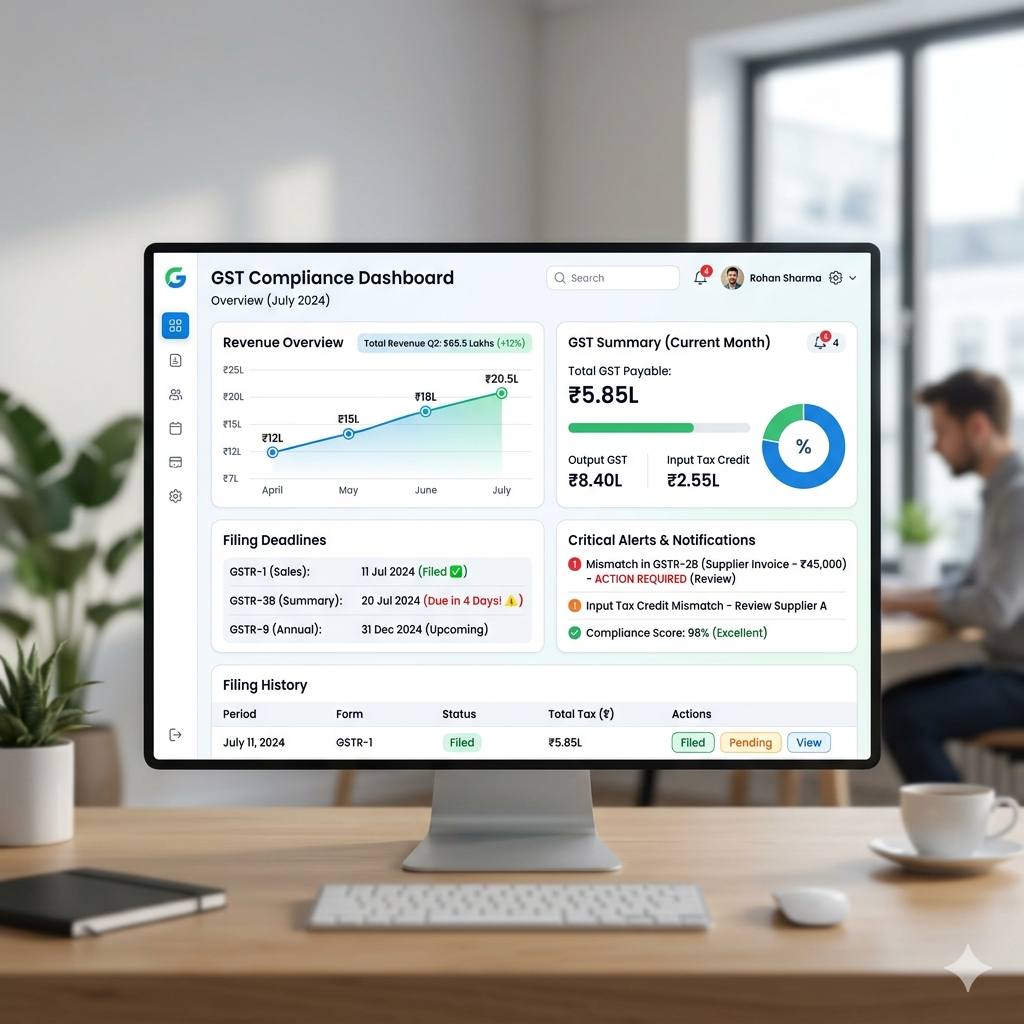
GST return filing: Your sales data flows directly into GSTR-1. No manual entry, no copy-paste errors.
Financial reporting: Real-time view of revenue, expenses, profit margins. Make decisions based on current data, not last month's numbers.
Most modern laundry POS systems offer these integrations. Check whether they support:
- Tally integration (if you use Tally)
- Direct GSTN filing
- Bank statement import
- Multi-payment mode handling
Without integration, you're maintaining separate records in multiple places. That's where errors creep in.
Ezer Laundry POS System
Streamline your laundry business with our comprehensive POS system. Features include smart billing, garment tracking, WhatsApp notifications, and cloud backup.
Managing Cash Flow with Digital Payments
Digital payments improve cash flow in ways that aren't immediately obvious.
Bank transfers are instant with UPI. Card payments settle within 1-2 days. Compare this to collecting cash, holding it until you have enough to deposit, then going to the bank during business hours.
For home delivery services, advance digital payments eliminate collection risks. Your delivery person doesn't carry cash, reducing theft concerns and failed collections.
But there are costs. Payment gateway charges eat into margins:
- UPI: Usually free for receiving, but some banks charge merchants
- Debit cards: 0.4-0.9% typically
- Credit cards: 1.5-2%
- Wallets: 1-2%
A shop processing ₹5 lakhs monthly through cards pays ₹5,000-10,000 in gateway fees. Factor this into your pricing.
Some owners offset this by offering small discounts for cash payments. Legally questionable for GST-registered businesses, and increasingly customers prefer digital convenience over tiny discounts anyway.
Compliance and Record Keeping
Tax authorities can audit you up to 5 years back. Your records need to be accessible and accurate.
Digital systems make this easier:
Automatic backups: Cloud-based software backs up daily. Your data survives even if your computer crashes or shop floods.
Searchable records: Find any invoice from 3 years ago in seconds. Try that with paper files.
Audit trails: Who created the invoice? When? Was it modified? All logged automatically.
GST filing reports: Generate period-wise sales reports that match your GST returns exactly.
What you need to maintain:
- All invoices (originals)
- Payment receipts
- Bank statements
- GST returns filed
- Input credit documentation (for business expenses)
Store these for at least 6 years. Digital storage costs almost nothing compared to physical filing cabinets.
Choosing the Right Software for Your Business
Not all laundry POS software is equal. What works for a single-shop operation won't work for a chain with 5 locations.
Evaluate based on:
Scale: Single shop, multiple branches, franchise model? The software should support your current and planned structure.
Features you actually need: Don't pay for SMS marketing automation if you're just starting. But do get proper GST billing and payment integration from day one.
Pricing model: Monthly subscription, one-time license, per-location fees? Calculate your 3-year cost.
Support quality: When billing stops working at 7 PM on a Saturday, can you reach someone? Test their support before committing.
Data ownership: Can you export your data? What happens if you switch software later?
Mobile access: Can you check your business from home? Can delivery staff mark orders completed from their phones?
Try before you buy. Most providers offer free trials. Use them with real transactions for at least a week.
A good Laundry POS Software will handle billing, GST compliance, order management, customer data, and payment integration in one system. It should reduce your workload, not add to it.
How to Start Your Laundry Business in 2026: Complete Guide
Training Your Staff on New Systems
Your software is only as good as the people using it.
Plan for a transition period. The first week will be slow. Staff will make mistakes. Some might resist the change.
Tips that work:
Hands-on training: Don't just show them. Let them process real orders under supervision.
Cheat sheets: Print simple step-by-step guides for common tasks. Laminate them, keep them at the counter.
Gradual rollout: Start with just billing. Once that's smooth, add inventory tracking. Then customer management.
Identify a champion: One staff member who picks it up quickly. They become the go-to person for questions.
Common issues to prepare for:
- Login problems
- Printer configuration
- Handling returns/refunds
- Dealing with payment failures
- System downtime (always have a backup process)
Most resistance comes from fear of technology. Show staff how the system makes their job easier—less calculation, fewer errors, faster checkout—and adoption improves.
Cost-Benefit Analysis
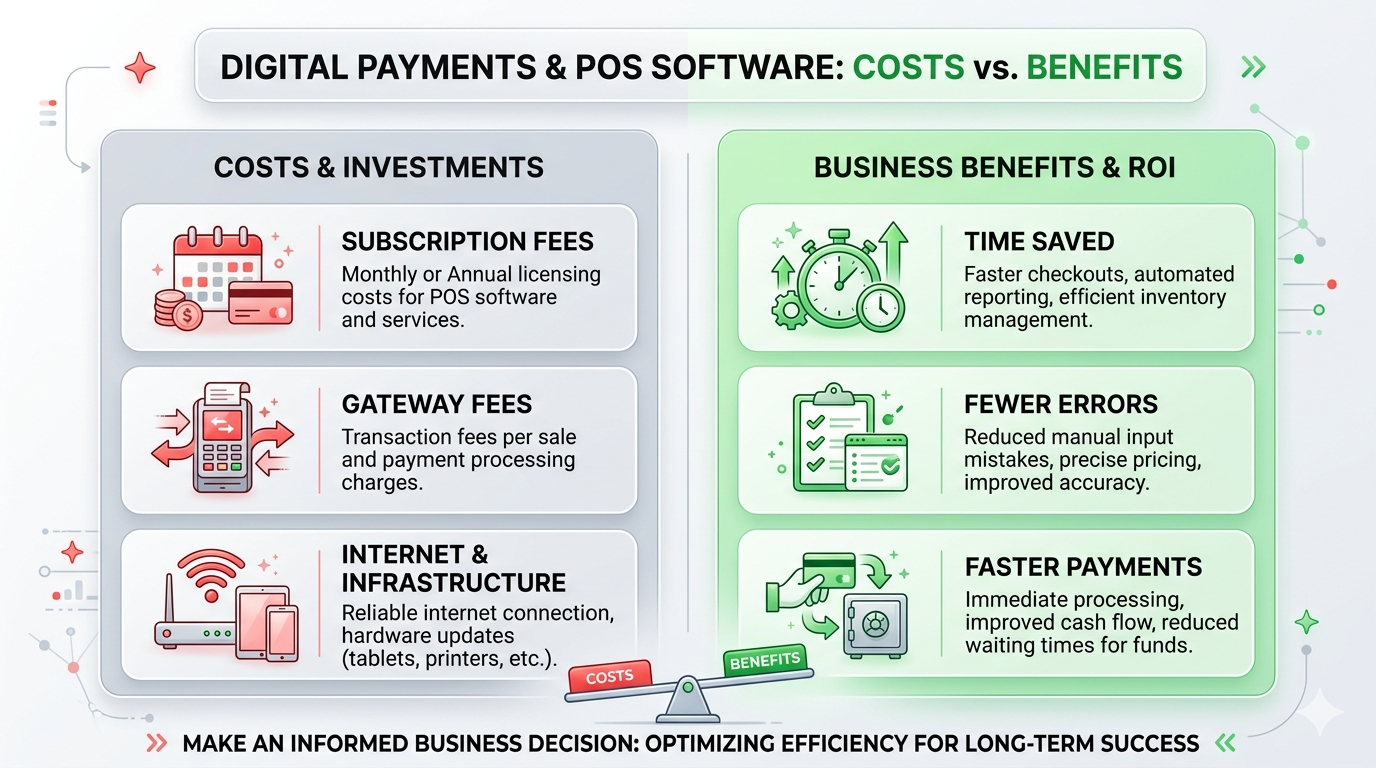
Let's talk numbers. Setting up digital payments and proper billing has costs:
Initial setup:
- POS software: ₹500-2,000/month
- Payment gateway setup: Usually free
- Hardware (if needed): ₹10,000-30,000
- Training time: 2-3 days
Ongoing costs:
- Software subscription: ₹500-2,000/month
- Payment gateway charges: 0.5-2% of transactions
- Internet: ₹500-1,000/month
For a shop doing ₹3 lakhs monthly revenue, you're looking at ₹3,000-5,000 in total monthly costs.
Benefits:
- Time saved: 10-15 hours/month (billing, accounting, reporting)
- Reduced errors: Fewer billing mistakes, better tax compliance
- Better cash flow: Faster payment collection, reduced outstanding
- Customer satisfaction: Faster checkout, payment convenience
- Scaling capability: Add branches without proportional admin overhead
The payback period is typically 3-6 months. After that, it's pure efficiency gain.
Future-Proofing Your Billing System
Tax rules change. Payment technologies evolve. Your billing system should adapt without requiring a complete overhaul.
What to look for:
Cloud-based systems: Updates happen automatically. New GST rules? Your software provider updates the system, you get the changes immediately.
API access: If you want to integrate with other tools later (accounting software, marketing platforms, delivery apps), APIs make it possible.
Mobile-first design: More business happens on phones. Your system should work well on mobile devices.
Scalability: Can it handle 10x your current transaction volume? What if you add 5 more locations?
The laundry business is moving digital fast. Home pickup apps, subscription models, AI-based sorting—these require proper tech infrastructure. Get your billing and payments right now, and adding these features later becomes easier.
FAQs
Is GST registration mandatory for small laundry shops?
Yes, if your annual turnover exceeds ₹40 lakhs (₹20 lakhs in special category states). Below this threshold, registration is optional but recommended if you serve business clients who need input tax credit. Voluntary registration also builds customer trust and opens up credit facilities from suppliers.
What's the GST rate on laundry and dry-cleaning services?
The applicable GST rate is 18% under SAC code 9988. This applies to all washing, pressing, dry-cleaning, and ironing services. Some owners mistakenly apply lower rates meant for other services—this creates compliance issues during audits.
Can I accept digital payments without GST registration?
Yes, digital payment acceptance and GST registration are separate. You can use UPI, cards, and payment gateways regardless of your GST status. However, if you're GST-registered, your invoices must be GST-compliant even for digital transactions.
Which payment methods should a laundry shop accept?
Start with UPI (lowest cost, highest adoption) and add card payments for premium customers. Cash remains necessary since some customer segments prefer it. Payment wallets are optional—most wallet users also have UPI, so it's redundant unless you're running promotions with specific wallet companies.
How do I handle payment gateway charges in my pricing?
You have three options: absorb the cost in your margins, add a small convenience fee (check local regulations), or offer discounts for zero-cost payment methods like UPI. Most successful shops absorb the cost—the business benefits of digital payments outweigh the 1-2% transaction fee.
What happens if my billing software goes down?
Always maintain a backup process. Keep a manual receipt book, calculator, and GST rate chart accessible. Issue handwritten receipts, then enter them into the system once it's back up. Cloud-based systems have better uptime than local installations, but internet failures still happen.
Do I need separate software for billing and payments?
Not necessarily. Modern laundry POS software integrates billing, GST calculations, and payment processing in one system. This reduces errors and saves time. Separate systems mean manual reconciliation work, which defeats the purpose of going digital.
Conclusion
Setting up proper digital payments and GST billing isn't optional anymore—it's basic business infrastructure. The initial learning curve exists, but most shop owners report that the time saved and errors prevented make it worthwhile within the first few months.
Start with the basics: get your GST registration right, set up UPI payments, and choose software that handles both billing and compliance. You can add more sophisticated features later as your business grows.
The laundry business runs on trust and convenience. Customers trust proper invoices. They appreciate payment flexibility. Get these fundamentals right, and you've built a foundation that supports everything else you want to do with your business.
Ready to modernize your laundry shop's billing and payment systems? Look for a comprehensive Laundry POS Software that handles GST compliance, payment integration, and order management in one place. The right system pays for itself through time saved and mistakes prevented.