
Home-Based vs Shop-Based Laundry Business: Which One Works in 2026?
Starting a laundry business is easier than most people think. But here's where first-time entrepreneurs get stuck: should you run it from home or invest in a physical shop? I've worked with dozens of laundry business owners across Delhi, Mumbai, and Bengaluru, and this decision shapes everything—your costs, customer base, scalability, even your daily stress levels. Both models work. The question is which one matches your capital, location, and long-term goals. Let's break it down.
What Defines a Home-Based Laundry Business?
A home-based laundry setup operates from your residence. You're typically handling pickup and delivery orders, processing clothes in a spare room or garage, and managing everything yourself or with minimal staff.
This model works well in residential areas where you can build trust with neighbors first. You don't pay commercial rent. Your overheads stay low. Many entrepreneurs start here because the entry barrier is realistic—₹50,000 to ₹1.5 lakh can get you a decent washing machine, dryer, and basic supplies.
But there's a catch. You're limited by space. Most residential societies don't allow commercial signage. Walk-in customers are rare unless you're in a ground-floor location with street access. Your capacity tops out quickly, usually around 30-50 orders per week depending on turnaround time.
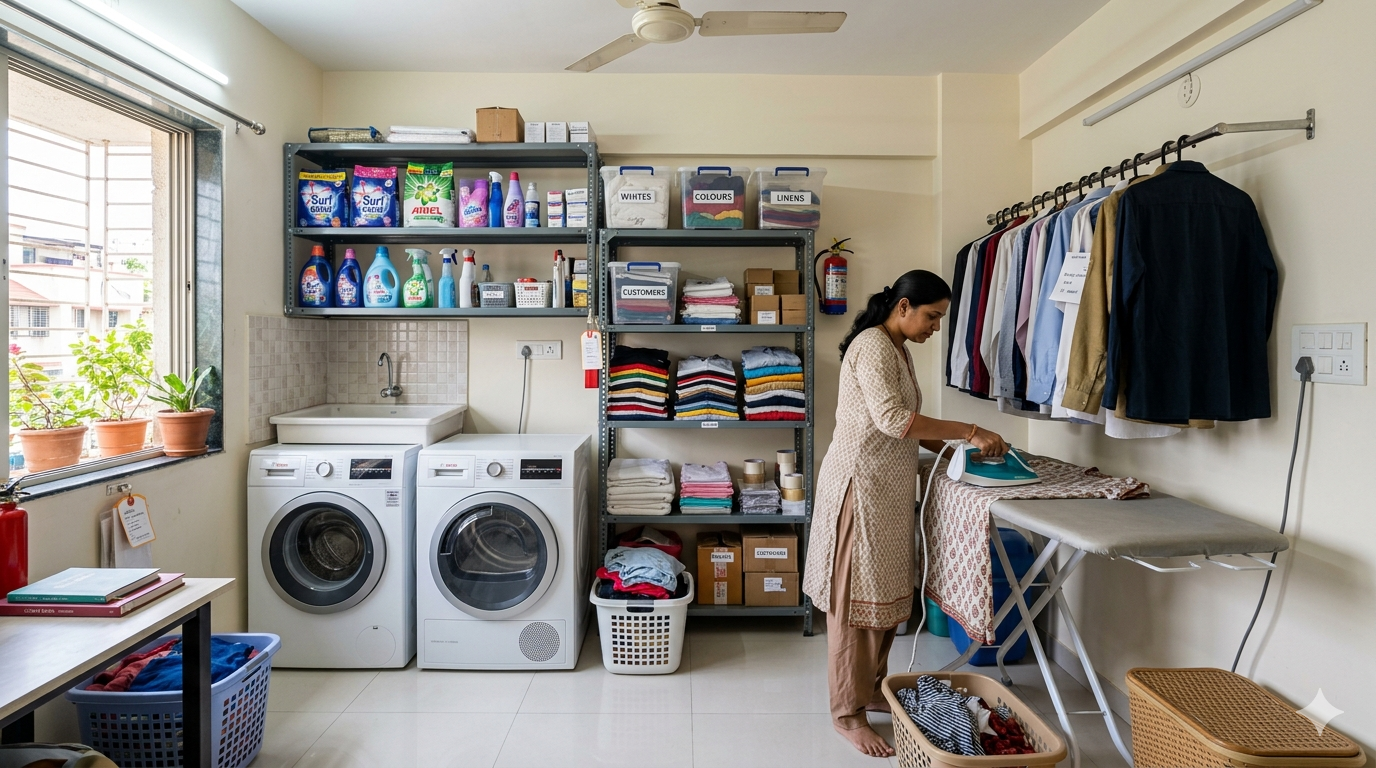
The real advantage? Flexibility. You control your hours. There's no lease pressure. If the business doesn't work out, you haven't burned through savings on a shop deposit.
The Shop-Based Model: What Changes?
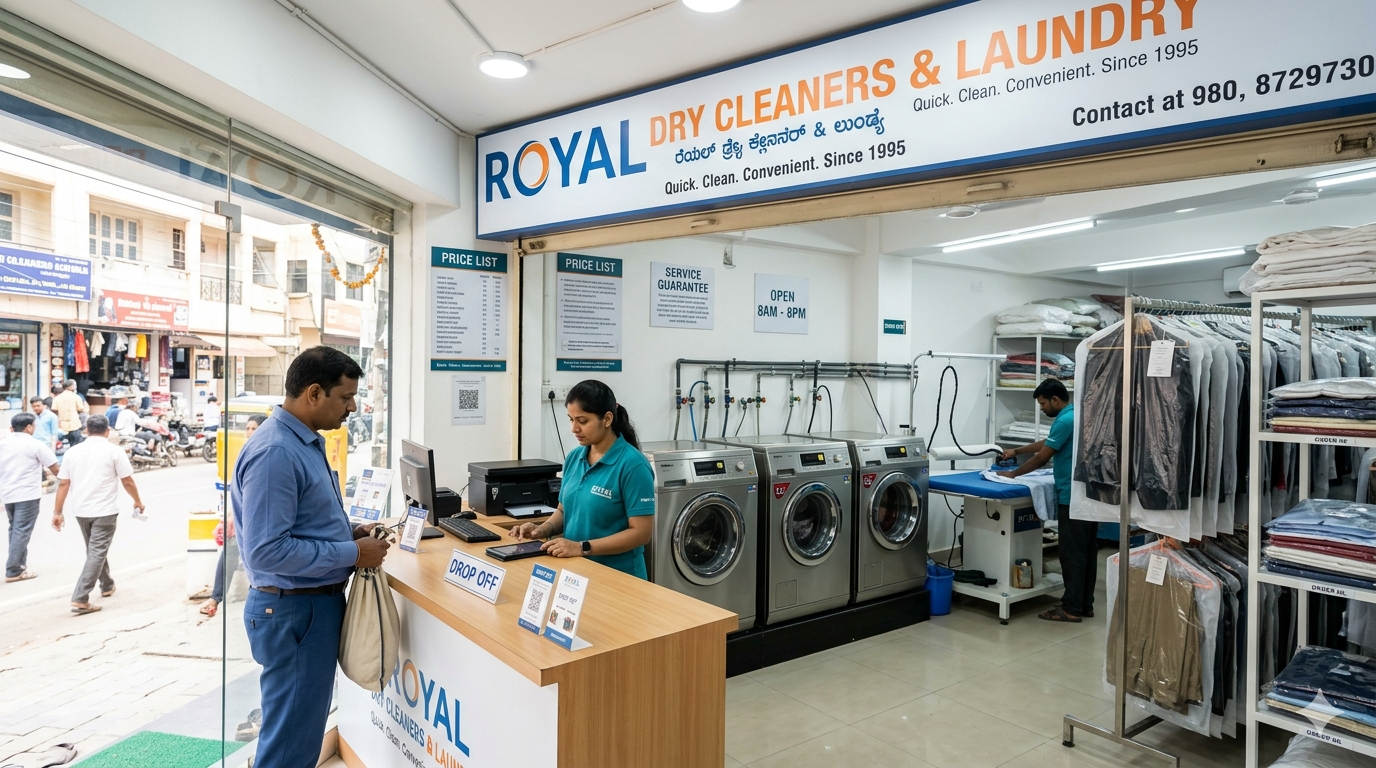
A shop-based laundry business operates from a commercial space—typically a ground-floor unit in a market, residential complex, or standalone location with visible signage and walk-in access.
Visibility matters more than most people realize. I've seen shop owners in Pune and Hyderabad double their revenue just by moving from a first-floor setup to ground level. Customers want convenience. They want to drop off clothes while running errands, not hunt for your location.
You'll pay ₹15,000 to ₹40,000 monthly rent depending on your city and locality. Add electricity, staff salaries, and maintenance—your fixed costs jump significantly. But so does your capacity. A 400-500 sq ft shop can handle 100+ orders weekly with proper workflow.
The shop model also builds credibility faster. New customers trust a physical presence. You can display pricing, show your equipment, offer express services. Corporate clients and bulk orders (hotels, salons, gyms) prefer dealing with established shops over home operations.
Startup Costs: The Real Numbers
Let's talk money. Home-based setups require:
- Commercial washing machine (8-10 kg): ₹35,000 - ₹60,000
- Dryer or drying space setup: ₹20,000 - ₹40,000
- Iron, pressing table, steam iron: ₹8,000 - ₹15,000
- Initial detergent and supplies: ₹5,000 - ₹10,000
- Packaging materials: ₹3,000 - ₹5,000
Total: ₹70,000 - ₹1.3 lakh
Shop-based needs everything above, plus:
- Shop deposit (3-6 months rent): ₹45,000 - ₹2.4 lakh
- Interior setup (racks, counter, seating): ₹25,000 - ₹50,000
- Signage and branding: ₹15,000 - ₹30,000
- Business registration and licenses: ₹10,000 - ₹20,000
Total: ₹2.5 lakh - ₹5 lakh
These aren't theoretical numbers. I'm seeing these ranges consistently across tier-1 and tier-2 cities in 2025-26.
Customer Acquisition: Where Each Model Wins
Home-based businesses rely heavily on word-of-mouth and digital marketing. You'll need a Google My Business listing, active WhatsApp Business presence, and possibly partnerships with apartment complexes. Your first 20 customers will likely be neighbors, friends, or referrals.
The growth curve is gradual. Building trust takes time when people can't see your operation. But once you establish quality and reliability, customer retention is actually higher—people stick with convenient, familiar services.
Shop-based businesses get foot traffic. Someone walking past your shop is a potential customer. You can run opening offers, put up banners, attract impulse decisions. Corporate tie-ups are easier to secure when you have a physical address and GST registration.
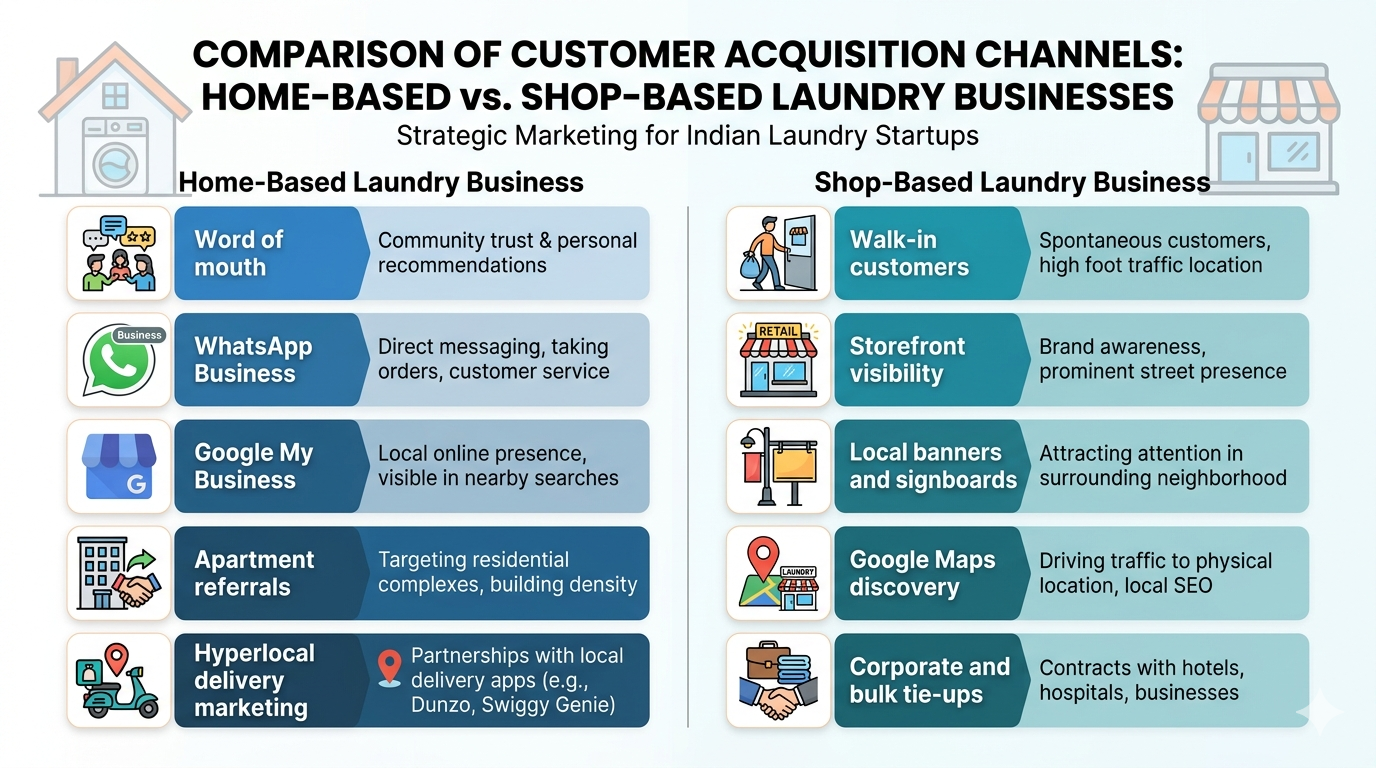
However, shops face more competition. If there are three other laundries within 500 meters, you're fighting for the same customer base. Location research becomes critical—avoid oversaturated areas unless you're offering something distinctly different.
Operational Complexity and Daily Workflow
Running a home-based laundry is simpler. You or one helper can manage everything initially. Sorting, washing, drying, ironing, packaging—it's a linear process. Your biggest operational challenge is scheduling pickups and deliveries without a dedicated driver.
Shops need systems from day one. You're handling walk-ins while managing delivery orders. Staff coordination becomes essential. Without proper billing and order tracking, clothes get mixed up. I've consulted with shop owners who lost customers because they couldn't track which kurta belonged to which Mrs. Sharma.
This is where most shop-based businesses hit a wall around 80-100 orders per week. Manual record-keeping fails. Handwritten bills get lost. Delivery boys forget addresses. The business stalls not because of demand, but because operations can't scale.
When Laundry POS Software Actually Helps
Here's what nobody talks about: software isn't about being "modern" or "digital." It's about removing the friction points that kill growth.
A proper laundry management system handles:
- Automated billing with item-wise pricing and GST calculation
- Order tracking from pickup to delivery with status updates
- Customer database with preferences, addresses, and order history
- SMS/WhatsApp notifications that reduce "where's my order?" calls
- Staff management for delivery assignments and task tracking
- Multi-branch visibility if you expand
I've seen shop owners reduce billing errors by 90% after implementing POS software. One client in Gurgaon cut his customer complaint calls from 15-20 daily to 2-3 just by sending automated delivery updates.
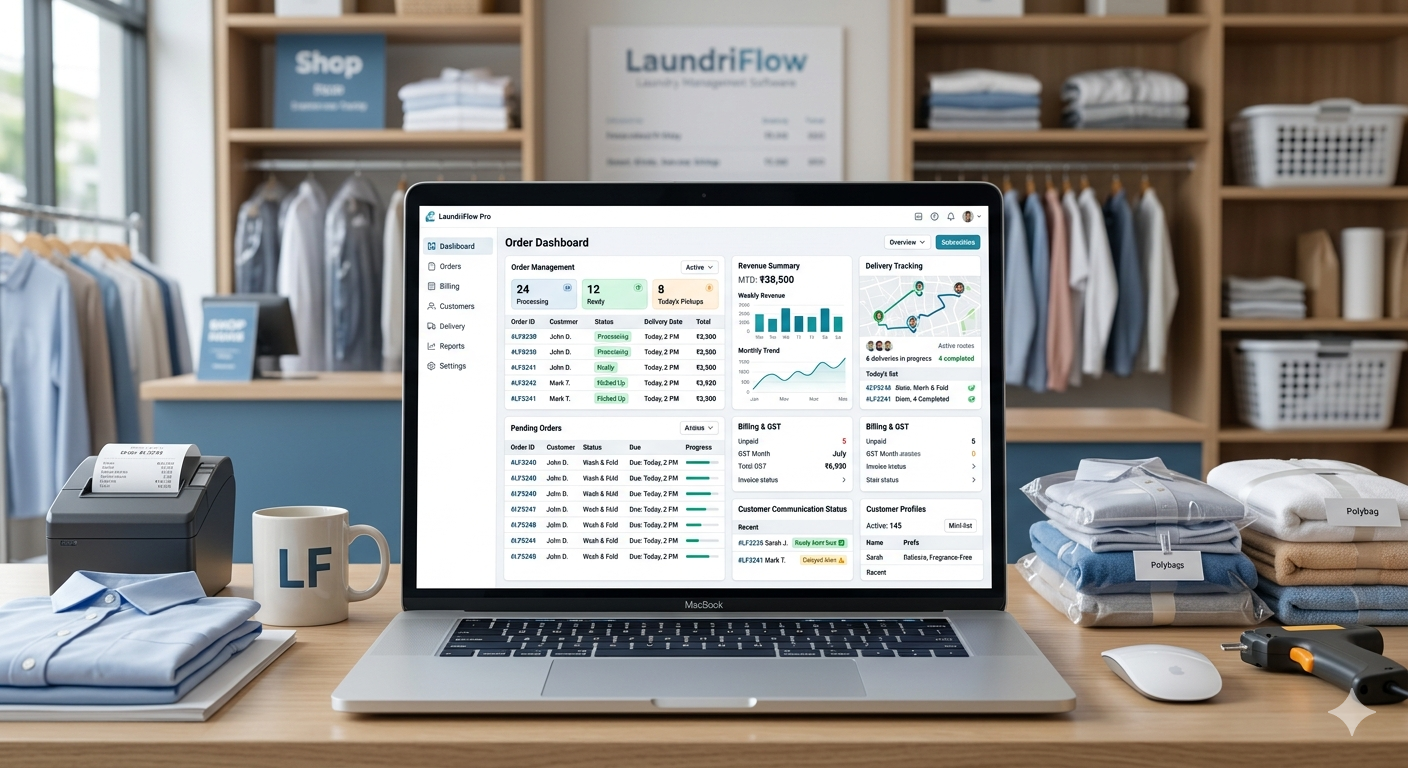
For home-based businesses considering growth, cloud-based systems make sense because you can manage everything from your phone. No complex setup. No expensive hardware. Just cleaner operations.
The key is choosing software built specifically for laundry businesses, not generic retail POS systems adapted awkwardly. Laundry has unique needs—item-level pricing, service categorization, express charges, membership discounts.
How to Start Your Laundry Business in 2026: Complete Guide
Ezer Laundry POS System
Streamline your laundry business with our comprehensive POS system. Features include smart billing, garment tracking, WhatsApp notifications, and cloud backup.
Scaling Potential: Where Each Model Hits Limits
Home-based businesses cap out around ₹40,000-₹60,000 monthly revenue unless you shift to a shop or add pickup points. Physical space becomes the constraint. You can't install industrial equipment in a residential building. Society rules, noise complaints, parking issues—these create natural boundaries.
Some entrepreneurs solve this by keeping the home as a processing unit and opening small pickup/drop points in nearby areas. It's a hybrid model that works if you're operationally tight.
Shop-based businesses can scale vertically (more equipment, more staff, higher capacity in the same location) or horizontally (multiple branches). I know shop owners generating ₹2-3 lakh monthly from a single well-run location in Bangalore and Pune.
But scaling shops means replicating systems. Each branch needs reliable staff, consistent quality, and tight operational control. This is where many fail—they open a second location before the first one runs smoothly.
Legal and Compliance Considerations
Home-based laundries operate in a grey area for commercial licensing in many cities. Technically, you might need GST registration if your turnover exceeds ₹20 lakh annually (₹40 lakh for some states). But enforcement is inconsistent for home businesses.
Shop-based setups need:
- GST registration (mandatory for commercial operations)
- Trade license from municipal corporation
- Fire safety clearance (if applicable)
- Pollution clearance (in some states for dry cleaning)
- Shop and Establishment Act registration
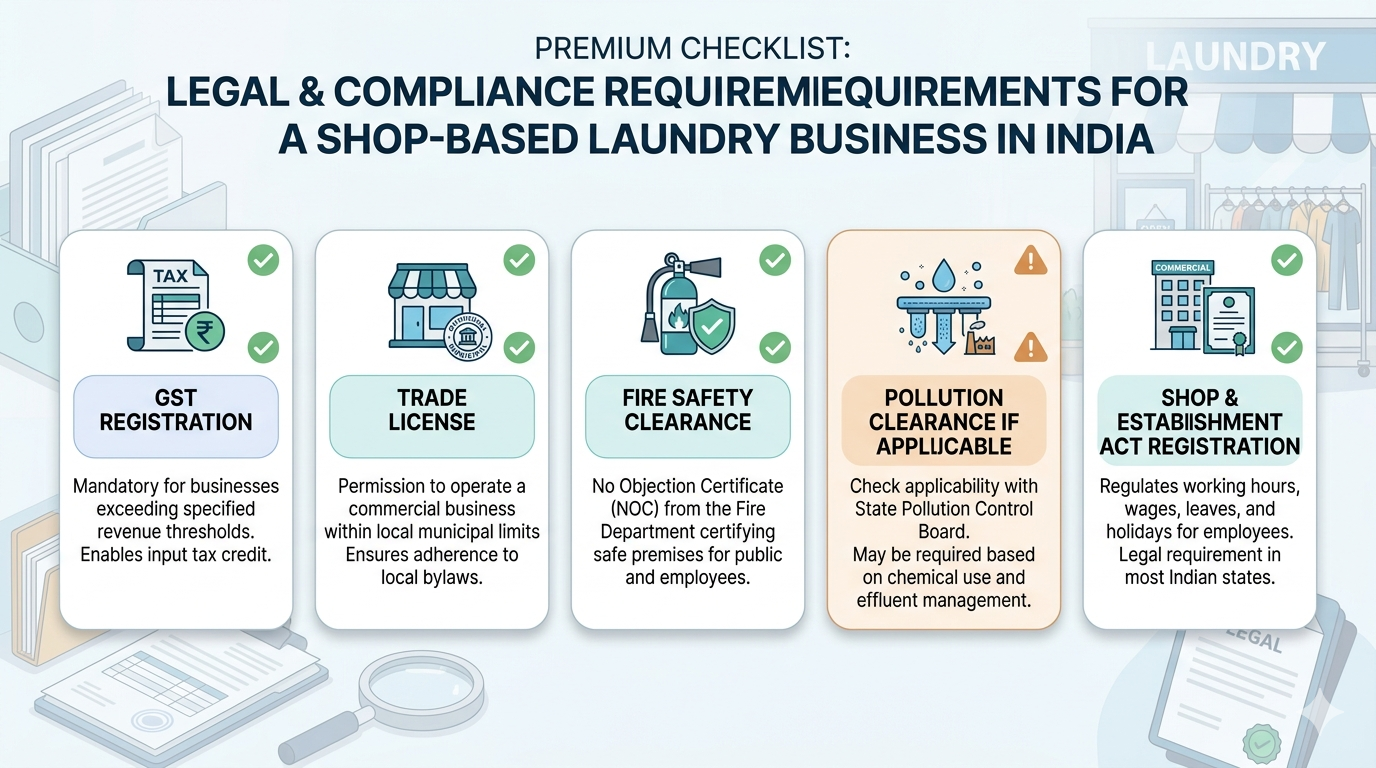
Compliance sounds tedious, but it opens doors. You can't service corporate clients or hotels without proper invoicing and GST. B2B contracts require business registration proof.
Risk Factors: What Can Go Wrong?
Home-based risks:
- Society objections to commercial activity
- Limited growth potential trapping you in low-revenue cycles
- Difficulty hiring reliable staff for a "home" setup
- Mixing personal and business life causing burnout
Shop-based risks:
- High fixed costs during slow months
- Lease disputes or sudden rent increases
- Competition from established players or new entrants
- Dependency on location foot traffic
Neither model is risk-free. The question is which risks you're better positioned to manage based on your savings, experience, and support system.
Which Model Fits Your Situation?
Choose home-based if you:
- Have less than ₹1.5 lakh startup capital
- Want to test the business without major financial commitment
- Live in an area with good residential density and delivery potential
- Can manage operations yourself initially
- Prefer flexible working hours
Choose shop-based if you:
- Have ₹3-5 lakh available capital (including working capital for 6 months)
- Found a high-visibility location with reasonable rent
- Want faster customer acquisition through walk-ins
- Plan to hire staff and scale within 12-18 months
- Can handle fixed costs during the initial ramp-up period
There's no universal "better" option. I've seen successful entrepreneurs in both models. What matters is honest assessment of your resources, location advantages, and risk tolerance.
FAQs
Can I start a laundry business from home without commercial space?
Yes, many entrepreneurs successfully run home-based laundry services. Focus on pickup-delivery models, build trust through quality service, and ensure you're not violating society rules. Keep noise levels manageable and maintain professional customer communication. Start small and scale as demand grows.
What's the minimum investment needed for a shop-based laundry?
Expect ₹2.5-5 lakh depending on your city and shop size. This includes shop deposit (typically 3-6 months rent), equipment (washing machine, dryer, iron), interior setup, initial supplies, and working capital for the first few months until revenue stabilizes.
How much can I earn monthly from a home-based laundry business?
Realistically, ₹20,000-₹60,000 monthly profit after expenses once established. Your earning depends on order volume, pricing strategy, operational efficiency, and area demographics. Initial months will be lower as you build the customer base.
Do I need GST registration for a home-based laundry service?
GST is mandatory if your annual turnover exceeds ₹20 lakh (₹40 lakh for certain states). Below this threshold, it's optional. However, having GST registration helps with business credibility and allows you to service corporate clients who need proper invoices.
Which location is best for a shop-based laundry business?
Look for ground-floor spaces in residential areas with high apartment density, near working professional colonies, or in market areas with good foot traffic. Avoid locations with multiple existing laundries within 300-500 meters unless you offer specialized services.
Can laundry POS software help a small home-based business?
Yes, especially if you're handling 15+ orders weekly. Cloud-based systems help track orders, manage customer data, send automated updates, and generate proper bills. You avoid the chaos of manual tracking and reduce customer complaints about order status or billing errors.
How long does it take to break even in a shop-based laundry?
Most shop-based laundries break even within 8-14 months if operations are managed well. Your timeline depends on location, competition, customer acquisition speed, and operational efficiency. Keeping fixed costs controlled during the initial phase is critical.
Conclusion
The home vs shop decision isn't about which model is objectively better—it's about which one aligns with your current situation. Home-based setups offer low-risk entry and flexibility. Shop-based models provide faster growth potential and higher revenue ceilings.
What I've noticed working with successful laundry entrepreneurs: the ones who thrive aren't necessarily those who picked the "right" model. They're the ones who executed their chosen model well—tight operations, consistent quality, smart use of technology where it matters.
If you're serious about scaling beyond basic operations, look into how modern laundry management software can remove operational bottlenecks. The right tools don't just make things easier—they make growth possible without proportionally increasing your stress.
Want to see how a cloud-based POS system can streamline your laundry operations? Check out modern solutions built specifically for Indian laundry businesses.