
How to Scale a Laundry Business Using Software in 202 6
Most laundry shop owners hit the same wall around 30-40 orders per day. The billing takes longer. Delivery boys start missing addresses. One staff member calls in sick and the whole operation slows down. You're working harder but profits aren't growing proportionally.
This isn't a people problem. It's a systems problem. And that's exactly what this guide addresses—how to scale a laundry business using software without hiring twice the staff or working twice the hours.
Why Traditional Laundry Businesses Struggle to Scale
Running a single laundry outlet is manageable with pen-paper registers and a WhatsApp group. But when you try to grow—whether that's more customers, a second location, or adding pickup-delivery services—the cracks show up fast.
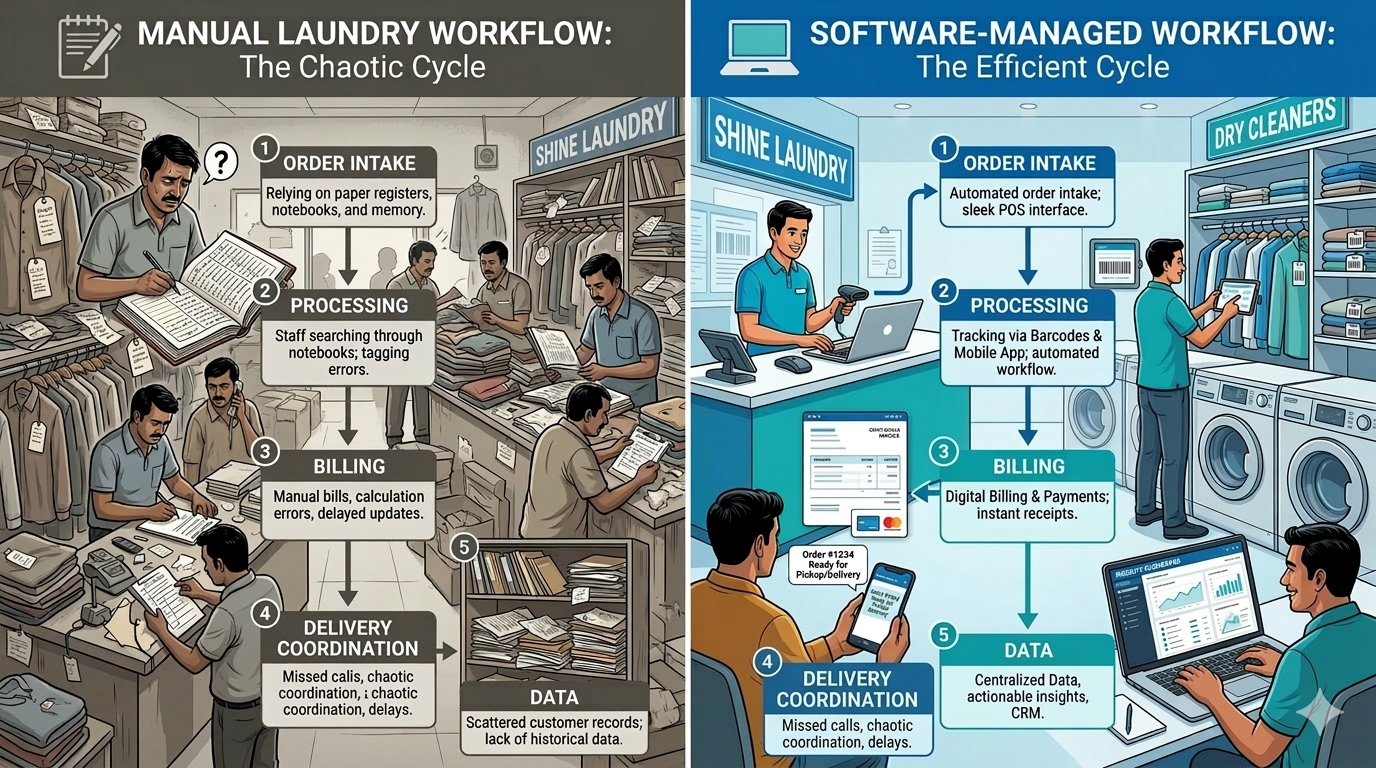
Here's what typically breaks first: order tracking. A customer calls asking about their shirt. You're flipping through three different notebooks trying to find which delivery boy has it. Meanwhile, two more calls are coming in.
Then there's billing. Manual calculations mean GST errors. Pricing inconsistencies between morning and evening shifts. No way to offer membership discounts without confusing your cashier.
The real issue? You can't see your business clearly. Which services make money? Which customers haven't visited in two months? What's your actual daily revenue after accounting for pending payments? These questions should take seconds to answer, not hours of manual counting.
Understanding the Scaling Bottlenecks in Laundry Operations
Before throwing technology at the problem, you need to identify where your operation actually gets stuck.
Staff dependency is the biggest one. If only Ramesh knows how to handle the billing software (or worse, only Ramesh remembers customer preferences), you're not running a business—you're running a Ramesh-dependent operation. Real scaling means any trained person can step in.
Customer data scattered everywhere is another killer. Phone numbers in one register. Addresses in another. Pending payments on loose sheets. When you want to send a Diwali discount SMS, you're manually typing numbers for an hour.
Delivery coordination becomes chaos past a certain volume. Which orders go to Malviya Nagar? Which driver is free? Who promised same-day delivery? Without a central system, you're playing telephone all day.
Cash flow visibility matters more than most owners realize. You might be doing ₹40,000 in billing but only collecting ₹28,000 because of pending payments you've lost track of. That gap kills growth plans.
The breaking point usually comes when you want to open a second branch. Suddenly you need to know: what inventory is where? Which branch is more profitable? Can customers drop off at one location and pick up from another? Manual systems can't handle this.
How to Scale a Laundry Business Using Software: The Core Framework
Scaling doesn't mean just getting bigger. It means handling more volume with the same or better quality, without proportionally increasing your stress or costs.
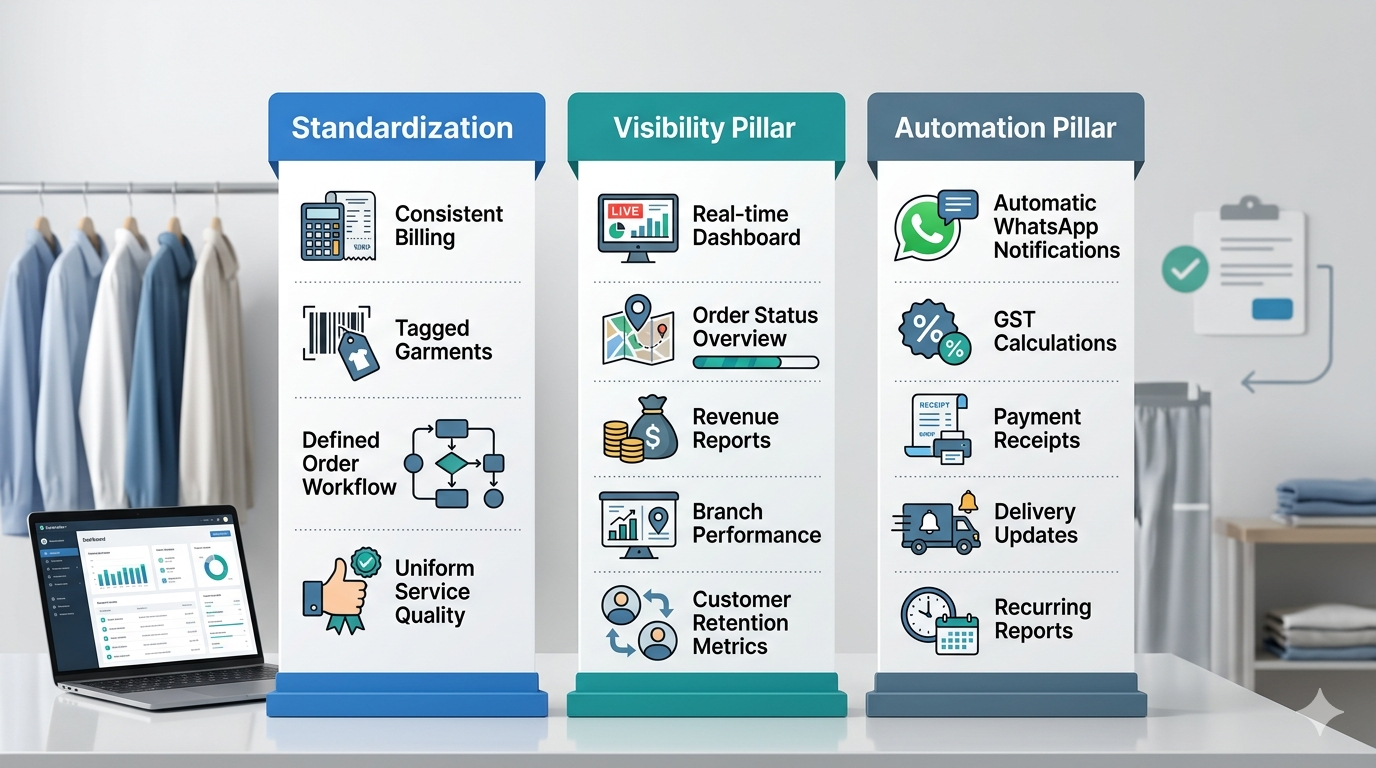
Software creates this leverage in three specific ways.
First: standardization. Every order follows the same process. Every bill looks the same. Every customer gets the same quality of service regardless of which staff member helps them. This consistency is what allows you to grow without things falling apart.
Second: visibility. You can see real-time what's happening across your operation. Orders in progress. Revenue by service type. Staff performance. Customer retention rates. When you can measure things, you can improve them.
Third: automation. The software handles the repetitive work. Sending pickup reminders. Calculating GST. Tracking delivery status. Generating monthly reports. Your team focuses on actual customer service, not paperwork.
The practical implementation starts with understanding your current workflow. Map out how an order moves through your business right now—from customer call to delivery. Every step. Every handoff. Every place information gets written down.
Then identify which steps cause the most errors or delays. That's where software provides immediate value. Usually it's order entry, billing, or delivery tracking.
Key Software Features That Actually Drive Scale
Not all laundry management software is built the same. Some are glorified billing tools. Others try to do everything and end up clunky. Here's what actually matters for scaling.
Cloud-based order management means you're not tied to one computer. Your manager checks orders from home. You monitor the business while visiting a potential second location. Delivery staff update order status from their phones.
Automated customer communication saves hours daily. The system sends pickup reminders, ready-for-delivery notifications, and payment receipts automatically. Customers feel informed. You're not playing phone tag.
Multi-branch capability isn't just about managing two locations. It's about treating your business as one system with multiple access points. A customer should be able to drop off clothes at your Sector 15 outlet and pick them up from Sector 22. The software makes this seamless.
Real reporting and analytics means more than just seeing yesterday's revenue. You need to understand trends. Which services are growing? What's your average order value? How many customers come back monthly? This data guides your expansion decisions.
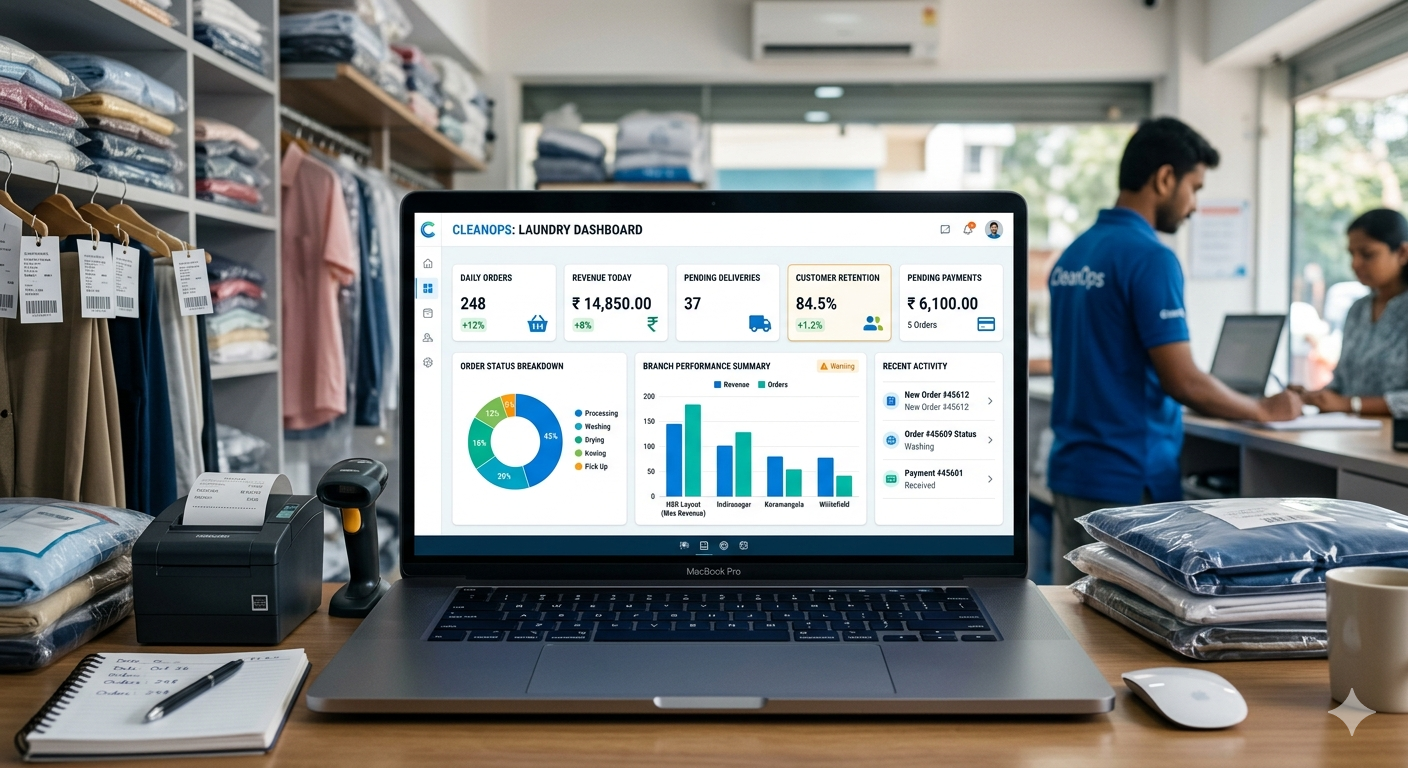
Mobile app access—both for you and customers—isn't a luxury anymore. Customers want to book pickups and track orders from their phones. Your delivery team needs to update order status in real-time. Your billing staff should be able to process payments on a tablet.
Integration with payment systems matters if you want to scale. UPI, card payments, digital wallets—everything should flow into your system automatically. Manual reconciliation becomes impossible when you're processing 200+ orders daily.
Step-by-Step: Implementing Software in Your Laundry Business
The implementation matters as much as the software itself. I've seen good software fail because of poor rollout, and average software succeed because the owner managed the transition well.
Week 1-2: Data migration and setup. Get your existing customer data into the system. This is tedious but crucial. Names, phone numbers, addresses, pricing preferences. Start with your top 50 customers if you have hundreds. The rest can be added as they place new orders.
Set up your service catalog properly. Every item type, every service (wash, iron, dry clean), every price point. Include GST rates. Create any package deals or membership tiers you offer.
Week 3: Staff training. This makes or breaks implementation. Your team needs to feel comfortable, not threatened. Train your most adaptable staff member first. Let them use it for a few days, find the quirks, get confident. Then they help train others.
Run parallel systems for at least a week. Manual register AND software. This feels redundant, but it catches mistakes and builds trust. Staff see that the software isn't losing orders or miscalculating bills.
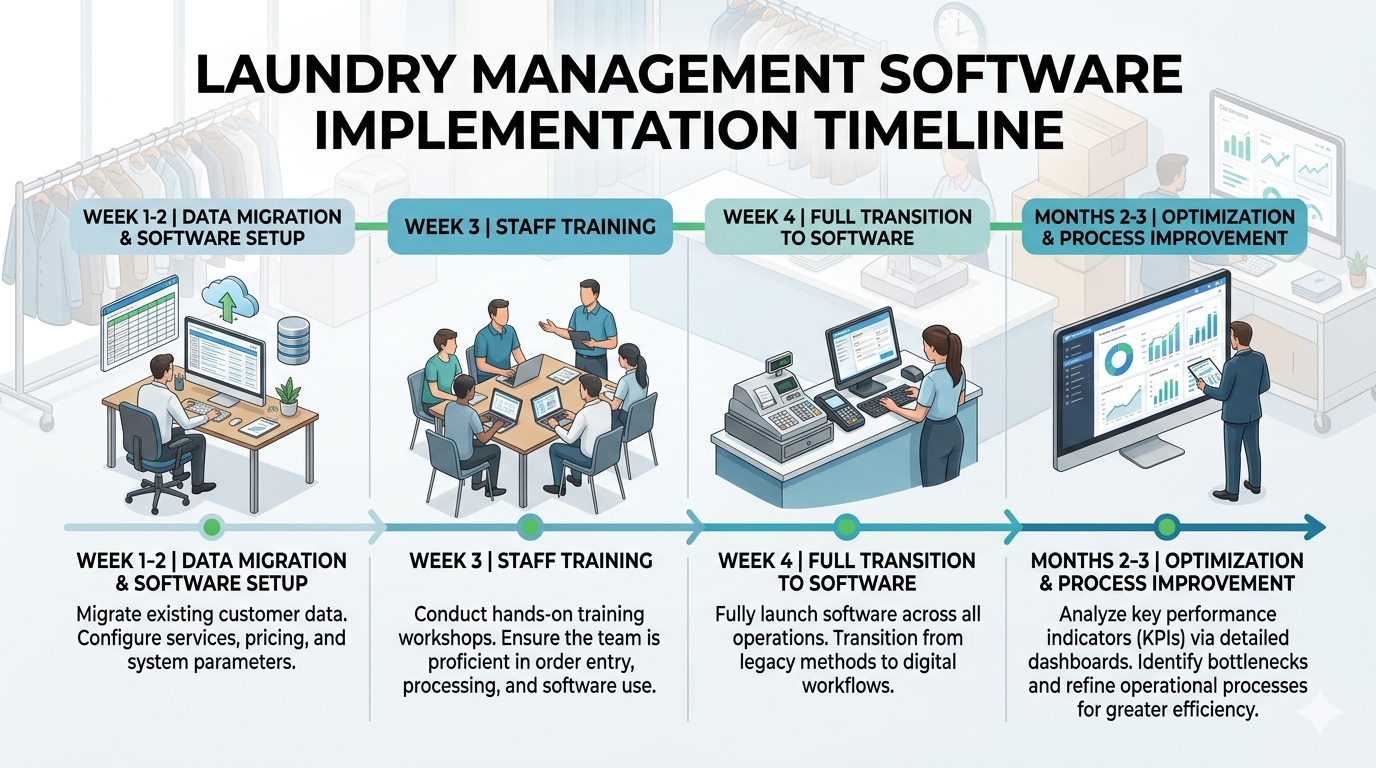
Week 4: Full transition. Make the software your primary system. Keep the manual register as backup for another week, but all decisions come from the software data.
Month 2-3: Optimization. Now you start seeing the real benefits. Look at the reports. What's the software showing you that surprises you? Adjust your processes based on actual data, not assumptions.
Common mistakes during implementation:
Trying to customize everything on day one. Use the standard setup first. Learn it. Then customize based on actual needs, not imagined ones.
Not involving senior staff in the decision. The person who handles billing should test the software before you buy it. Their buy-in matters.
Choosing based on features list instead of ease of use. The most powerful software is useless if your team won't use it properly.
How Ezer Laundry POS Software Is Different from Generic Solutions
Most laundry owners try generic POS systems or basic billing software first. They're cheap, sometimes free. And they work—until they don't.
The difference shows up in the details. Generic software doesn't understand garment tracking. You can't easily mark that a specific kurta has a stain that needs pre-treatment. Or that Mrs. Sharma always wants light starch on her sarees.
Laundry-specific workflows matter more than you'd think. A dedicated system knows about pickup-delivery cycles. It understands that an order might be received today, processed tomorrow, and delivered the day after. It tracks each garment separately within an order.
Pricing flexibility in laundry businesses is complex. You might charge per piece for some items, per kilogram for others. Different rates for express service. Membership discounts. Seasonal offers. Generic software makes this complicated. Purpose-built systems handle it naturally.
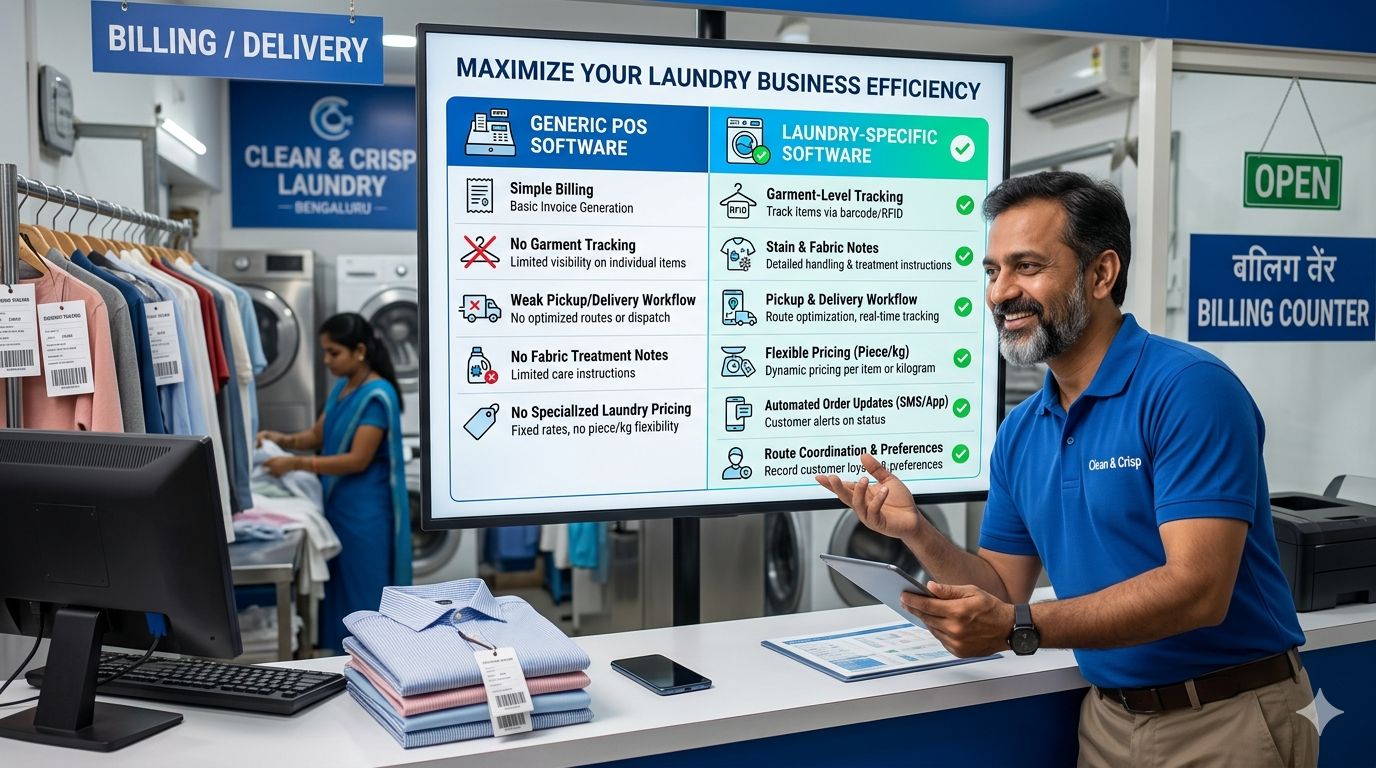
Integration with your actual operations is another gap. Can the software generate delivery route maps? Does it track which items are at the washing stage versus ironing? Can it flag orders that are delayed?
The mobile experience matters differently in laundry compared to retail. Your delivery team needs to capture photos of picked-up items. Mark addresses on a map. Collect payments and signatures. A system built for laundry anticipates these needs.
Support and updates make a long-term difference. When GST rates change or you need to add a new service category, how quickly can the software adapt? Generic solutions often require technical workarounds. Specialized systems update for the whole industry.
Ezer Laundry POS System
Streamline your laundry business with our comprehensive POS system. Features include smart billing, garment tracking, WhatsApp notifications, and cloud backup.
Real Cost-Benefit Analysis: What to Expect
Let's talk actual numbers because "increased efficiency" is too vague.
Direct cost savings are easiest to measure. Software typically costs ₹2,000-5,000 monthly depending on features and scale. You're eliminating or reducing: register books, printing of manual receipts, time spent on manual billing and reconciliation, SMS costs (if software includes automated messaging), payment collection delays through better tracking.
For most shops processing 50+ orders daily, these direct savings often cover the software cost within the first month.
Time savings translate to money. If billing and order entry take 30% less time, your staff can handle more volume without hiring additional help. Or existing staff can focus on quality control and customer service instead of paperwork.
Revenue protection is harder to quantify but significant. How many pending payments do you currently lose track of? What's that worth annually? How many customers don't return because of a single bad experience (wrong delivery, lost item)? Software reduces both.
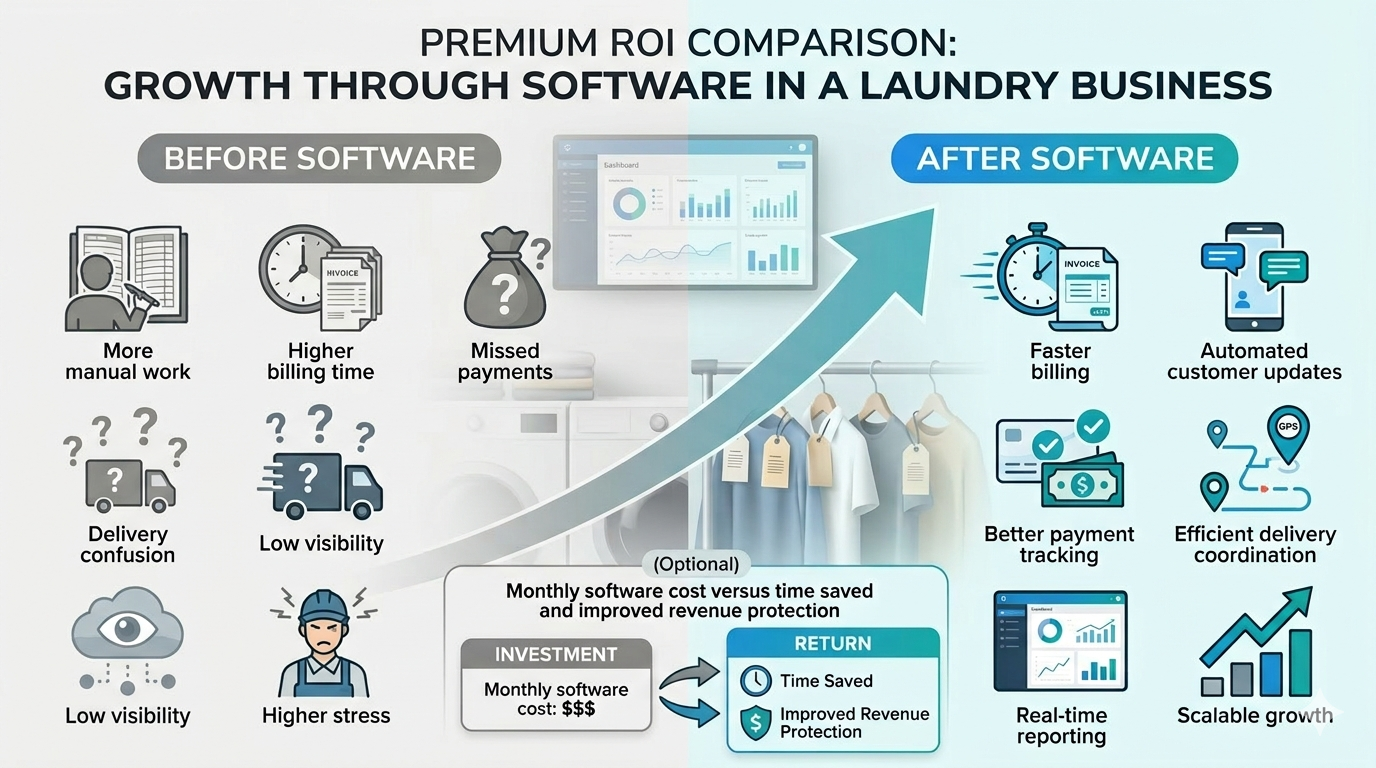
Growth enablement is the real payoff. Can you confidently open a second location knowing you'll have visibility into both? Can you launch pickup-delivery services without the coordination becoming unmanageable? This is where software moves from "nice to have" to "business requirement."
The breakeven point for most laundry shops is 2-4 months. After that, it's pure leverage.
Hidden benefits that owners report: better sleep (you can actually check if everything's okay from home), easier holidays (business runs without you), more professional appearance (customers notice the difference), hiring becomes easier (systems reduce training time).
Common Mistakes When Scaling with Software
The biggest mistake is treating software as a magic solution. It's a tool. It amplifies your existing systems—good or bad.
Mistake 1: Not fixing processes first. If your current workflow is chaotic, software just speeds up the chaos. Map your ideal process, then implement software to support it.
Mistake 2: Buying based on price alone. The cheapest option often costs more long-term through limitations, poor support, or having to switch systems later.
Mistake 3: Inadequate training. You spend ₹50,000 on software but won't invest two days in proper staff training. Then blame the software when adoption is poor.
Mistake 4: Ignoring customer-facing features. Your internal efficiency improves but customers don't feel any difference. They should get better service, more communication, easier interaction. Otherwise, why scale?
Mistake 5: No data backup plan. Cloud software usually handles this, but confirm it. Your customer data and order history is your business's memory.
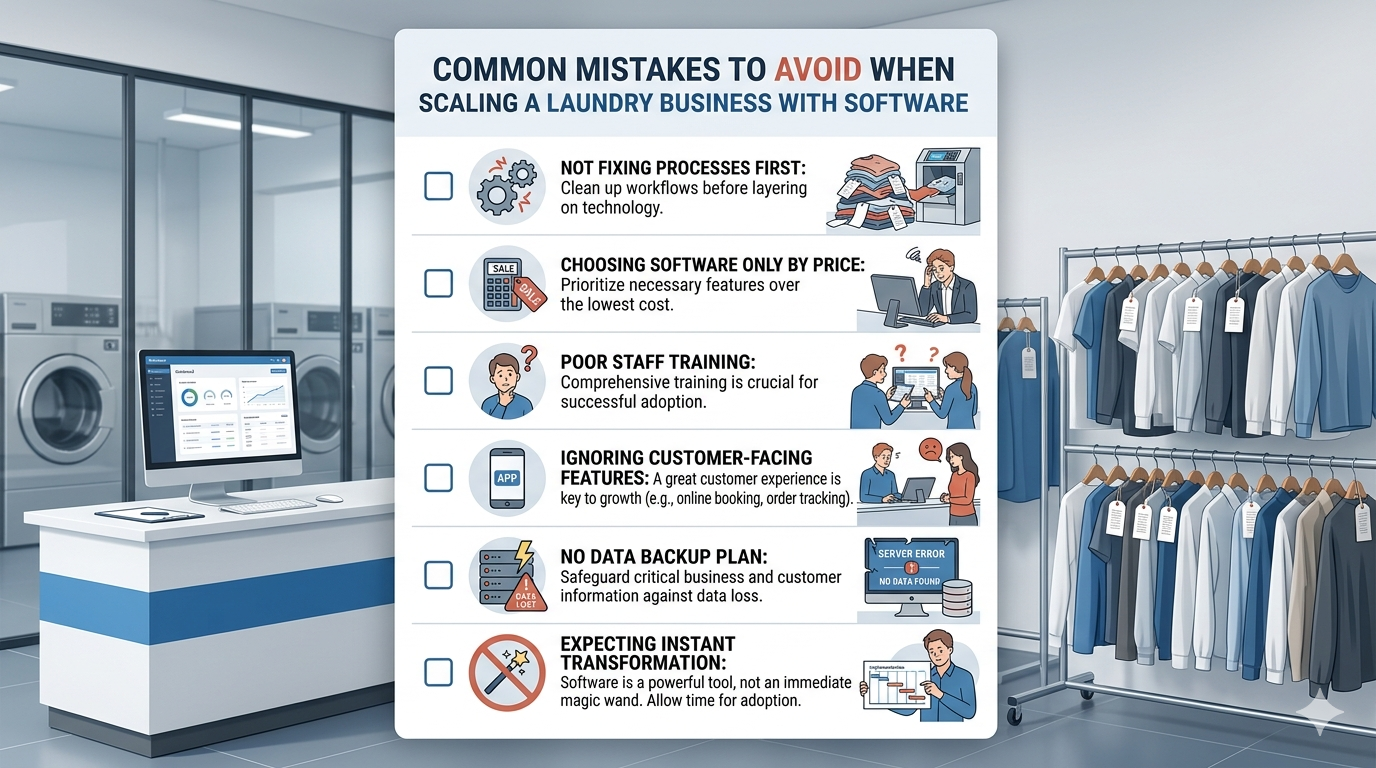
Mistake 6: Expecting overnight transformation. Real benefits compound over months. The first month is about stabilization. Months 2-3 show efficiency gains. Month 4+ is when you see growth enablement.
Beyond Software: Building Systems for Sustainable Growth
Software is one piece of scaling. The real unlock comes from building repeatable systems around it.
Standard operating procedures matter more as you grow. Document everything: how to receive an order, how to handle customer complaints, how to process express requests, how to train a new staff member. Software makes these procedures easier to follow and enforce.
Quality consistency across volume is the scaling challenge. When you go from 50 to 150 orders daily, maintaining the same quality requires systems. Checklists. Random quality checks. Customer feedback loops. Software helps track this, but you need to design the system.
Team structure needs to evolve. When you're small, everyone does everything. As you scale, you need specialists: someone handling customer service, someone managing operations, someone focused on delivery logistics. Software enables this division by making information accessible to everyone.
Financial discipline becomes critical. Regular review of key metrics: revenue per customer, average order value, customer acquisition cost, retention rate, profit margin by service type. Software generates these numbers. You need to act on them.
The shops that scale successfully treat software as infrastructure, not expense. It's the foundation that allows everything else to grow.
FAQs
What size laundry business needs management software?
If you're processing more than 30-40 orders daily, or planning to offer pickup-delivery services, or considering a second location—you need software. Below that volume, simple tools might suffice, but you'll outgrow them quickly if you're serious about growth.
How long does it take to implement laundry management software?
Expect 3-4 weeks for full transition. Week one for setup and data migration, week two for staff training, week three running parallel systems, week four going fully live. Don't rush this. Poor implementation undermines good software.
Can software really help with delivery management?
Yes, significantly. Route optimization, real-time status updates, driver assignment, proof of delivery capture, automatic customer notifications—all these reduce delivery errors and coordination time. Most owners say delivery management is where they see the clearest benefit.
What if my staff resists using new software?
Normal and expected. Involve them early in the selection process. Choose user-friendly software. Train thoroughly. Show them how it makes their work easier, not harder. Usually resistance comes from fear of looking incompetent—address that with patient training.
Is cloud-based software safe for customer data?
Reputable cloud providers offer better security than your local computer. Data is encrypted, backed up automatically, and protected by professional security teams. Confirm the provider complies with data protection standards and has clear privacy policies.
How much does good laundry management software cost?
Pricing typically ranges from ₹2,000-6,000 monthly for small to medium operations, depending on features and scale. Some charge per transaction, others per location. Calculate based on order volume, not just shop count. Most offer free trials—use them to test fit.
Can I switch from manual to software without disrupting business?
Yes, with proper planning. Run both systems parallel for 1-2 weeks. Migrate existing customer data gradually. Train staff in batches. The key is not rushing. Most businesses maintain normal operations during transition if they allocate adequate setup time.
Conclusion
Scaling a laundry business isn't about working harder or hiring more people. It's about building systems that create leverage—where small improvements compound into significant growth.
Software provides the infrastructure for this. It standardizes your operations, gives you visibility into what's actually happening, and automates the repetitive work that doesn't need human judgment.
The laundry businesses that thrive over the next few years will be those that embrace these tools early. Not because software is trendy, but because it solves real operational problems that manual systems can't.
Start small if you need to. Implement one feature at a time. But start. The gap between shops using modern systems and those stuck with manual processes will only widen.
How to Start Your Laundry Business in 2026: Complete Guide
Ready to see how software can transform your laundry operations? Ezer Laundry POS offers a free demo where you can explore features specific to your business needs. Book a 15-minute walkthrough and see if it's the right fit for your growth plans.