
What is a Laundry POS System? (And How It Helps You Scale)
Running a laundry business without proper systems is like trying to track 50 orders on paper slips while managing three phone calls. You've probably been there—missed pickups, billing errors, angry customers asking "where's my order?" Most laundry owners I've spoken with mention the same breaking point: when they hit 30-40 orders a day, everything starts falling apart. That's exactly where a laundry POS system comes in. This guide explains what it actually does, why it matters for your business, and how it helps you grow without hiring five more people.
What Exactly is a Laundry POS System?
A laundry POS (Point of Sale) system is specialized software built specifically for dry cleaning and laundry businesses. Unlike a generic billing system you'd use at a retail shop, it handles the unique workflows of laundry operations—order intake, item tagging, service pricing, delivery tracking, and customer history.
Think of it as your digital operations manager. When a customer walks in with clothes, the system helps you create an order, print tags, calculate pricing based on services (dry clean, wash & fold, ironing), track the order through processing, and handle final billing. Most modern systems are cloud-based, which means you can access everything from your phone or any computer with internet.
The difference between a regular POS and a laundry-specific one? A regular system just records sales. A laundry POS tracks each garment, knows if that shirt is in washing or ready for delivery, sends SMS updates to customers, and remembers that Mrs. Sharma always wants light starch on her sarees.
Why Traditional Methods Stop Working
Many shop owners start with a register book and phone-based coordination. Works fine initially. But here's what happens once you cross 25-30 daily orders:
The staff dependency trap. Only Ramesh knows which order belongs to which customer. If he's sick or leaves, you're stuck searching through piles of clothes. I've seen shops lose customers permanently over misplaced orders.
Billing becomes guesswork. You can't remember if that customer paid advance or not. GST calculation gets messy. Revenue tracking happens once a month when you manually count everything.
Delivery chaos. Customers call asking for updates. You have no clear answer. Your delivery person maintains a separate notebook that nobody else understands.
The breaking point isn't obvious until you're already losing money. One shop owner told me he realized too late that 15% of his orders had billing errors—usually in the customer's favor.
Core Features That Actually Matter
Not all laundry POS systems are equal. Some are bloated with features nobody uses. Here's what genuinely helps:
Order Management and Tagging
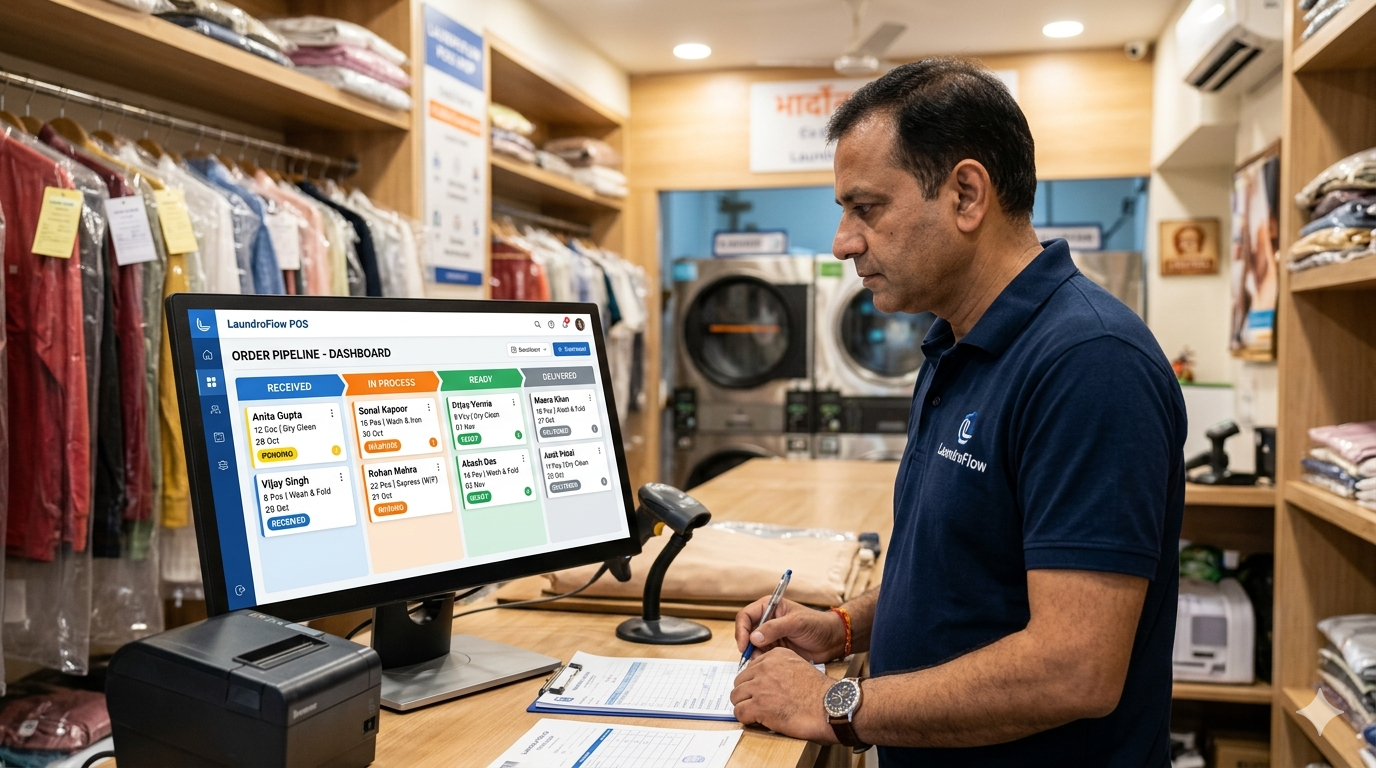
Every garment gets a unique tag or barcode. The system tracks it from entry to exit. Customer drops off 5 shirts and 2 pants—each item is logged with service type (dry clean, wash, iron). This eliminates the "we can't find your clothes" conversation.
The system should show order status in real-time. You should be able to filter by pending, in-process, ready, and delivered. Simple, but incredibly powerful when handling multiple orders simultaneously.
Smart Pricing and Billing
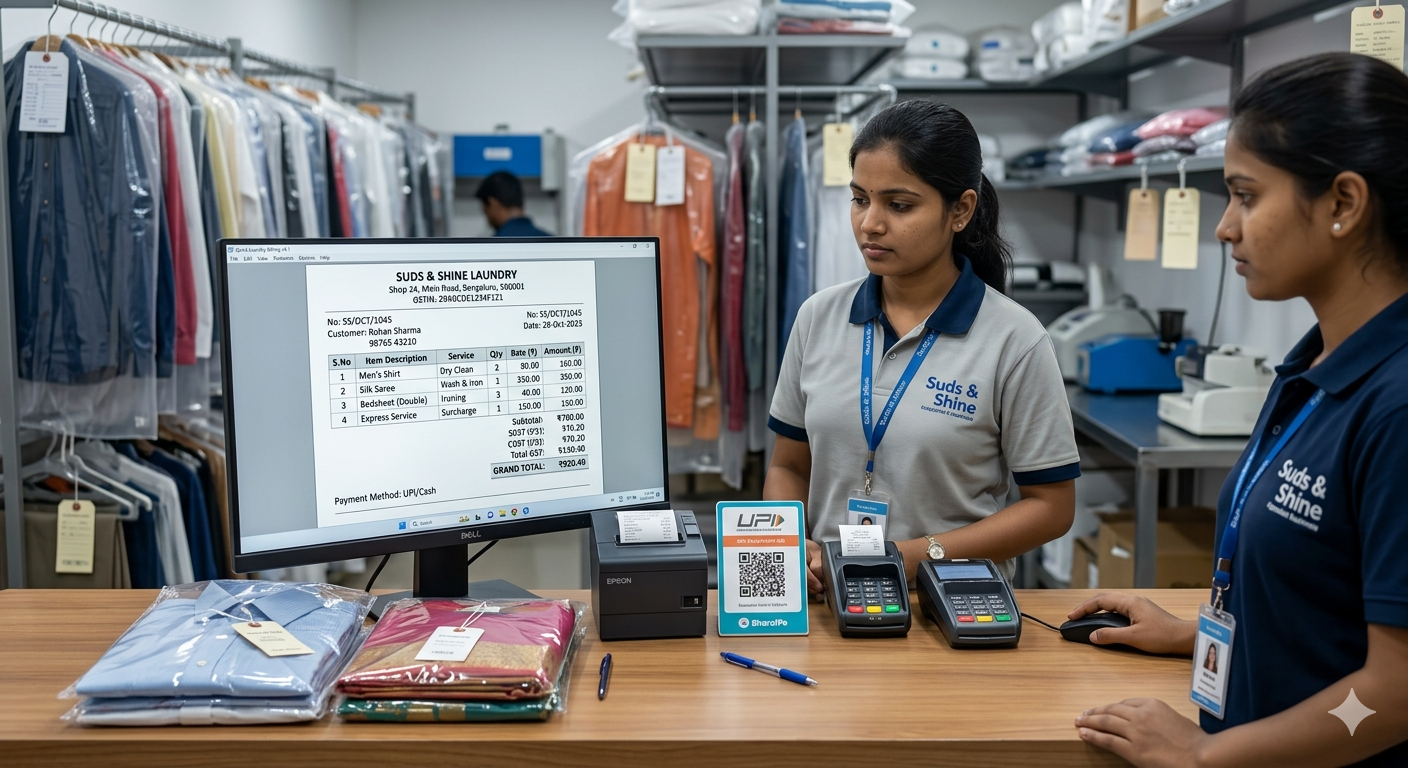
Your system should store rate cards for different services. Shirt dry clean ₹40, saree washing ₹60, bedsheet ironing ₹30—whatever your pricing is. When you create an order, it auto-calculates the total.
GST integration matters if you're billing above certain thresholds. The system should generate proper invoices with tax breakdowns. Many shop owners don't realize they need this until tax filing season hits.
Customer Database and History
This feature saves you more money than you'd expect. The system remembers every customer—their phone number, address, past orders, preferred services, and payment history.
When someone calls, you type their number and instantly see: "Mr. Patel, last order was 3 shirts on Jan 15th, total ₹280, paid by UPI." No fumbling through papers. You look professional. Customers notice.
Regular customers also get faster service because their preferences are saved. Someone who always wants medium starch doesn't need to repeat it every time.
Pickup and Delivery Tracking
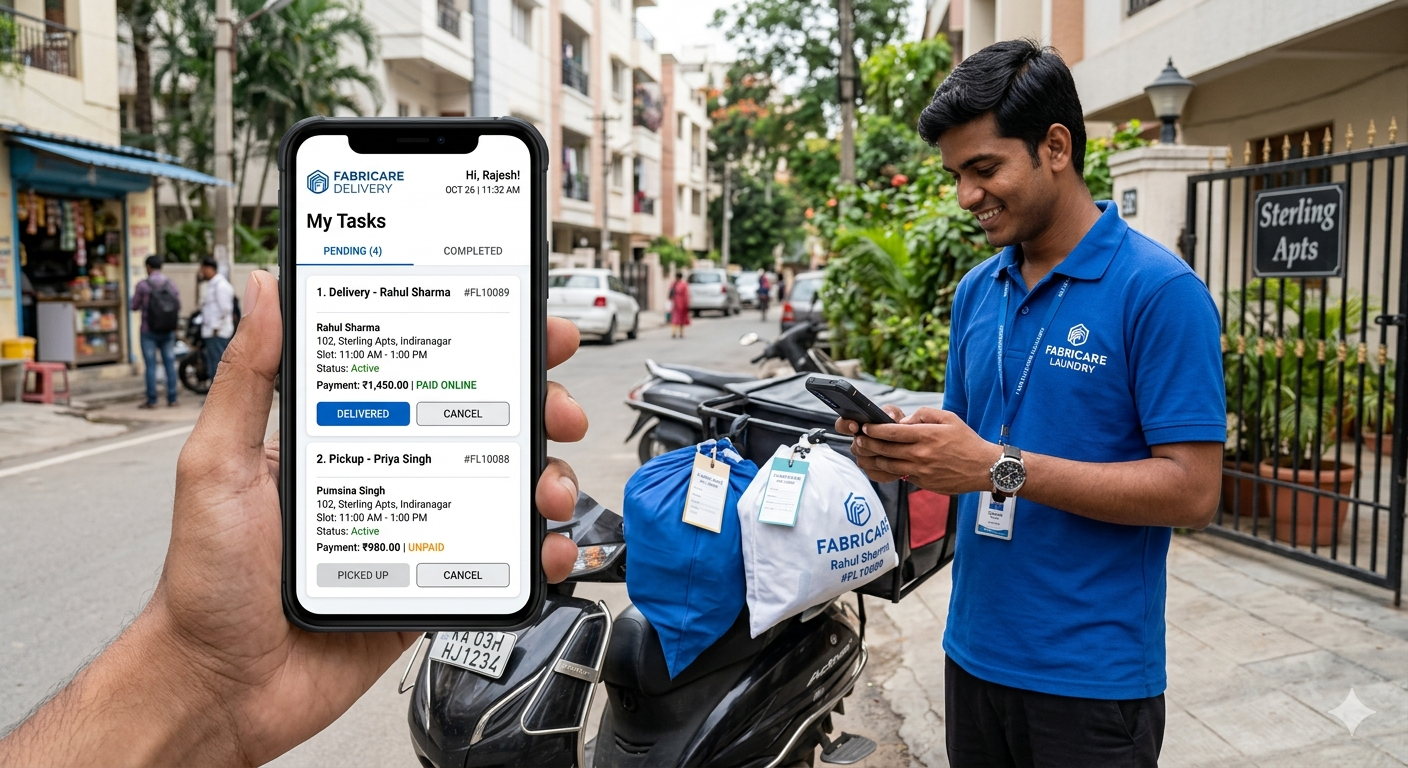
If you offer home pickup and delivery, this becomes critical. The system should let you assign orders to delivery personnel, track pickup addresses, log delivery times, and collect proof of delivery.
Some shops use Google Sheets for this. That approach breaks when you have multiple delivery people working different routes. A proper POS integrates everything—orders, delivery assignments, customer communication—in one place.
How POS Systems Help You Scale (Real Business Impact)
Scaling a laundry business isn't just about getting more customers. It's about handling more volume without proportionally increasing costs or chaos.
Reducing Staff Dependency
With a POS, anyone on your team can handle any customer. The system contains all information—no need to ask "where's that blue kurta order?" Everything is searchable. Order number, customer name, phone number, date—any of these brings up the complete details.
This means you can hire part-time staff during busy hours without extensive training. The system guides them through order creation, billing, and handover. Your business isn't held hostage by one or two key employees anymore.
Actual Revenue Visibility
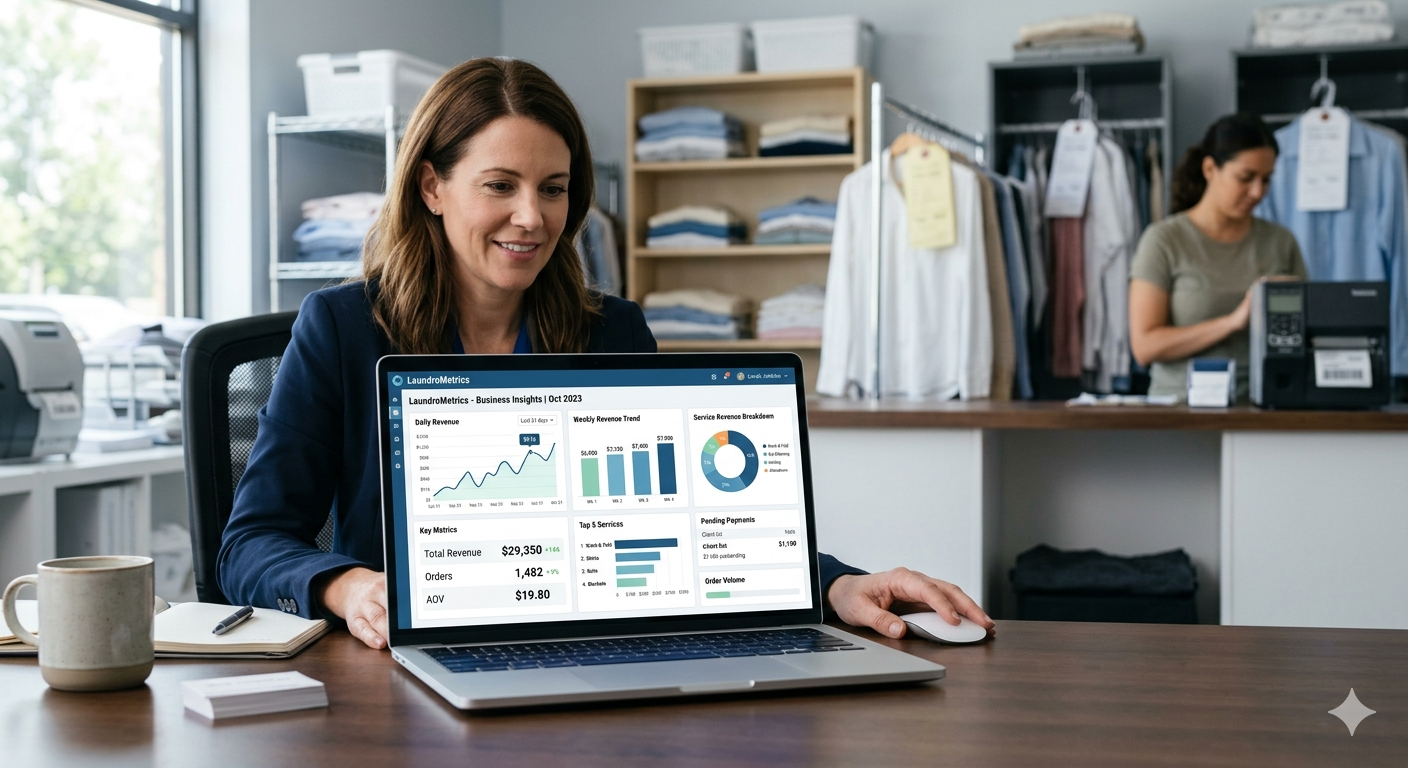
Most laundry owners don't know their daily revenue until they manually count at night. With a POS, you see real-time sales. Morning batch ₹4,200. Evening batch ₹6,800. Total pending payments ₹12,000.
This visibility helps you make faster decisions. Slow day? Send promotional SMS to regular customers. Peak season approaching? Stock up on hangers and packing materials before you run out.
You can also identify which services are most profitable. Maybe dry cleaning brings in 60% of revenue. Or maybe express delivery commands a premium that customers happily pay. This data shapes your pricing and marketing strategy.
Improving Customer Retention
Customers leave laundry shops for two main reasons: poor service quality and lack of communication. A POS fixes the second issue completely.
Automated SMS updates keep customers informed. "Your order is ready for pickup." "Your delivery is on the way." Simple messages that reduce anxiety and phone calls to your shop.
The system also helps you run loyalty programs. After 10 orders, give a 10% discount. Or offer a free service after ₹5,000 in spending. These programs are impossible to track manually but trivial with software.
Enabling Multi-Branch Operations
Opening a second location without a POS is extremely difficult. How do you track inventory across branches? How do you prevent customers from dropping off at Branch A and picking up from Branch B? How do you consolidate revenue reporting?
A cloud-based laundry POS solves this by centralizing data. All branches connect to the same system. You see combined performance, transfer orders between branches if needed, and maintain consistent pricing and service standards.
Some owners I've worked with mentioned this was the main reason they invested in a POS—they knew they wanted to expand eventually.
Choosing the Right System (Practical Considerations)
The market has many options. Here's how to evaluate them without getting overwhelmed:
Start with your actual workflow. Don't buy based on feature lists. Map out how an order flows through your shop—customer entry, sorting, processing, packaging, delivery. The POS should match this flow, not force you to change everything.
Cloud vs. installed software. Cloud systems (access via browser/app) are more flexible. You can check orders from home. Updates happen automatically. Installed systems (software on one computer) are cheaper initially but create dependency on that specific machine.
Mobile app availability. If you do home pickups and deliveries, your delivery person needs a mobile app to mark status updates. Not all systems offer this.
Pricing model. Some charge monthly subscriptions (₹1,500-₹3,000 per month). Others have one-time costs (₹15,000-₹40,000 upfront). Calculate total cost over 2-3 years before deciding. Monthly plans are easier to test without big commitment.
Support and training. This matters more than fancy features. If something breaks during peak hours, can you call someone? Is training included? Some companies just hand over the software and disappear.
Ezer Laundry POS System
Streamline your laundry business with our comprehensive POS system. Features include smart billing, garment tracking, WhatsApp notifications, and cloud backup.
Common Mistakes When Implementing POS Systems
Buying too early or too late. If you're handling 5-10 orders daily, a POS might be overkill. But if you're at 40+ orders and still using notebooks, you're bleeding money through inefficiencies. The sweet spot is usually around 20-30 daily orders.
Not involving your staff. Your team will actually use the system. If you choose something complicated that they resist, it'll fail. Include them in the decision process. Show them demos. Get their feedback.
Skipping data migration. You have existing customer data in registers or phones. Many shop owners start fresh with a new POS and lose all that history. Good systems help you import existing data.
Ignoring integration needs. Do you use UPI for payments? Does your accountant need specific report formats? Will you eventually want to integrate with a website for online bookings? These integrations should be possible.
Modern Laundry POS Features You Might Not Know About
Technology keeps evolving. Here are newer capabilities that some advanced systems now offer:
WhatsApp integration. Instead of SMS, send order updates via WhatsApp. Higher open rates. Customers can also place orders by messaging you.
Digital payments tracking. Integrate with UPI, card machines, and wallets. The system automatically reconciles payments and reduces cash handling errors.
Expense management. Track operational costs—detergent purchases, electricity, staff salaries. See actual profitability, not just revenue.
Staff performance tracking. See which team members process more orders, make fewer errors, or generate more upsells. Useful for incentive planning.
These aren't essential to start. But they're worth knowing about as your business grows.
Real Cost-Benefit Analysis
Let's be practical about numbers. A decent laundry POS costs ₹2,000-₹3,000 per month for subscription plans, or ₹20,000-₹35,000 as a one-time investment for simpler systems.
What do you get in return?
Error reduction. Even 5 billing errors per month at ₹200 average is ₹1,000 lost. Over a year, that's ₹12,000. A POS eliminates most of this.
Time savings. Manually searching for orders, calculating bills, tracking payments—this easily wastes 2-3 hours daily. That's time you could spend on marketing or quality control.
Customer retention. One regular customer spending ₹1,500 monthly over a year is ₹18,000. If better service and communication helps you keep just 3-4 such customers who would otherwise have left, the POS pays for itself.
The payback period is typically 3-6 months for most shops doing reasonable volume.
FAQs
Can small laundry shops afford a POS system?
Yes. Many cloud-based systems offer plans starting at ₹1,500-₹2,000 per month with no upfront costs. For shops doing 20+ orders daily, the efficiency gains and error reduction usually cover this cost within a few months. Think of it as hiring a digital assistant who never takes leave.
Do I need internet for a laundry POS to work?
Most modern systems need internet since they're cloud-based. However, some offer offline modes that sync data once connection is restored. If your area has unstable internet, specifically ask vendors about offline capabilities before purchasing.
How long does it take to train staff on a new POS?
For basic operations (creating orders, billing, searching customers), most staff learn within 2-3 days of regular use. The learning curve isn't steep if the system is well-designed. Advanced features like reporting and inventory management might take a week or two to master.
Can the POS handle different pricing for different services?
Absolutely. This is a core feature. You can set up rate cards for dry cleaning, washing, ironing, stain removal, express service—whatever services you offer. You can also have different pricing for different garment types (shirt vs. jacket vs. bedsheet).
What happens if the POS company shuts down?
This is a valid concern with cloud systems. Before choosing, ask about data export options. Can you download your complete database? Reputable companies allow this. Also check how long they've been in business and their customer base size—this indicates stability.
Is a POS system necessary if I already use Excel?
Excel works until it doesn't. If you're managing customer communications, order tracking, billing, and delivery coordination across multiple Excel files, you're creating unnecessary complexity. A POS integrates everything and reduces human error. Plus, your staff can't accidentally delete an Excel formula.
Can I try a POS before fully committing?
Many companies offer free trials (7-15 days) or demo accounts. Some have freemium plans with basic features. Always test with your actual workflow before paying. Create sample orders, try the mobile app, generate reports—make sure it fits your needs.
Conclusion
A laundry POS system isn't just billing software. It's the operational backbone that lets you handle growth without chaos. It reduces errors, improves customer communication, and frees you from dependency on specific staff members.
The question isn't whether you need one—if you're doing serious volume, you do. The question is timing and which system fits your workflow.
Start by mapping your current pain points. Is it delivery tracking? Billing errors? Customer complaints about order status? Then evaluate systems that specifically solve those problems. Don't pay for features you won't use.
If you're curious about how modern laundry management systems work in practice, explore cloud-based options that offer free trials. See the difference in your daily operations before making any financial commitment.
How to Manage Laundry Orders Digitally in 2026: A Complete Guide