
How to Manage Laundry Orders Digitally in 2026: A Complete Guide
Running a laundry business without a proper order management system is like trying to remember 50 phone numbers in your head. It works until it doesn't. I've seen shop owners lose customers because they mixed up delivery addresses or couldn't track who paid what. Digital order management isn't just about going paperless—it's about staying in business when your competitor down the street already uses a system that sends automated SMS updates to customers.
This guide walks you through everything you need to know about managing laundry orders digitally, whether you're running a single shop in Pune or planning to expand across multiple locations.
Why Traditional Order Management Fails for Modern Laundry Businesses
Most laundry shops still rely on handwritten registers or basic Excel sheets. The problem shows up when you scale beyond 20-30 orders daily.
Register books get messy. Staff members have different handwriting styles. A customer calls asking about their order status, and you're flipping through pages trying to decode someone else's notes. You've probably experienced this—the 10 AM rush when three customers are waiting, phones are ringing, and you're trying to write down order details while simultaneously handling payment.
Excel sheets are better, but they're not designed for real-time operations. You can't have multiple staff members updating the same file without creating version conflicts. Tracking pickup and delivery becomes a separate nightmare. And if someone accidentally deletes a row? Good luck explaining to a customer why you lost their expensive suit.
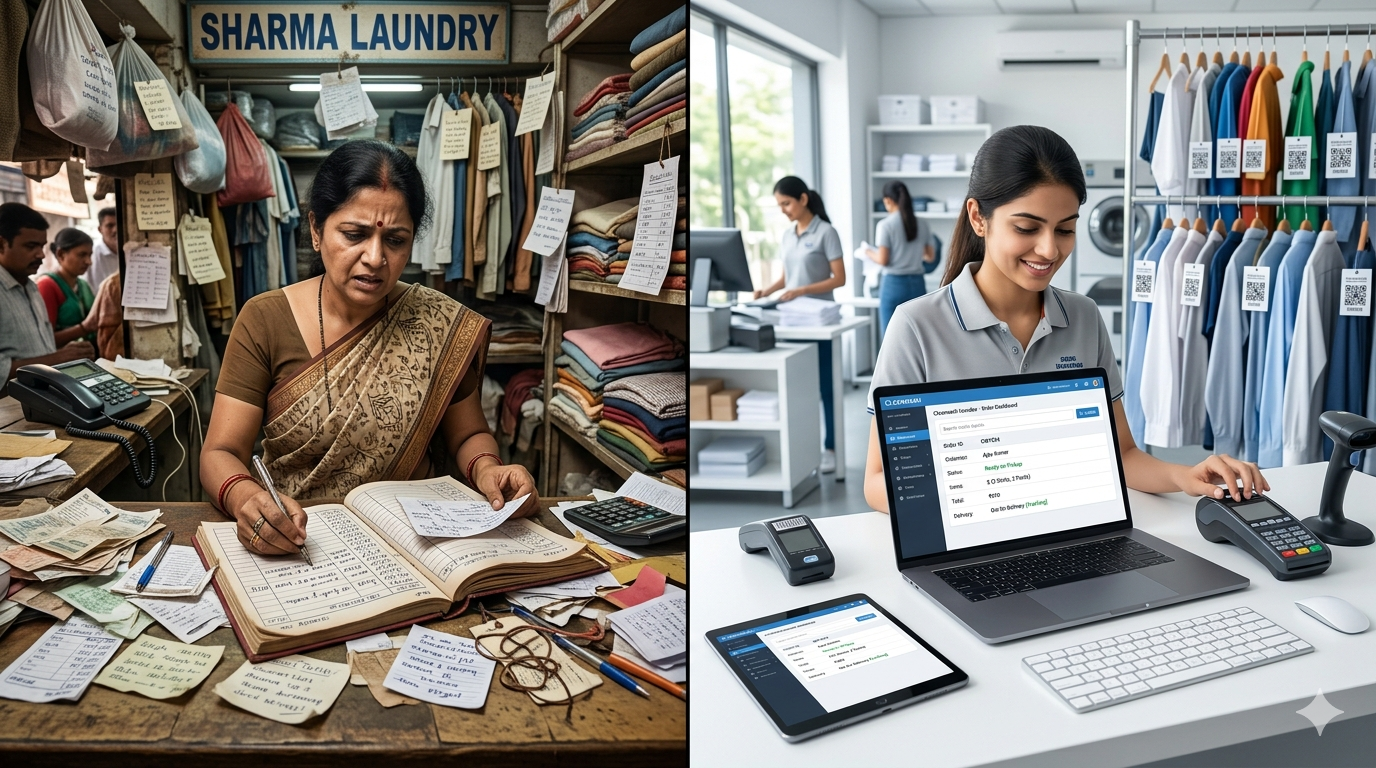
The real cost isn't just operational headaches. It's the business you lose when customers choose convenience over loyalty. A customer who can't track their order online or doesn't get delivery updates will simply try the new app-based laundry service next time.
What Digital Order Management Actually Means
Digital order management for laundries isn't complicated. At its core, it means every order exists as a digital record that multiple people can access, update, and track in real-time.
When a customer drops off clothes, you create an order entry with their details, items, services selected, pricing, and expected delivery date. This information lives in a system—not in someone's memory or on a piece of paper that can get lost.
The system tracks the order through its lifecycle: received, in-process, ready for delivery, delivered. Staff can update status with a tap. Customers can check progress without calling. You can pull reports showing how many orders are pending, which customers haven't picked up their items, and which staff member is handling what.
Most importantly, digital systems connect different parts of your business. Billing, inventory (detergent stock, packaging materials), customer history, and delivery routes—everything flows together instead of existing in separate notebooks and Excel files.
Step-by-Step: How to Digitally Manage Laundry Orders
Setting Up Your First Digital Order
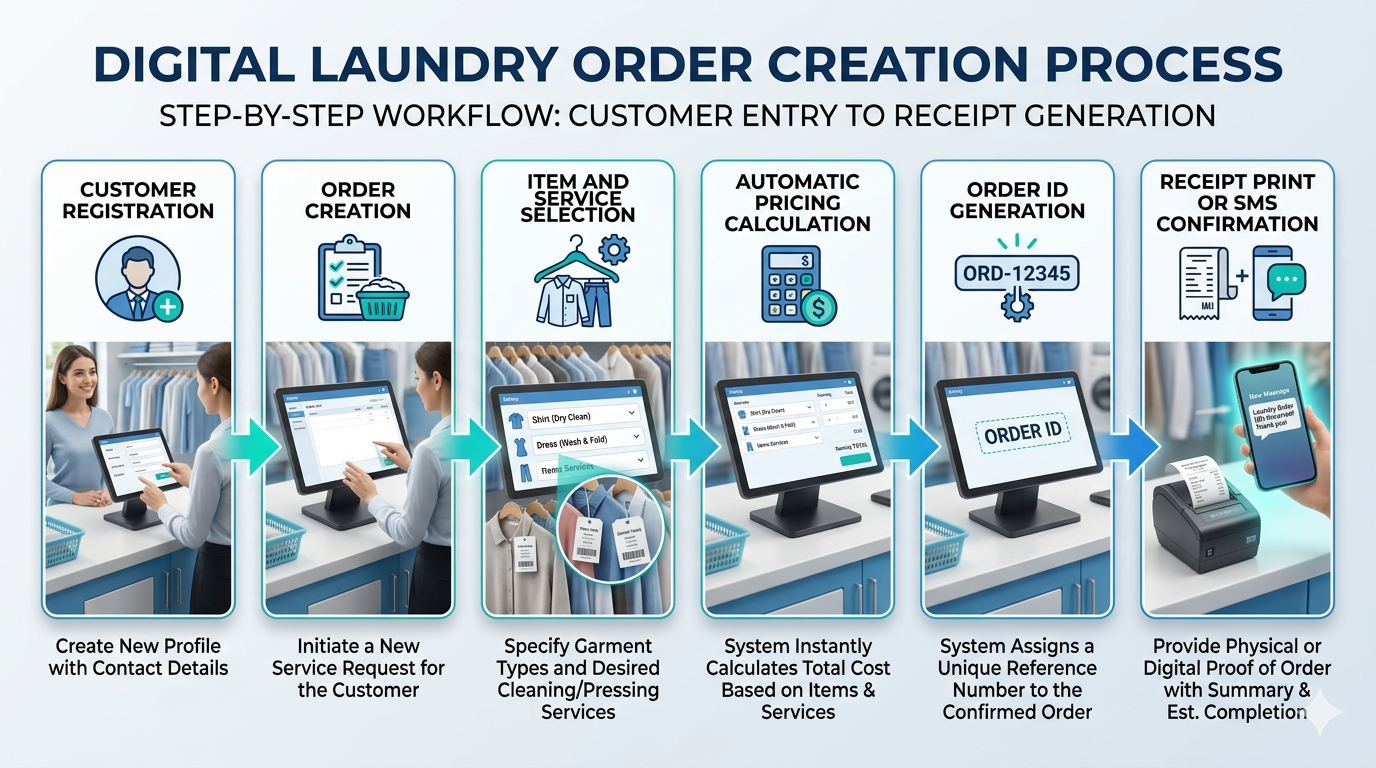
Start with customer registration. Capture basic details: name, phone number, address. Some systems let you scan ID cards or import contact details directly, but manual entry works fine for most shops.
Next comes order creation. Select the customer, add items (shirts, trousers, bedsheets), choose services (wash-iron, dry clean, stain removal), and the system calculates pricing based on your rate card. This takes about the same time as writing in a register, but you're building a searchable database instead of creating a paper trail.
Assign an order number. Good systems auto-generate unique order IDs that customers can use to track their items. Print a receipt with this number—or send it via SMS if your system supports it.
Managing Orders During Processing
This is where digital systems shine. Staff can update order status from any device—a computer at the counter, a tablet in the processing area, or even a mobile phone.
When clothes move from washing to drying to ironing, update the status. It takes seconds, but customers who check online see real-time progress instead of calling to ask "is it ready?"
You can also tag special requirements digitally. "Customer wants extra starch on collars" or "Handle with care - expensive fabric" appears on every screen that displays this order. No need to remember or relay messages verbally.
Handling Pickup and Delivery
Digital systems separate walk-in pickups from home deliveries cleanly.
For walk-ins: Customer arrives, you search by phone number or order ID, verify items, mark as delivered, collect payment if pending. The entire transaction is logged with timestamp and staff name.
For deliveries: Create a delivery run by grouping orders by area. Most modern systems show addresses on a map, helping delivery staff plan efficient routes. When delivered, staff mark it complete from their phone with optional photo proof. Customers can rate the delivery experience.
This eliminates the common problem of "did we deliver to Sharma ji or is the order still in the van?"
Choosing the Right Digital System for Your Laundry
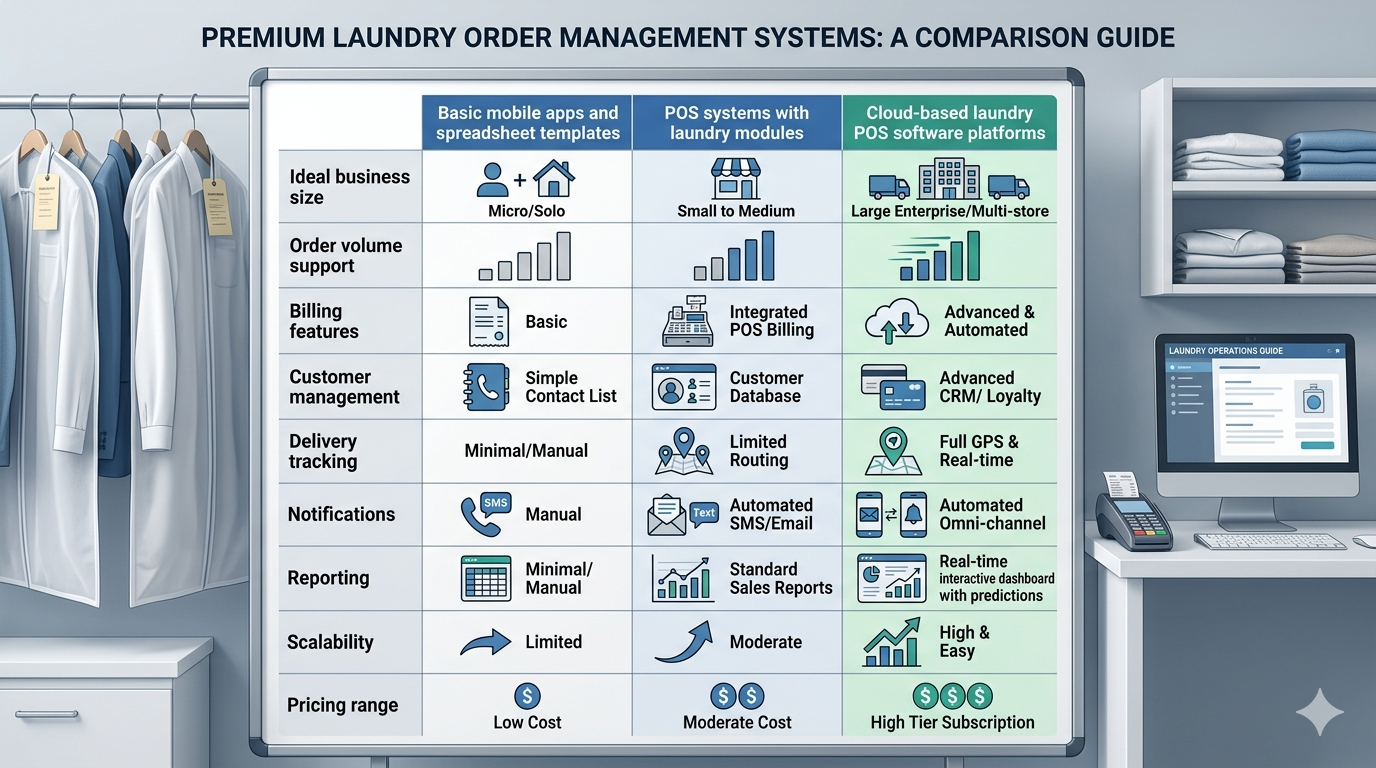
You have three main options, each suited for different business sizes and tech comfort levels.
Basic mobile apps and spreadsheet templates work if you're processing under 15 orders daily. These are often free or very cheap. You'll still do a lot of manual work, but at least everything is in one place. The limitation is that you can't scale easily, and reporting is minimal.
Point-of-sale (POS) systems with laundry modules are the middle ground. They handle billing, basic order tracking, and customer management. Good for single-location businesses processing 30-100 orders daily. Most offer offline mode, which matters when internet connectivity is unreliable.
Cloud-based Laundry POS Software platforms are built specifically for laundry businesses. They include everything: order management, automated SMS notifications, delivery route optimization, inventory tracking, GST-compliant billing, multi-branch management, and customer apps. These cost more but save significant operational time once implemented.
The honest truth? Most shop owners resist switching until they hit a crisis—a major billing dispute, a delivery mix-up that loses a big corporate client, or rapid growth that breaks their manual system. Don't wait for the crisis.
Real Business Benefits You'll Actually Notice
Revenue tracking becomes automatic. You'll know exactly how much you made today, this week, this month. Compare periods to spot trends. Is Monday slower than Friday? Are wash-iron services declining while dry-cleaning is growing? You can make informed decisions instead of gut-feeling guesses.
Customer retention improves measurably. When customers can track orders online and receive SMS updates, they feel more in control. They're less likely to switch to competitors. Some systems let you send birthday discounts or win-back offers to customers who haven't used your service in 60 days.
Staff accountability changes completely. Every action is logged with user ID and timestamp. If an order gets delayed or damaged, you can trace exactly what happened instead of playing blame games. This also protects good staff from false accusations.
Operational efficiency jumps. Tasks that took 10 minutes now take 2. Finding old orders, generating monthly reports, checking customer payment history—all instant instead of requiring manual searching through registers.
How to Start Your Laundry Business in 2026: Complete Guide
Common Mistakes When Implementing Digital Systems
The biggest mistake is choosing software based on features list instead of actual business needs. A system with 50 features you'll never use isn't better than a simple system you'll actually adopt.
Many owners skip staff training, assuming the system is "easy enough." Then staff continue using old methods because they're faster at what they know. Dedicate proper training time. Make sure every staff member can create orders, update status, and handle pickups before going fully digital.
Not cleaning up existing customer data before migration creates long-term problems. If you have 500 customers in your register with duplicate entries, incomplete phone numbers, or wrong addresses, digitizing this mess just gives you a digital mess.
Some shop owners try to run parallel systems—digital and paper—"just in case." This defeats the purpose. Pick a go-live date, commit to the digital system, and use paper only as backup for the first week.
Understanding Costs and ROI
Software costs vary widely. Basic systems start around ₹2,000-5,000 per month. Mid-range Laundry POS Software options run ₹5,000-15,000 monthly depending on features and order volume. Enterprise solutions for multi-location chains can exceed ₹25,000 monthly.
Hardware costs depend on what you already have. A decent billing computer costs ₹25,000-40,000. Receipt printers run ₹5,000-8,000. If you need tablets for the processing area or staff mobile devices, budget accordingly.
But here's what matters more than costs: time savings and error reduction. If digital management saves your staff 2 hours daily, that's 60 hours monthly. If it prevents just one major order mix-up that would have cost ₹10,000 in customer compensation and reputation damage, it's already paid for itself.
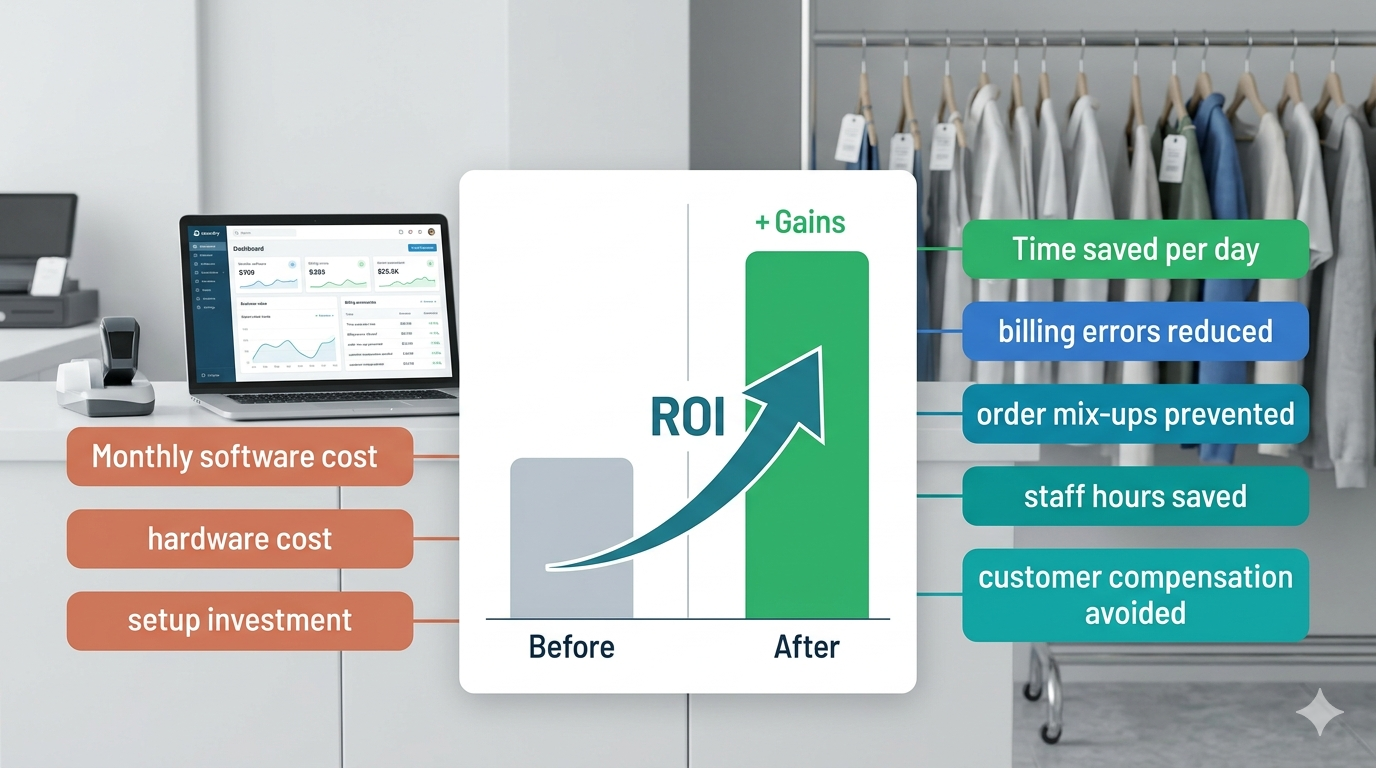
Most businesses recover implementation costs within 3-4 months from efficiency gains alone. Long-term benefits come from scalability—you can double your order volume without doubling staff because the system handles the organizational load.
How Modern Laundry POS Software Solves Core Problems
Good laundry management software tackles the specific pain points of this industry.
Order mix-ups become nearly impossible when every item is tagged with a unique order ID and customer details appear on every screen. Even if clothes physically get mixed, the digital trail helps you reunite items with owners.
Billing disputes drop dramatically. When customers can see itemized bills with clear service descriptions and pricing, arguments about "you charged wrong" decrease. GST calculations happen automatically, eliminating manual tax computation errors.
Customer communication becomes effortless. Instead of calling customers when orders are ready, the system sends automated SMS or WhatsApp notifications. Customers can also check status themselves through a customer app or web portal, reducing incoming calls by 40-60%.
Delivery management transforms from chaotic to systematic. Systems can generate optimal delivery routes, track delivery staff location in real-time, and maintain proof-of-delivery records. This matters especially if you're handling 20+ deliveries daily across different areas.
Multi-branch operations become manageable. If you expand to a second or third location, cloud-based systems let you monitor all branches from anywhere. Customer who drops off at Branch A can pick up from Branch B without issues.
How to Manage Laundry Orders Digitally in 2026: A Complete Guide
The shift isn't just about technology—it's about treating your laundry business with the same operational rigor that larger businesses use.
Ezer Laundry POS System
Streamline your laundry business with our comprehensive POS system. Features include smart billing, garment tracking, WhatsApp notifications, and cloud backup.
Integration with Other Business Tools
Digital order management works best when connected to other systems you might use.
Payment integration with UPI, card machines, and digital wallets means faster checkout. Customer pays digitally, payment status automatically updates in the order record, and reconciliation happens automatically instead of manually matching receipts at day-end.
Accounting software integration eliminates double entry. Sales data from your laundry system flows automatically into Tally or QuickBooks, saving hours of monthly accounting work.
SMS gateways enable automated customer communication. Order confirmation, ready-for-pickup notifications, payment reminders—all sent automatically without staff intervention.
Some businesses integrate with Google Maps API for delivery route optimization or with WhatsApp Business API for richer customer communication. These aren't essential for everyone, but they're powerful if you're handling significant delivery volume.
Mobile Access and Remote Management
Being able to manage your laundry business from anywhere isn't just convenient—it's becoming necessary.
Cloud-based systems let you check business performance from your phone while you're away. How many orders came in today? Did yesterday's deliveries complete? Which customers have pending payments? You get real-time answers without calling your shop.
This matters during expansion or when managing multiple shifts. You can monitor evening shift performance even if you're physically present only during morning hours.
Staff can also benefit from mobile access. Delivery personnel update order status from customer locations. Processing staff check order details from their phones instead of walking to the counter computer repeatedly.
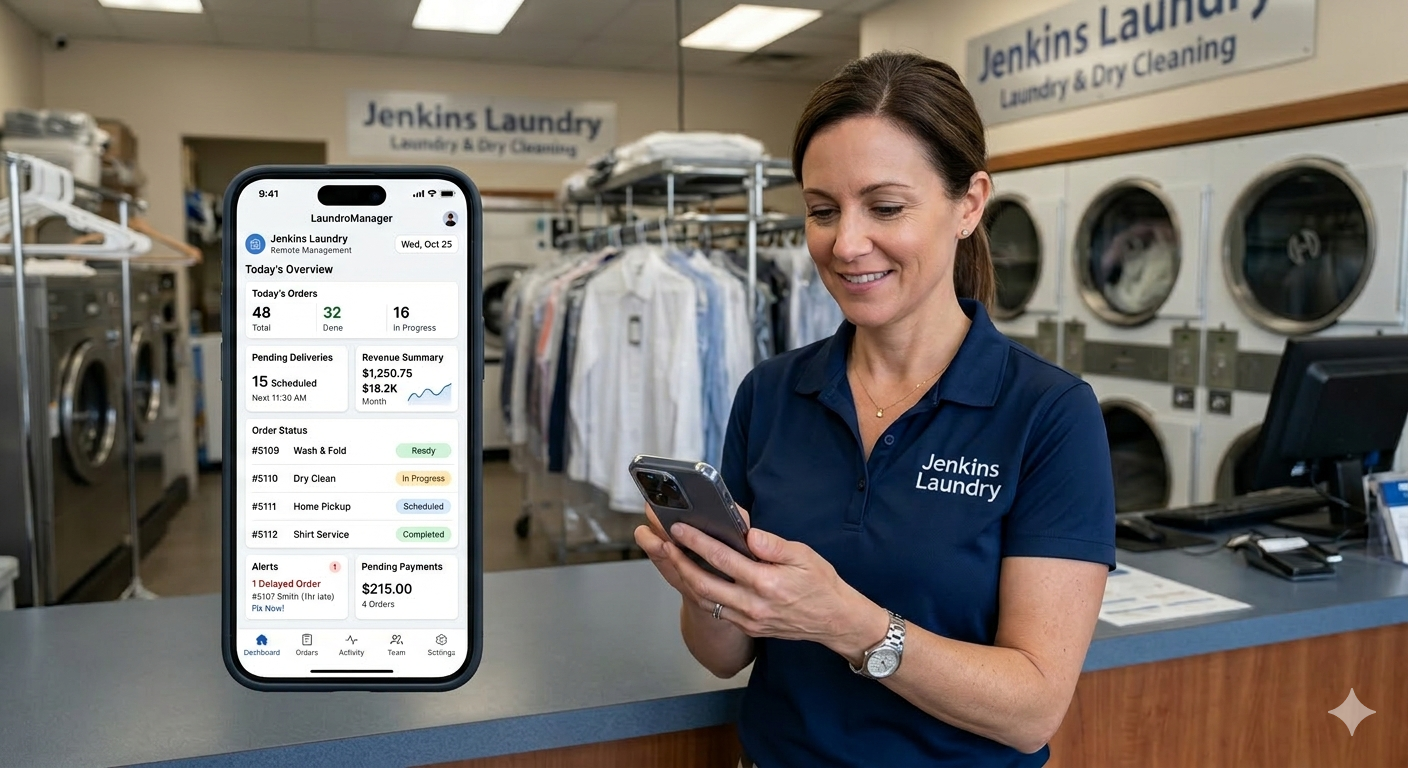
Remote management also means faster problem resolution. Customer calls you directly with a complaint about a missing item? You can check the order details, see which staff handled it, and resolve the issue immediately instead of waiting until you reach the shop.
Security and Data Backup
One concern many owners have: what if the system crashes or data gets lost?
Good cloud systems automatically backup data multiple times daily to secure servers. Even if your shop computer dies, your data is safe. You can log in from any device and continue operations.
This is actually more secure than paper registers that can burn, get water-damaged, or simply get lost. I know a shop owner who lost three years of customer data when their register got destroyed in a minor fire.
Access controls let you set user permissions. The billing staff sees only billing and customer management. The owner sees everything including financial reports. Delivery staff access only their assigned orders. This prevents unauthorized access to sensitive business data.
For payment data, reputable systems comply with security standards. Credit card details aren't stored in plain text. Customer information is encrypted. This matters not just for security but also for customer trust.
Preparing Your Team for Digital Transition
Staff resistance is the biggest implementation barrier, bigger than technical challenges or costs.
Some employees worry that digital systems will make them redundant. Address this directly: explain that the system eliminates boring repetitive work (searching registers, manual calculations) so they can focus on customer service and growing the business.
Involve senior staff in the selection process. Let them test different systems and provide input. People support what they help create.
Training should be hands-on and gradual. Don't dump a 50-page manual on staff. Train them on one function at a time: first order creation, then status updates, then delivery management. Use real scenarios during training, not theoretical examples.
Keep the old system running in read-only mode for the first month. If staff need to check historical data, they can refer to the old register without being forced to use it for new orders.
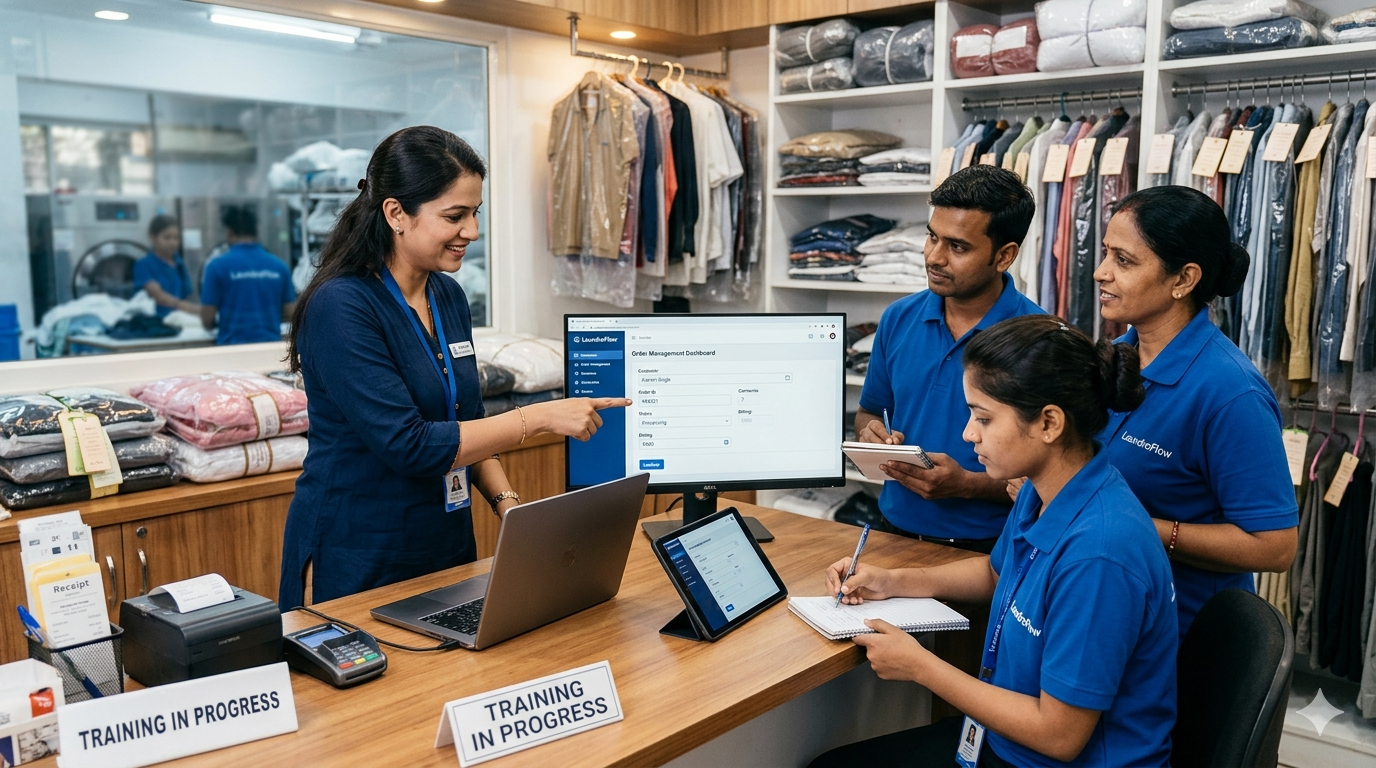
Celebrate small wins. When the system helps resolve a customer query faster or catches a potential billing error, acknowledge it publicly. This builds positive association.
Measuring Success After Implementation
How do you know if digital order management is actually working?
Track these metrics before and after implementation:
Order processing time: How long from customer drop-off to order entry completion? Should decrease by 30-50%.
Customer inquiry calls: How many calls asking "is my order ready?" Should drop significantly once customers can check status themselves.
Billing errors: How many disputes about incorrect charges? Should reduce noticeably.
Delivery completion rate: What percentage of scheduled deliveries complete on-time? Should improve with route optimization.
Staff overtime: Are employees staying late to update registers or complete reconciliation? This should decrease.
Also monitor customer feedback. You might notice improved ratings on Google Reviews or increased repeat customer percentages. These are harder to quantify but equally valuable.
Future-Proofing Your Laundry Business
Digital order management isn't just about solving today's problems—it's about being ready for tomorrow's opportunities.
Customer expectations keep rising. In 2026, customers expect real-time tracking, digital payments, and app-based services across all industries. Laundries that can't meet these expectations will gradually lose customers to those who can.
Business expansion becomes possible when your operations are systematized. You can't open a second branch if your first branch runs on your memory and manual supervision. Digital systems let you scale because operations continue smoothly even when you're not physically present.
Data becomes an asset. Years of customer data, order patterns, and service preferences help you make smarter decisions. Which services are most profitable? Which customer segments are growing? What promotions actually work? You can answer these questions with data instead of guesswork.
New revenue opportunities emerge. Subscription laundry services, corporate contracts, app-based ordering—all require digital infrastructure. You're leaving money on the table if you can't support these models.
How to Start Your Laundry Business in 2026: Complete Guide
FAQs
Can small laundry shops with 10-15 daily orders benefit from digital management?
Yes, even small shops benefit from digital order management. The primary advantages are error reduction and customer convenience rather than just speed. You'll eliminate order mix-ups, provide better customer service through SMS updates, and build a customer database that helps with marketing. Many affordable systems start around ₹2,000-3,000 monthly, which is reasonable for most shops processing even 10-15 orders daily.
How long does it take to train staff on a digital order management system?
Most staff become comfortable with basic operations within 3-5 days of hands-on training. Complete proficiency, including handling exceptions and generating reports, typically takes 2-3 weeks. The key is structured training focusing on one feature at a time rather than overwhelming staff with everything at once. Younger staff usually adapt within days, while senior employees might need more patient training.
What happens if internet connection fails? Will I lose access to my data?
Quality cloud-based systems offer offline mode that lets you continue creating orders and processing transactions without internet. Data syncs automatically when connection restores. Your data isn't lost because it's backed up on secure cloud servers. However, features requiring real-time connectivity (like sending SMS notifications or customer app access) won't work during offline periods.
Is customer data safe in cloud-based laundry management systems?
Reputable systems use bank-grade encryption and regular automated backups, making cloud storage more secure than paper registers or local computers. Your data is stored in certified data centers with redundant systems. However, choose established vendors with good security track records. Check if they comply with data protection standards and offer user access controls so only authorized staff can view sensitive information.
Can digital systems handle complex pricing like corporate contracts or membership discounts?
Most modern Laundry POS Software platforms support flexible pricing structures including volume-based discounts, customer-specific rates, membership tiers, and corporate contract pricing. You can set these up once in the system, and appropriate rates apply automatically when processing orders. This is actually more reliable than manual calculation where staff might forget to apply discounts or apply wrong rates.
How do I migrate existing customer data from registers to a digital system?
Most vendors offer data migration support during implementation. You'll need to compile customer information (names, phone numbers, addresses) in a spreadsheet format, which the vendor imports into the system. This is also a good opportunity to clean duplicate entries and update outdated information. For small shops, gradual migration works too—add existing customers to the system as they come in for service over the first month.
Will digital order management work for both walk-in and pickup-delivery models?
Yes, comprehensive systems handle both models within the same platform. You can mark orders as walk-in or delivery during creation, manage delivery routes separately, track delivery status, and maintain different pricing for delivery services. The system accommodates mixed operations where some customers drop off and pick up themselves while others use delivery services.
Conclusion
Managing laundry orders digitally isn't optional anymore—it's table stakes for running a competitive laundry business in 2026. The transition requires upfront investment in software and training, but the payoff comes quickly through time savings, error reduction, and improved customer experience.
Start by evaluating your current pain points. Are you losing customers due to order mix-ups? Spending too much time on manual record-keeping? Unable to provide delivery status updates? Choose a system that solves your specific problems rather than one with the most features.
If you're ready to transform your laundry operations with modern order management technology, explore how the right Laundry POS Software can streamline your business. Book a free demo to see how digital management works for businesses like yours.