
WhatsApp & SMS Automation for Laundry Business: Complete Guide 2026
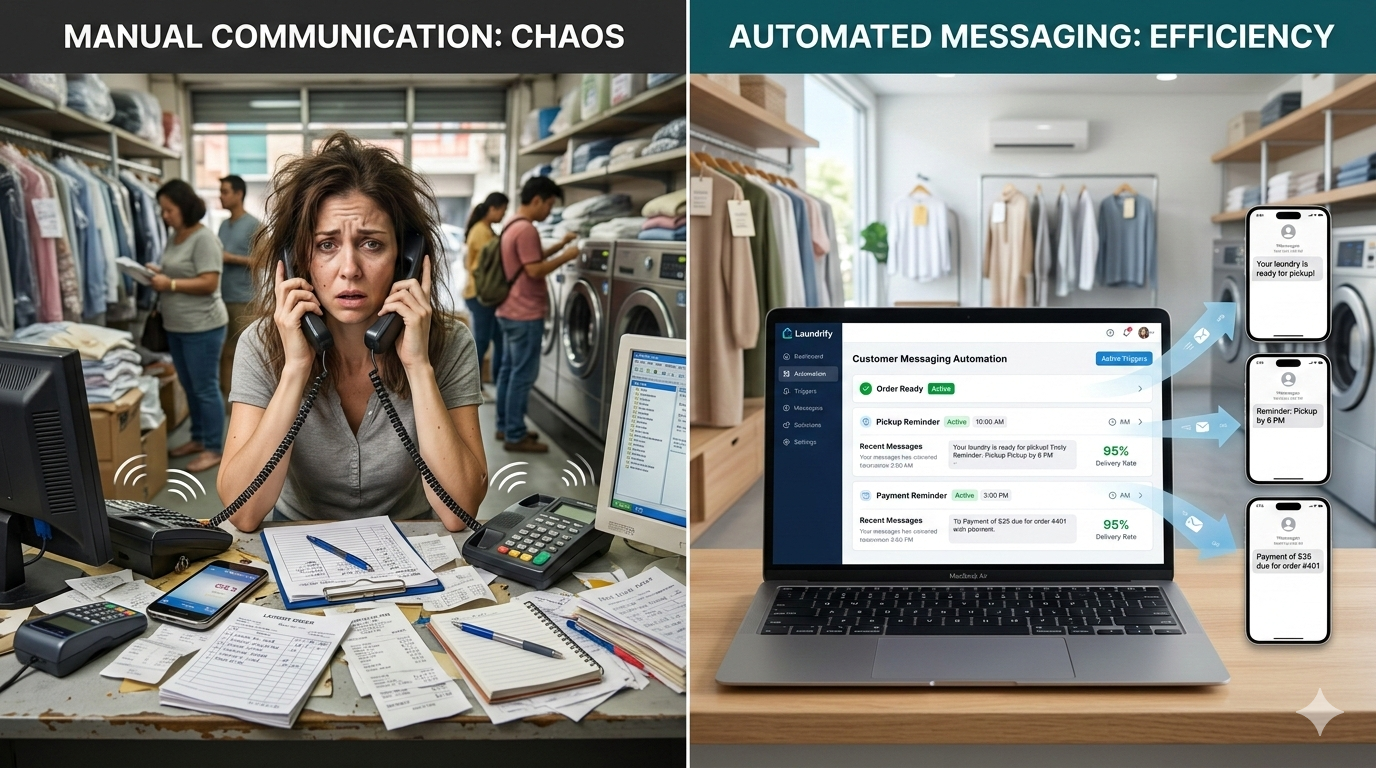
Running a laundry shop means juggling dozens of calls daily. "When will my order be ready?" "Did you pick up my clothes?" "What's the bill amount?" Sound familiar?
Most laundry owners spend 2-3 hours every day just answering these repetitive questions. Meanwhile, customers get frustrated waiting on hold, and your staff can't focus on actual work.
This guide shows you how WhatsApp and SMS automation can solve these problems without hiring more people or buying expensive equipment.
Why Laundry Businesses Need Communication Automation
Customer communication is where most laundry shops lose money. Not because they want to, but because manual processes don't scale.
Think about this: A single delivery boy handles 15-20 orders daily. Each customer calls at least twice—once to confirm pickup, once to check status. That's 40 calls your team needs to handle. Add walk-in customers, and your phone never stops ringing.
The real cost isn't just time. Missed calls mean lost orders. Delayed updates mean angry customers. Manual follow-ups mean forgotten payments.
Automation fixes this by sending updates automatically. When an order is ready, your customer gets a message. When payment is pending, they get a reminder. No phone calls. No staff dependency. No missed communication.
How WhatsApp Automation Works for Laundry Shops
WhatsApp has 550+ million users in India. Your customers already check it 50+ times daily. Why force them to call you instead?
Here's what automated WhatsApp messages can do:
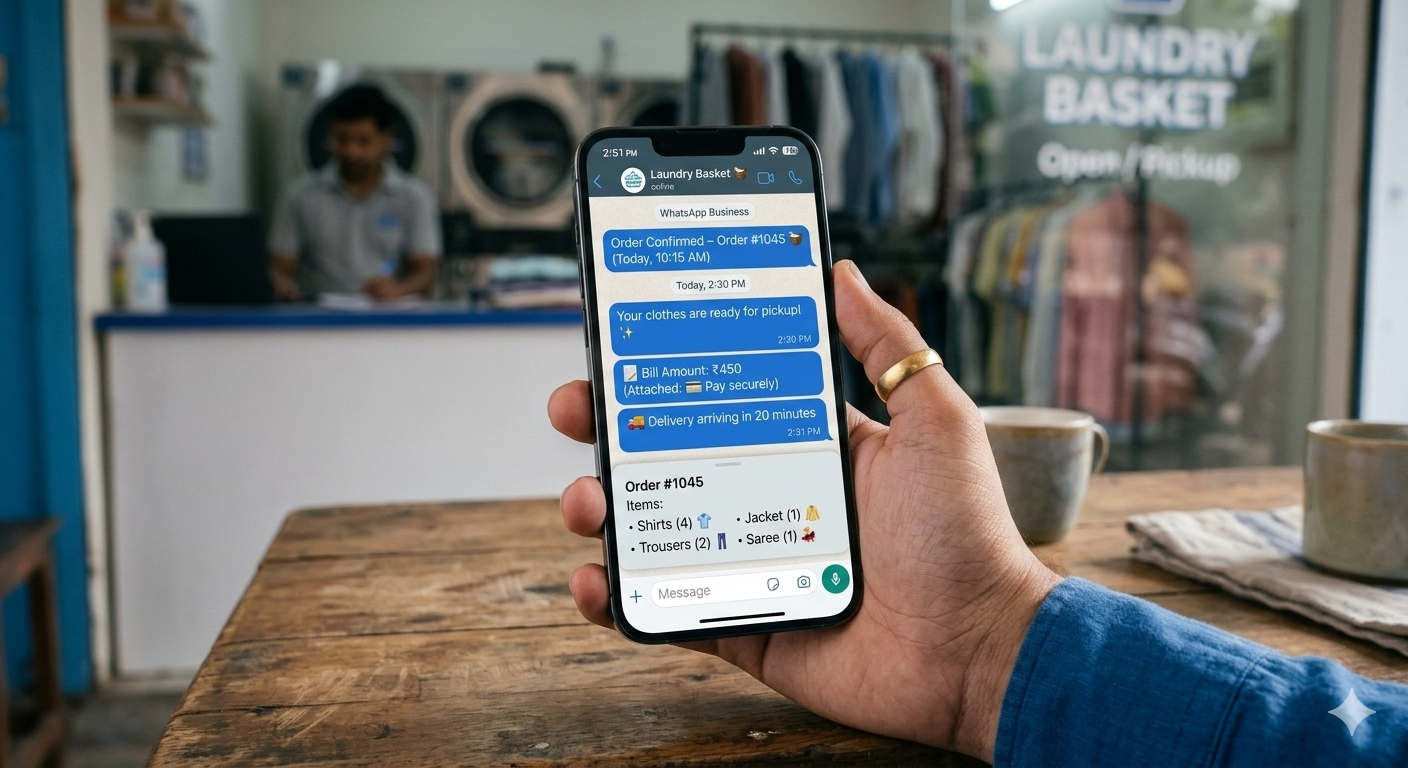
Order confirmation: Customer drops clothes → Instant WhatsApp with order ID, items list, and expected delivery date.
Pickup reminders: Scheduled message 30 minutes before pickup. Reduces "I forgot" cancellations by 60-70%.
Ready notifications: Clothes cleaned → Customer gets "Your order is ready for pickup" with bill details.
Payment reminders: For customers with pending dues. Polite, automated, effective.
Delivery updates: Real-time tracking when delivery boy is on the way.
The difference between this and regular SMS? People actually read WhatsApp messages. Open rates are typically 70-90% compared to 20-30% for SMS.
Plus, WhatsApp allows richer content. You can send itemized bills, photos of stained garments for approval, or even location links for pickup addresses.
SMS Automation: When to Use It Over WhatsApp
WhatsApp is powerful, but SMS still matters. Especially for certain customer segments.
Older customers (50+) often don't use WhatsApp actively. Rural customers may have basic phones. Corporate clients prefer SMS for record-keeping. These groups respond better to traditional text messages.
SMS works best for:
- One-time passwords and verification codes
- Critical alerts (payment failures, missed pickups)
- Customers who specifically request SMS
- Backup when WhatsApp delivery fails
Cost is another factor. WhatsApp Business API can charge ₹0.25-1 per message depending on category. SMS typically costs ₹0.15-0.30 per message through bulk providers.
Smart laundry POS software for automation sends WhatsApp first, then falls back to SMS if undelivered. This ensures 95%+ message delivery without wasting money.
Setting Up SMS Templates That Convert
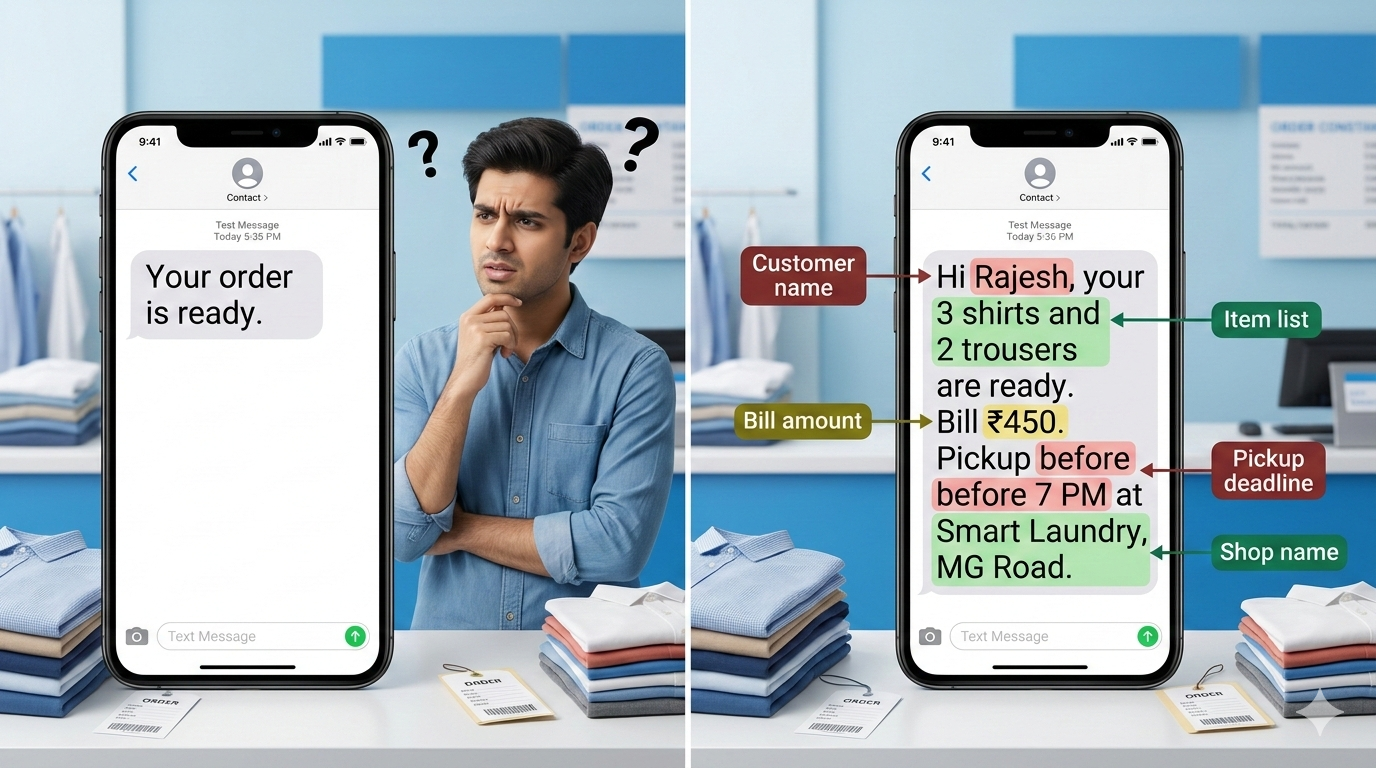
Generic messages get ignored. "Your order is ready" tells customers nothing useful.
Better template: "Hi [Name], your 3 shirts + 2 trousers are ready. Bill: ₹450. Pickup by 7 PM today from [Shop Name], [Address]. Call [Number] for home delivery."
Include: Customer name, specific items, exact amount, deadline, and action option. This reduces follow-up calls by half.
Also maintain separate templates for different order statuses. Don't send the same message format for confirmations, delays, and completions. Customers notice lazy automation.
Choosing the Right Automation Platform
You have three options: standalone tools, WhatsApp Business API integrations, or laundry POS software for automation.
Standalone tools (like Gupshup, Twilio, TextLocal) give you messaging capabilities but require manual work. You still need to update order status, track customers, and trigger messages yourself. Works if you have technical knowledge and minimal order volume.
WhatsApp Business API requires approval from Meta. Monthly costs start at ₹3,000-5,000 for 1,000 conversations. You'll need a developer to integrate it with your operations. Setup takes 2-4 weeks.
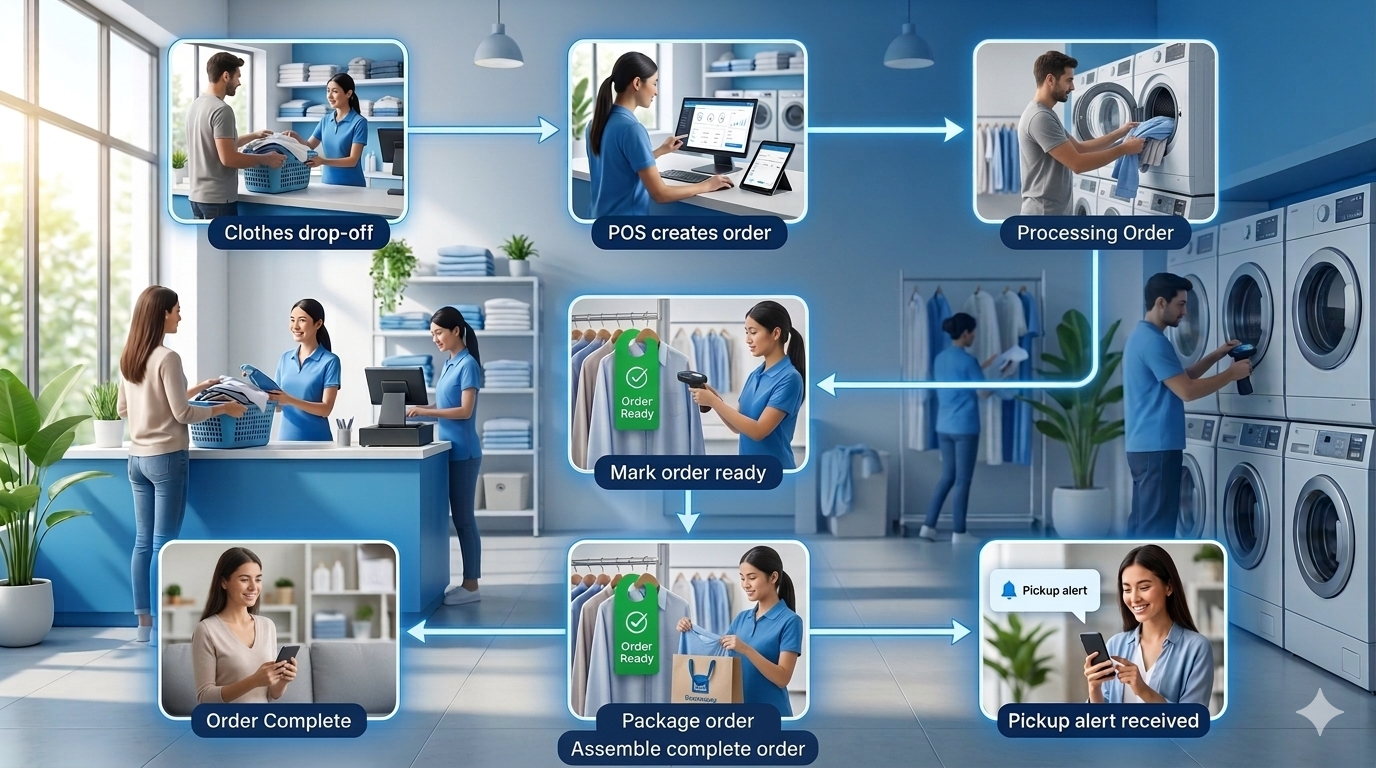
Integrated Laundry POS is where automation makes business sense. Your billing software already knows when orders are placed, cleaned, and delivered. It triggers messages automatically based on actual order status.
For example: You mark an order as "Ready" in your POS → Customer instantly gets WhatsApp notification. No extra work. No separate platform. Everything syncs.
This integration eliminates human error. When staff updates status, communication happens automatically. No forgetting to send messages. No sending wrong information.
Real Implementation: Step-by-Step Setup
Let's walk through actual implementation, assuming you're using a cloud-based laundry management system.
Week 1: Database cleanup Export your customer list. Remove duplicates. Verify phone numbers (correct 10-digit format). Tag customers who prefer SMS vs WhatsApp. This foundation determines your success rate.
Week 2: Template creation Write 8-10 message templates covering your entire workflow. Get them approved (WhatsApp requires template approval). Keep language simple and benefit-focused.
Week 3: Integration and testing Connect your automation platform with POS. Test with 10-20 actual orders. Check if messages trigger correctly. Verify timing, formatting, and personalization.
Week 4: Soft launch Enable automation for 50% of customers. Monitor response. Track if customers still call as frequently. Adjust templates based on feedback.
Week 5+: Full rollout Switch on for all customers. Train staff to update order status accurately since it now triggers communication.
Common mistake: Going live without testing. One shop sent 500 customers the same message at 2 AM because they didn't configure time restrictions. Always test thoroughly.
Cost Breakdown: What You'll Actually Spend
Let's talk real numbers for a shop processing 100 orders daily.
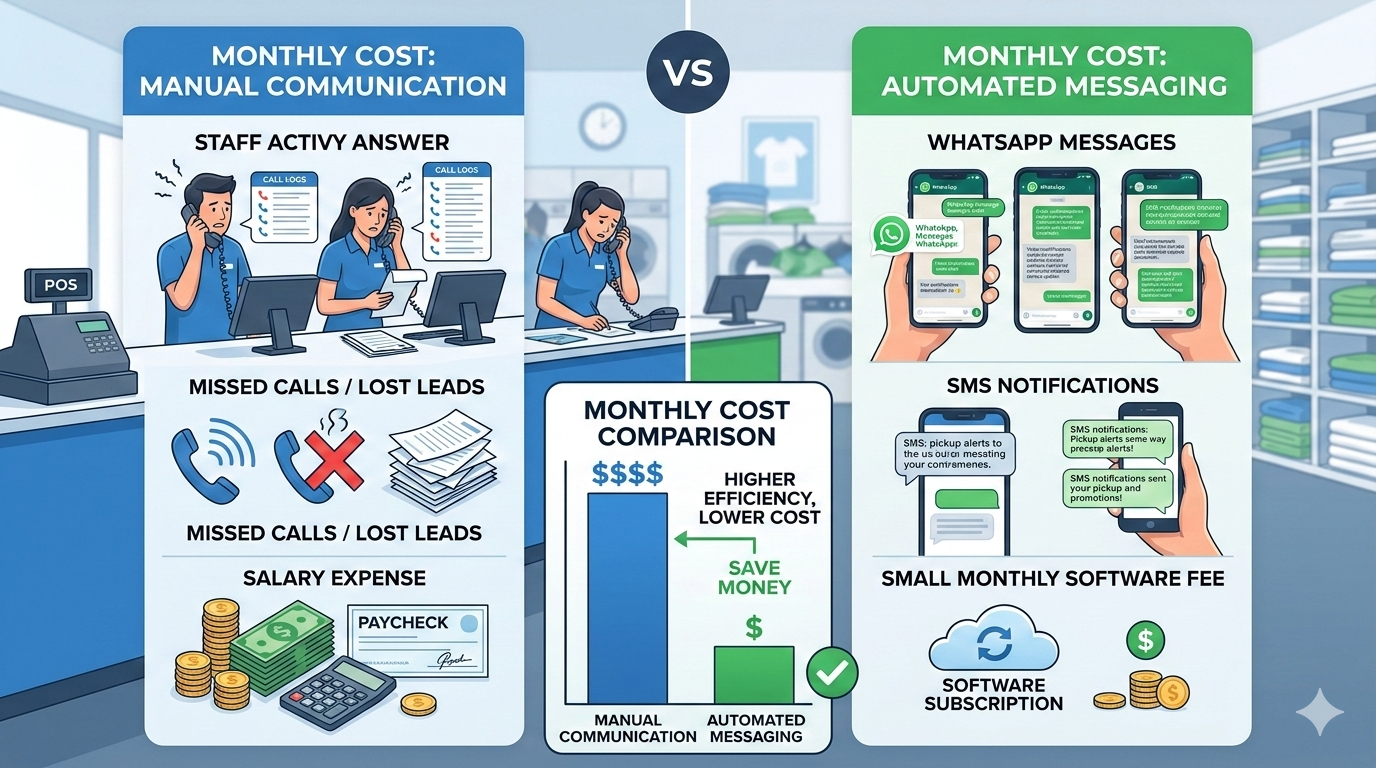
Message costs: 100 orders × 3 messages each (confirmation, ready, reminder) = 300 messages/day. At ₹0.50 per WhatsApp message = ₹150/day = ₹4,500/month.
Platform fees: Integrated laundry POS software for automation typically includes messaging in subscription. Standalone platforms charge ₹2,000-10,000/month depending on volume.
Setup costs: One-time. If using external developer for API integration, expect ₹15,000-30,000. If using integrated POS, usually included.
Maintenance: Minimal. Maybe ₹500-1,000/month for template updates or troubleshooting.
Total monthly cost for most laundry shops: ₹5,000-8,000.
Compare this to hiring one person just to handle customer calls: ₹12,000-15,000/month plus compliance costs.
The ROI usually shows up in 2-3 months through reduced staff workload, fewer missed orders, and better customer retention.
Measuring Success: Metrics That Matter
Don't just automate and forget. Track actual business impact.
Message delivery rate: Should be 90%+. If lower, your customer database needs cleaning.
Phone call reduction: Most shops see 40-60% fewer incoming calls within the first month. If you're not seeing this, your templates might lack necessary information.
Pickup compliance: Percentage of customers who collect orders on time. Good automation increases this by 25-30%.
Repeat customer rate: Customers who receive timely updates tend to return more frequently. Track month-over-month changes.
Revenue per customer: When customers get reminded about additional services (dry cleaning, shoe repair), average ticket size usually increases 10-15%.
One Bangalore shop owner tracked that automated payment reminders recovered ₹45,000 in pending dues in just two months. That alone paid for their software subscription for a year.
Common Mistakes to Avoid
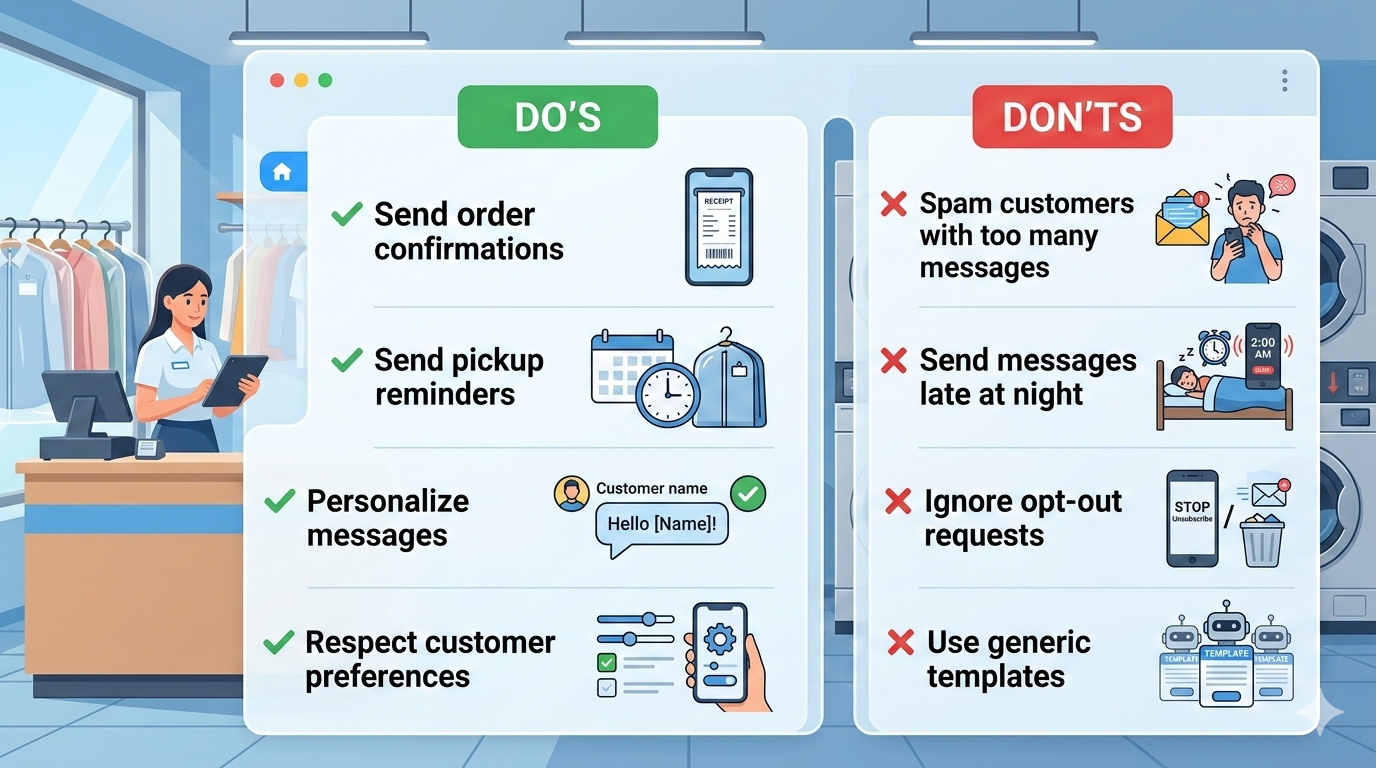
Sending too many messages: Some shops blast 5-6 messages per order thinking more communication is better. It's annoying. Stick to 2-3 essential updates.
Ignoring opt-outs: If a customer asks to stop automated messages, respect it immediately. WhatsApp penalizes businesses that ignore user preferences.
Generic messaging: Using the same template for express service and regular orders confuses customers. Segment your communication.
Poor timing: Sending messages at 6 AM or 10 PM irritates people. Configure sending windows (9 AM to 8 PM works for most businesses).
Not updating templates: Your business evolves. Prices change. Services expand. Update templates quarterly or they'll start sending wrong information.
Zero human backup: Automation handles routine updates, but complex queries still need human response. Don't completely eliminate the option to talk to a real person.
How Modern Laundry POS Software Enables Automation
Here's where technology becomes your business advantage.
Traditional billing software just generates invoices. Modern cloud-based laundry POS systems are built differently. They treat communication as part of operations, not an afterthought.
When you create an order, the system captures customer name, phone, items, and delivery date. It automatically:
- Sends order confirmation via WhatsApp
- Schedules reminder for pickup date
- Triggers "ready" notification when you mark order complete
- Sends payment receipt after billing
- Follows up on pending payments
Everything happens in the background. Your staff focuses on washing clothes, not managing messages.
Better systems also track customer preferences. If someone always gets express service on Fridays, the software can send proactive offers. If a customer hasn't visited in 30 days, automated "we miss you" messages with a small discount can bring them back.
The key advantage: All data lives in one place. You're not manually copying order details from one system to send messages through another. This eliminates errors and saves time.
Multi-branch businesses get even more value. Centralized systems can send location-specific messages, track performance across outlets, and maintain consistent communication standards.
How to Start Your Laundry Business in 2026: Complete Guide
Ezer Laundry POS System
Streamline your laundry business with our comprehensive POS system. Features include smart billing, garment tracking, WhatsApp notifications, and cloud backup.
Privacy and Compliance Considerations
Automation requires storing customer phone numbers. You need to handle this responsibly.
Under India's Digital Personal Data Protection Act, you must:
- Get explicit consent before sending promotional messages
- Clearly explain what messages customers will receive
- Provide easy opt-out options
- Secure customer data properly
- Only use data for stated purposes
Transactional vs. promotional: Order updates are transactional (allowed without explicit opt-in). Discount offers are promotional (need consent). Don't mix them up.
Data security: Choose platforms with encryption and secure storage. If there's a data breach, your business reputation suffers.
DND compliance: Even with consent, respect Do Not Disturb registrations for promotional content.
Smart practice: During order creation, add a simple checkbox: "Send me order updates via WhatsApp/SMS." Most customers happily agree because they want updates. This covers your compliance requirement.
Future of Customer Communication in Laundry Business
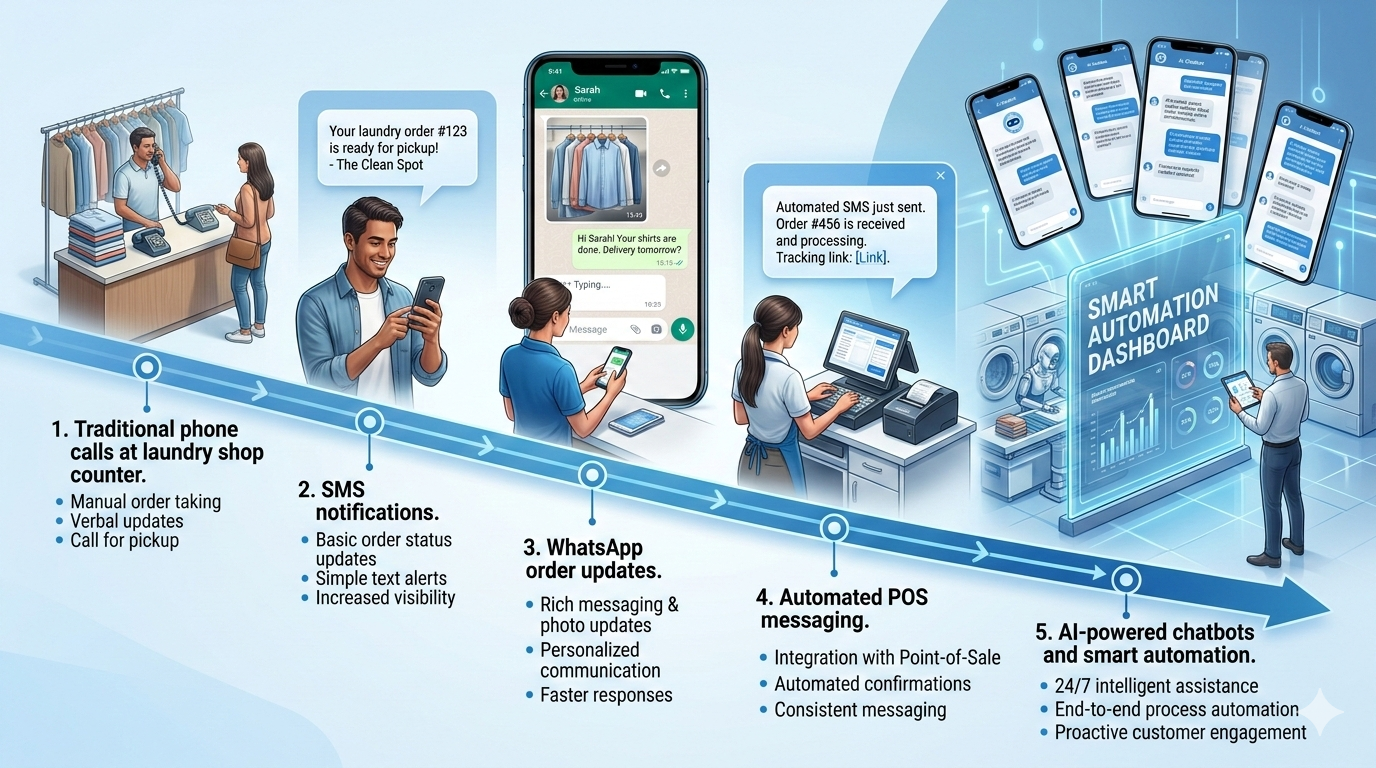
The direction is clear: customers expect real-time updates without needing to ask.
AI-powered chatbots are already handling basic queries in some premium laundry chains. "What time do you close?" "What are your dry cleaning rates?" These don't need human response.
Image recognition is coming. Customers might soon photograph stained clothes, and AI suggests the right treatment before they even visit your shop.
Voice messaging integration will grow. Some customers prefer sending voice notes over typing. Systems that handle both text and voice inputs will have an edge.
But here's what won't change: The need for reliable, timely, accurate communication. Automation simply makes it scalable.
Small shops that adopt these tools now will have significant advantages over competitors still relying on phone calls and manual follow-ups. Early movers build better customer relationships and operational efficiency that compounds over time.
FAQs
Can I use WhatsApp automation without getting banned?
Yes, if you follow WhatsApp Business API guidelines. Never use unauthorized third-party tools or personal WhatsApp for bulk messaging. Always use approved business API or integrated laundry POS software that has proper WhatsApp partnerships. Get message templates approved, respect opt-outs, and avoid spamming. Legitimate business communication for order updates is fully permitted.
How much technical knowledge do I need to set this up?
If you're using integrated laundry POS software for automation, almost none. The setup typically involves connecting your WhatsApp Business account (which customer support handles) and configuring message templates. Most modern systems offer guided setup. Standalone API integrations require developer help, but all-in-one laundry management platforms make it plug-and-play.
Will customers find automated messages impersonal?
Not if done right. Customers want information, not chitchat. A timely "Your order is ready" message is more valuable than a friendly phone conversation that happens three hours late. Personalize messages with customer names and specific order details. Reserve human interaction for complex queries and complaints. Most customers actually prefer automated updates over waiting on hold.
What happens if the system sends wrong information?
This depends on your workflow accuracy. Automated messages reflect what's in your system. If staff marks an order "ready" by mistake, the customer gets a wrong notification. Solution: Train your team properly and use confirmation prompts in the software before status changes. Quality systems also have message logs so you can track what was sent and fix issues quickly.
Can I customize messages for different customer types?
Absolutely. Good laundry POS software lets you create customer segments—regular vs. premium, retail vs. corporate, local vs. delivery. Each segment can have different message templates, timing, and even language preferences. Some shops send Hindi messages to certain customers and English to others, all automated based on customer profile.
Is automation worth it for small laundry shops with 20-30 orders daily?
Yes, because your business will grow. Starting automation early builds good operational habits. Even at 20 orders daily, that's 60+ messages you won't have to send manually. It frees up time for customer service and business development. Plus, early adopters gain reputation for being professional and reliable, which attracts more customers faster.
How quickly will I see return on investment?
Most shops recover costs within 2-4 months. Immediate benefits include reduced phone time and fewer missed orders. Medium-term gains come from better customer retention (automated follow-ups keep you top-of-mind) and reduced no-shows (pickup reminders work). Long-term value is in scalability—you can grow order volume without proportionally increasing staff. Track your phone call volume, customer complaints about communication, and repeat rates to measure impact.
Conclusion
WhatsApp and SMS automation isn't about replacing human touch. It's about eliminating repetitive communication so you can focus on actually running your laundry business.
The shops that implement this well see fewer missed calls, happier customers, and teams that can focus on service quality instead of answering "when will my order be ready" fifty times a day.
Start simple. Pick a reliable laundry POS software for automation that includes messaging features. Set up 3-4 basic templates. Test with a small customer group. Expand gradually.
Your customers will appreciate the professionalism. Your staff will appreciate the reduced workload. And you'll appreciate the business growth that comes from better operations.
Ready to automate your customer communication? Explore modern laundry management systems that include built-in WhatsApp and SMS automation, or book a demo to see how it works for businesses like yours.