
How Laundry Software Improves Profit and Efficiency in 2026
Running a laundry or dry-cleaning business in India isn't as simple as it looks. You're juggling customer orders, managing staff, tracking deliveries, and trying to keep everything organized with paper registers or Excel sheets. Most shop owners I've spoken with lose 2-3 hours daily just managing records. That's time you could spend growing your business. This guide shows you exactly how modern laundry software solves these problems and improves both profit margins and operational efficiency.
Why Traditional Laundry Management Methods Cost You Money
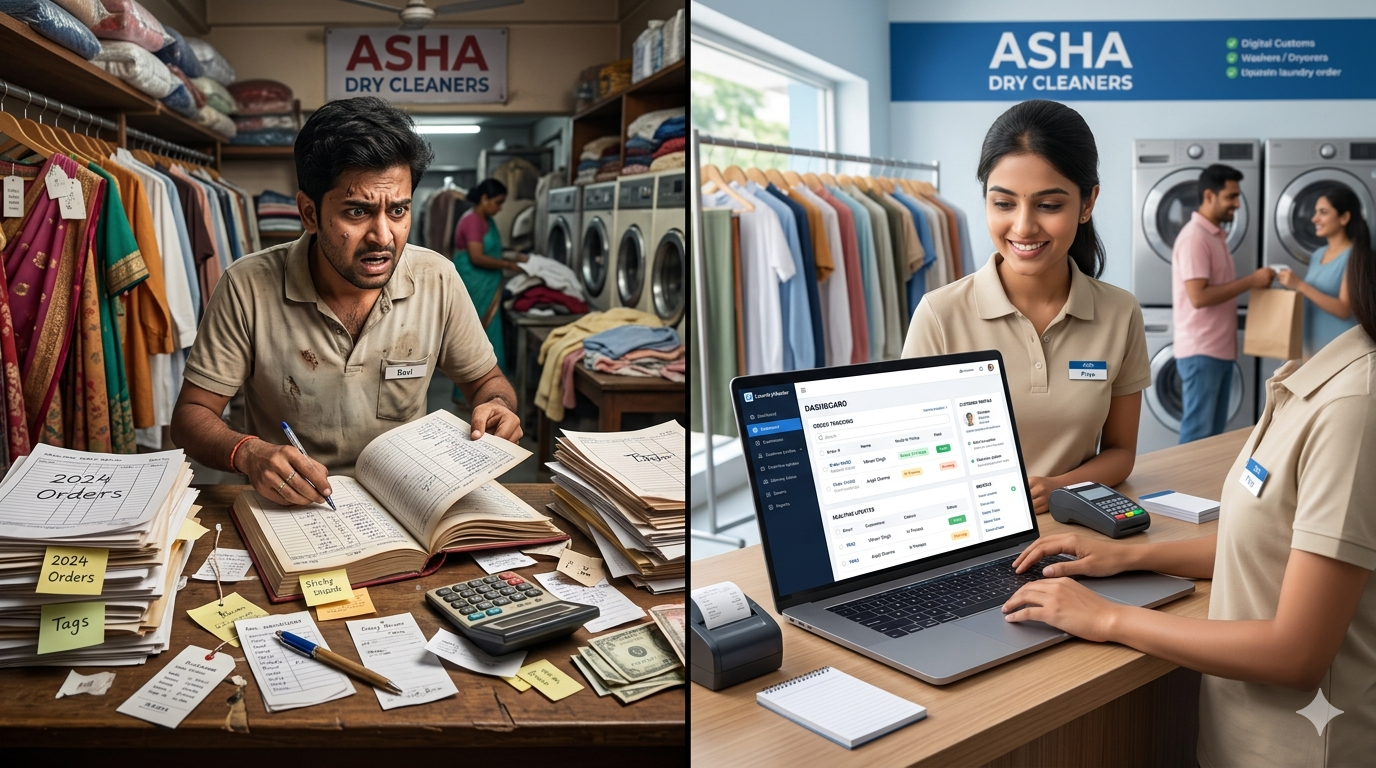
Walk into most laundry shops, and you'll find the same setup: handwritten registers, sticky notes for delivery addresses, and a calculator for billing. It works until it doesn't.
Here's what actually happens. A customer calls asking about their order. Your staff spends 5 minutes flipping through pages. Another customer walks in, gets frustrated waiting, and leaves. You've just lost a sale. By evening, you realize three delivery addresses are illegible. Your delivery person makes two extra trips. That's fuel cost, time wasted, and delayed orders.
I've seen shop owners in Meerut and Delhi struggle with the same issues. One owner told me he couldn't scale to a second location because he had no way to track inventory and orders across branches. Another mentioned losing nearly ₹15,000 monthly due to billing errors alone.
The problem isn't your work ethic. It's the system.
Real Problems That Eat Into Your Profit Margins
Let's talk numbers. Most laundry businesses operate on thin margins, typically 15-25%. Every inefficiency directly impacts your bottom line.
Staff dependency is the first killer. If your billing person takes a day off, operations slow down. New employees need weeks to understand your handwritten codes and pricing. I've watched businesses turn away customers simply because the owner wasn't available to handle complex orders.
Customer retention suffers when you can't remember preferences. Mrs. Sharma always wants extra starch on shirts. Mr. Verma needs express delivery on Saturdays. Without a system to track these details, you're treating every customer the same. That's how you lose loyal clients to competitors.
Billing errors compound over time. Undercharge someone, you lose money. Overcharge, you lose trust. Even a 2% error rate on 100 daily orders means 60 mistakes monthly. Each one requires time to fix, if customers even bother complaining.
Then there's the cash flow confusion. You don't know which services are actually profitable. Are wash-and-iron orders making money or just keeping you busy? Without data, you're guessing.
How Laundry Software Actually Works (Simple Explanation)
Think of laundry software as your digital assistant that never forgets, never makes calculation errors, and works 24/7.
When a customer drops off clothes, you create an order in seconds. The system automatically calculates pricing based on items and services. It generates a bill with GST breakdown, stores customer details, and sets delivery reminders.
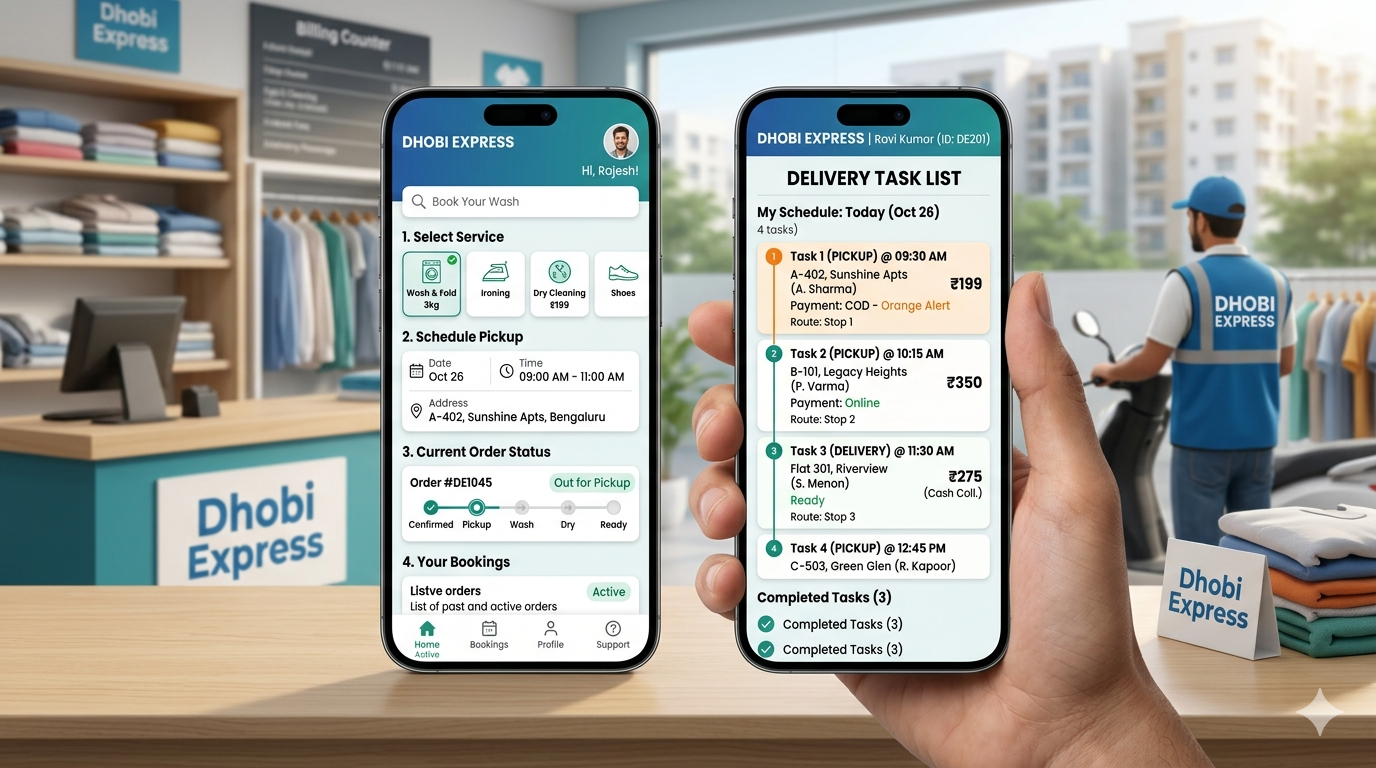
For pickups and deliveries, your staff uses a mobile app. They scan order IDs, update status in real-time, and customers receive notifications automatically. No phone calls needed.
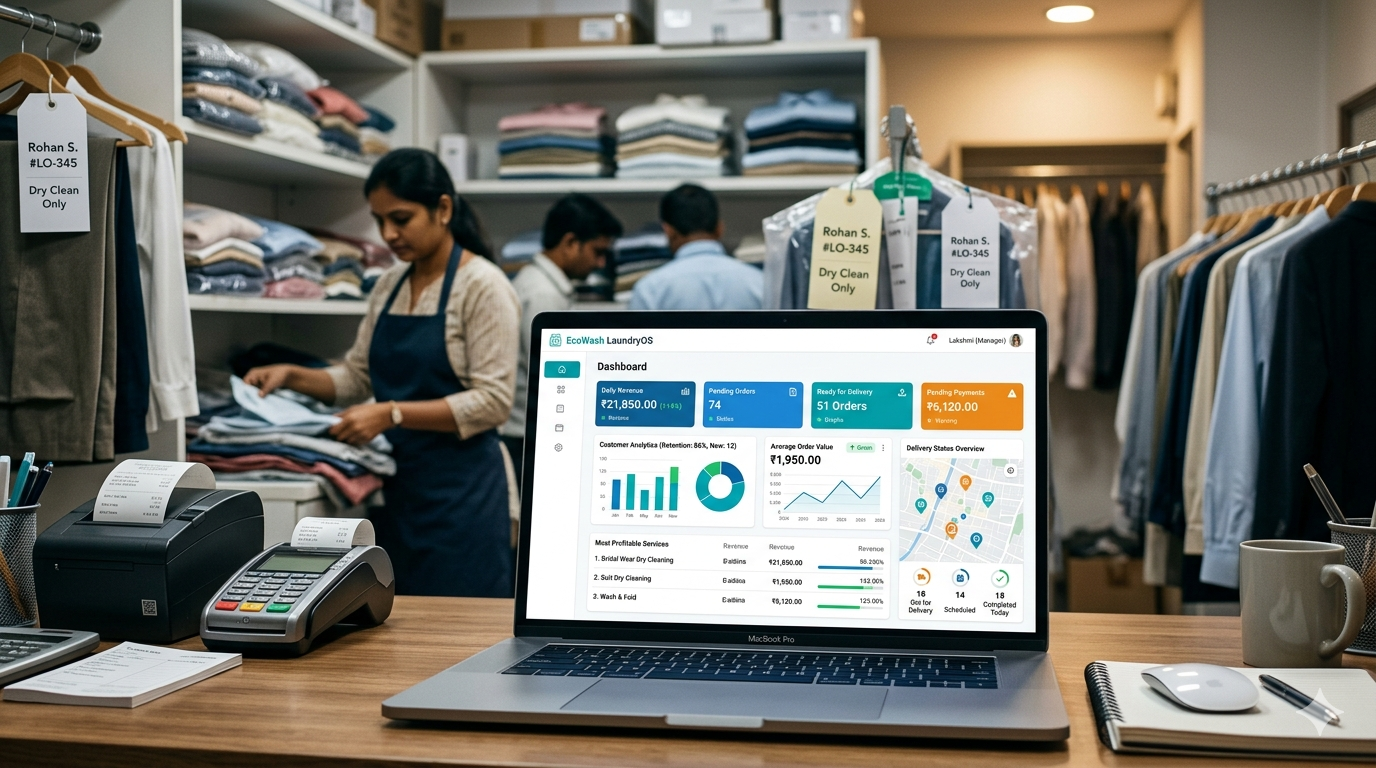
The backend tracks everything: which items are pending, which customer orders are ready, what revenue you generated today, and which services are most profitable. All accessible from your phone or computer.
Modern systems run on the cloud, which simply means your data is stored securely online. You can check business performance from home. If you open a second branch, both locations share the same customer database.
Ezer Laundry POS System
Streamline your laundry business with our comprehensive POS system. Features include smart billing, garment tracking, WhatsApp notifications, and cloud backup.
Specific Ways Software Increases Efficiency
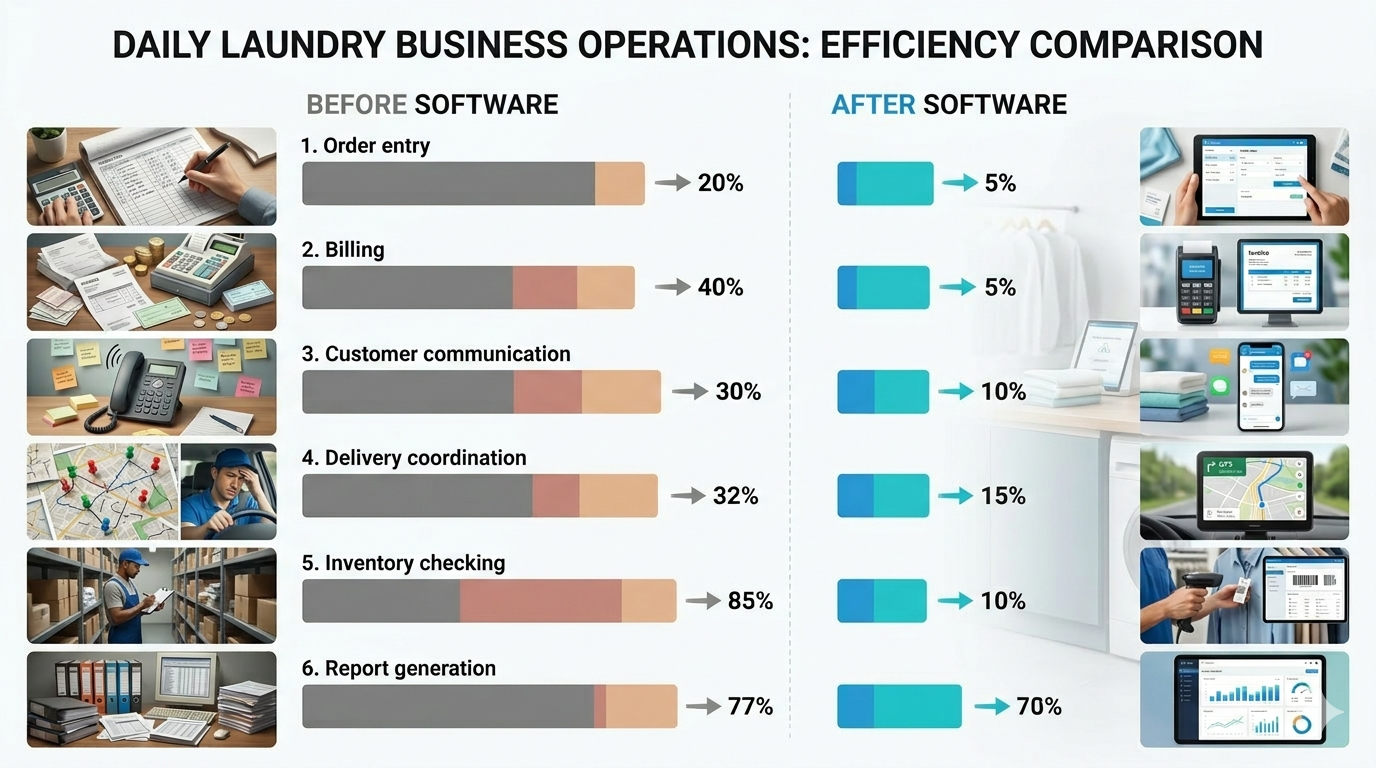
Let me break down the operational improvements you'll see within the first month.
Order processing time drops by 60-70%. Instead of writing details, calculating prices, and explaining charges, you tap a few buttons. A typical order that took 3-4 minutes now takes under a minute. Multiply that across 50-100 daily orders. You've freed up nearly 2 hours.
Delivery management becomes systematic. The software groups orders by location. Your delivery person gets optimized routes. One shop owner in Noida reduced daily fuel costs by ₹200 just through better route planning. That's ₹6,000 monthly saved.
Customer communication turns automatic. Order ready? System sends an SMS. Delivery scheduled? Automatic WhatsApp message. You're not paying staff to make reminder calls all day.
Inventory tracking prevents stockouts. When detergent levels drop, you get alerts. No more last-minute panic purchases at higher prices.
Staff accountability improves. The system logs who handled which order. If something goes wrong, you know exactly where. This alone reduces internal confusion and disputes.
The best part? You can actually take a day off. The business runs because systems handle routine tasks.
Direct Impact on Profit Margins
Efficiency gains mean nothing if they don't translate to money. Here's where software directly improves profitability.
Accurate pricing eliminates revenue leakage. When you're manually calculating bills, mistakes happen. Software ensures every item is charged correctly, every time. For a shop processing ₹2 lakh monthly, even fixing a 3% error rate adds ₹6,000 to revenue.
Customer retention increases when service improves. Faster processing, timely deliveries, and personalized service make customers stick around. Acquiring new customers costs 5x more than retaining existing ones. Software helps you remember customer preferences, purchase history, and special requests.
Upselling becomes easier with order history. When Mr. Patel drops off shirts, the system shows he usually gets premium washing. Your staff can suggest the same service naturally. These small additions compound.
Reduced operational waste shows up everywhere. Less time on paperwork means staff can handle more orders without hiring additional people. Better inventory management means you're not overstocking supplies. Optimized deliveries cut fuel costs.
One Chennai-based chain saw a 23% profit improvement in six months. Not from raising prices, but from operational tightening through software.
Why Laundry POS Systems Stand Out
Not all software is created equal. A proper laundry POS (Point of Sale) is built specifically for your business challenges.
Generic billing software doesn't understand laundry-specific needs. You need item-level tracking (two shirts, one pant), service-type variations (dry clean vs wash-iron), and GST calculations for different services. A dedicated laundry POS handles this natively.
Integrated billing and inventory means when you bill a dry-cleaning order, the system knows detergent and solvent consumption. You're not manually tracking supplies separately.
Customer management tools store contact details, order history, preferences, and credit balances. This turns one-time customers into regulars because you deliver personalized service.
Multi-branch capabilities matter if you're planning growth. Your customer in Sector 15 can drop off clothes at the Sector 22 branch and pick up from either location. The system syncs everything.
Mobile apps for delivery staff eliminate paper receipts and phone coordination. Real-time updates keep everyone on the same page.
The laundry POS is best in business when it combines these elements seamlessly, not as separate modules requiring manual coordination.
Real Cost vs Return Analysis
Let's address the obvious question: what's this going to cost, and is it worth it?
Most cloud-based laundry software operates on subscription models. Expect ₹2,000-₹5,000 monthly depending on features and order volume. Some providers charge one-time setup fees of ₹10,000-₹25,000.
Sounds like an expense, right? Let's calculate the return.
Time savings: 2 hours daily at ₹200/hour staff cost = ₹12,000 monthly saved.
Billing accuracy: ₹6,000 monthly recovered from eliminated errors (conservative estimate).
Delivery optimization: ₹6,000 monthly fuel savings.
Reduced customer loss: If you retain just 5 customers monthly who would've left due to service issues, at ₹500 average monthly value = ₹2,500.
That's ₹26,500 in tangible monthly benefits against a ₹3,000-₹4,000 software cost. The math works.
But here's what spreadsheets don't capture: reduced stress. When everything's organized, you sleep better. Your staff is happier because they're not drowning in paperwork. Your customers get better service.
How to Start Your Laundry Business in 2026: Complete Guide
Common Mistakes When Choosing Laundry Software
I've seen businesses make expensive mistakes during software selection. Avoid these.
Going for the cheapest option usually backfires. That ₹500/month system might lack essential features. You end up needing multiple tools, complicating operations further. Pay for what you actually need, not the bare minimum.
Ignoring mobile accessibility is shortsighted. If you can't check business metrics from your phone or if delivery staff can't update orders on the go, you're losing half the efficiency benefits.
Not checking integration capabilities creates data silos. Your billing software should talk to inventory management. Otherwise, you're manually transferring data, defeating the automation purpose.
Skipping the trial period is foolish. Most good providers offer 7-15 day free trials. Use them. Get your staff to actually process orders. Check if the interface makes sense for your workflow.
Overlooking customer support becomes painful when issues arise. A WhatsApp support that responds in hours beats email support that takes days. For small businesses, downtime is expensive.
Implementation Tips for Smooth Transition
Switching from manual to digital isn't instant. Here's how to do it without disrupting business.
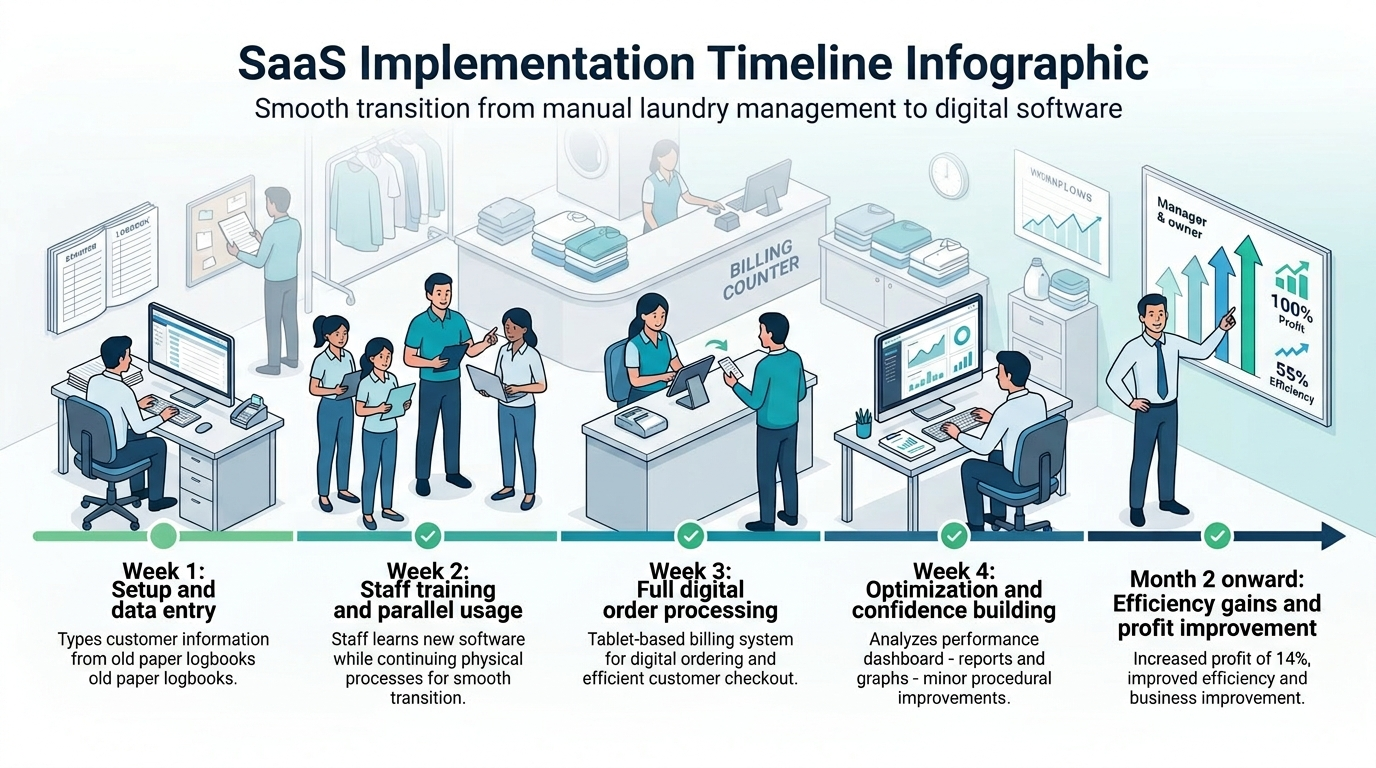
Run parallel systems for two weeks. Continue your manual register while also using software. This gives staff confidence and catches any migration issues.
Start with new customers first. Don't immediately digitize your entire customer base. As new orders come in, enter them into the system. Gradually add returning customers.
Train staff in batches. Don't try teaching everyone everything at once. Start with billing staff, then delivery team, then supervisors. Each group needs different training depth.
Use provider support heavily in the first month. Most vendors offer onboarding assistance. Book calls, ask questions, request customization help. You're paying for support, use it.
Set realistic expectations. First week will feel slower as everyone learns. By week three, you'll notice efficiency gains. Full benefits appear around month two.
How Software Enables Business Scaling
Once your single location runs smoothly, software makes expansion surprisingly manageable.
Centralized data means opening a second branch doesn't mean duplicating systems. Both locations access the same customer database, pricing, and inventory information.
Standardized operations reduce training time. New branch staff learn the same system. Your operational knowledge becomes transferable, not locked in one person's head.
Performance comparison becomes possible. Which location is more profitable? Where are delivery times longer? Data answers these questions instantly.
Franchise opportunities open up when you have documented, system-based operations. Replicating success becomes feasible because you're not dependent on specific individuals.
I know a Pune-based business that started with one shop. Three years and five locations later, the owner credits software for making multi-branch management possible without going insane.
Integration with Modern Business Tools
Good laundry software doesn't exist in isolation. It connects with tools you're probably already using or should be using.
WhatsApp integration for order updates is standard now. Customers expect instant communication. Manual messages don't scale.
Payment gateway connections let customers pay online during order booking or via QR codes at pickup. Reduces cash handling and improves convenience.
Accounting software sync (Tally, Zoho Books) eliminates double entry. Your daily sales automatically flow into accounting, saving hours during month-end closing.
Google Maps integration helps delivery staff navigate efficiently and provides customers real-time delivery tracking.
These integrations compound efficiency gains. You're not just automating laundry operations, you're building a connected business ecosystem.
How to Manage Laundry Orders Digitally in 2026: A Complete Guide
Data-Driven Decision Making
Here's something most laundry owners don't think about: you're sitting on valuable business intelligence.
Software captures patterns. Which services are most requested? What's your peak day and time? Which customers are most valuable? What's your average order value?
This data drives better decisions. If Saturday afternoons are consistently slow, run a promotion. If premium dry cleaning has better margins than basic washing, market it more aggressively. If certain areas generate more orders, consider opening a branch there.
Without software, you're making decisions on gut feeling. Sometimes you're right, sometimes wrong. With data, you're still making judgment calls, but informed ones.
Seasonal planning becomes smarter. Last winter, which services surged? Stock up accordingly this year. Summer slowdown? Plan your marketing push in advance.
Customer segmentation reveals who your best customers are. Focus retention efforts there. Identify customers you haven't seen in months and send them offers.
This isn't complex analytics requiring a data scientist. Modern systems present insights in simple dashboards anyone can understand.
The Mobile-First Advantage
Customers are on their phones. Your business should be too.
Mobile apps for laundry businesses serve two audiences: customers and your operations team.
For customers, apps provide order booking convenience. They check pricing, schedule pickup, track order status, and make payments without calling your shop. This reduces your staff's phone time significantly.
For your delivery team, mobile apps are operational tools. They see assigned deliveries, navigate to addresses, collect payments, update order status, and communicate with the shop instantly.
As a business owner, mobile access means checking today's revenue while having tea at home. You're not chained to the shop computer.
The competitive advantage is real. Customers choosing between two laundry services often pick the one with app convenience, even if slightly more expensive.
Security and Data Backup Considerations
Let me address a concern many shop owners have: what happens if the system crashes?
Cloud-based software means your data isn't stored on a single computer. It's on secure servers with automatic backups. If your shop's laptop breaks, you log in from another device. Everything's still there.
Automatic backups happen daily, sometimes hourly. You're not manually saving files or worried about data loss.
User access controls let you decide what each staff member can see. Billing staff don't need access to financial reports. Delivery personnel only see their assigned orders.
Data security is generally better than paper records. Fire, flood, or theft can destroy physical registers. Digital data survives.
That said, choose providers who explain their security measures clearly. Ask about data backup frequency, server locations, and access controls. If they can't answer, that's a red flag.
FAQs
How long does it take to see actual profit improvements from laundry software?
Most businesses notice efficiency gains within 2-3 weeks as staff gets comfortable. Measurable profit improvements typically appear by month two through reduced errors, better customer retention, and operational savings. The timeline varies based on current order volume and how consistently you use all features.
Is laundry management software suitable for small shops with 20-30 daily orders?
Absolutely. Small operations actually benefit more because you're running lean. Even saving 30 minutes daily or preventing two billing errors weekly makes a meaningful difference when you're managing everything yourself. Many providers offer plans scaled for smaller businesses.
Can I use laundry software without internet connectivity?
Most modern systems require internet for real-time syncing, but many offer offline modes. You can process orders offline, and data syncs once connectivity returns. However, cloud-based systems work best with stable internet. Consider this when selecting software based on your location's connectivity.
What happens to my existing customer data when switching to software?
Reputable providers help migrate existing customer data. You'll typically provide an Excel sheet with customer names, contacts, and preferences. The support team imports this into your new system. Expect some manual cleanup work, but it's a one-time effort that pays off.
Do I need technical knowledge to operate laundry POS systems?
No technical expertise required. These systems are designed for business owners and shop staff, not IT professionals. If you can use WhatsApp and basic smartphone apps, you can operate modern laundry software. Good providers include training and ongoing support.
How does software help with GST compliance for laundry businesses?
Software automatically generates GST-compliant invoices with correct tax breakdowns. It maintains digital records for filing returns, calculates GST on different service categories, and provides monthly reports. This eliminates manual calculation errors and makes return filing much simpler.
Can software really reduce customer complaints about delayed or lost orders?
Yes, significantly. Digital tracking ensures nothing gets lost in paper shuffles. Automatic status updates reduce "where's my order" calls. Clear delivery schedules prevent delays. Most importantly, accountability improves when everything's logged. Customers notice the difference in service quality.
Conclusion
Running a profitable laundry business in 2026 means working smarter, not just harder. Software isn't about replacing your expertise—it's about freeing you from repetitive tasks so you can focus on growing the business and serving customers better.
The shops that embrace systematic operations will outcompete those still managing everything manually. Not because the software is magical, but because it eliminates waste, prevents errors, and enables scaling.
Start with a free trial. Test it with your actual workflow. See if it solves your specific problems. The investment pays for itself quickly when you factor in time saved, errors prevented, and customers retained.
Ready to see how modern laundry software can transform your operations? Explore solutions built specifically for Indian laundry businesses and take the first step toward more profitable, efficient operations.