
Is Laundry Business Profitable in 2026? Real Numbers & Expert Analysis
Starting a laundry business sounds simple. Buy machines, wash clothes, make money. But is it really profitable in 2026? After working with dozens of laundry shop owners across India, I've seen businesses making ₹2-3 lakhs monthly profit, and others barely breaking even. The difference isn't location or investment size—it's how they operate. This guide breaks down actual profitability factors, hidden costs, and why modern laundry POS software has become essential for staying competitive.
Understanding Laundry Business Profitability in 2026
The laundry industry in India is growing at 12-15% annually. Urban households are outsourcing laundry more than ever. Working couples don't have time for weekend washing. Students in PG accommodations need reliable services. Bachelors prefer pickup-delivery over laundromats.
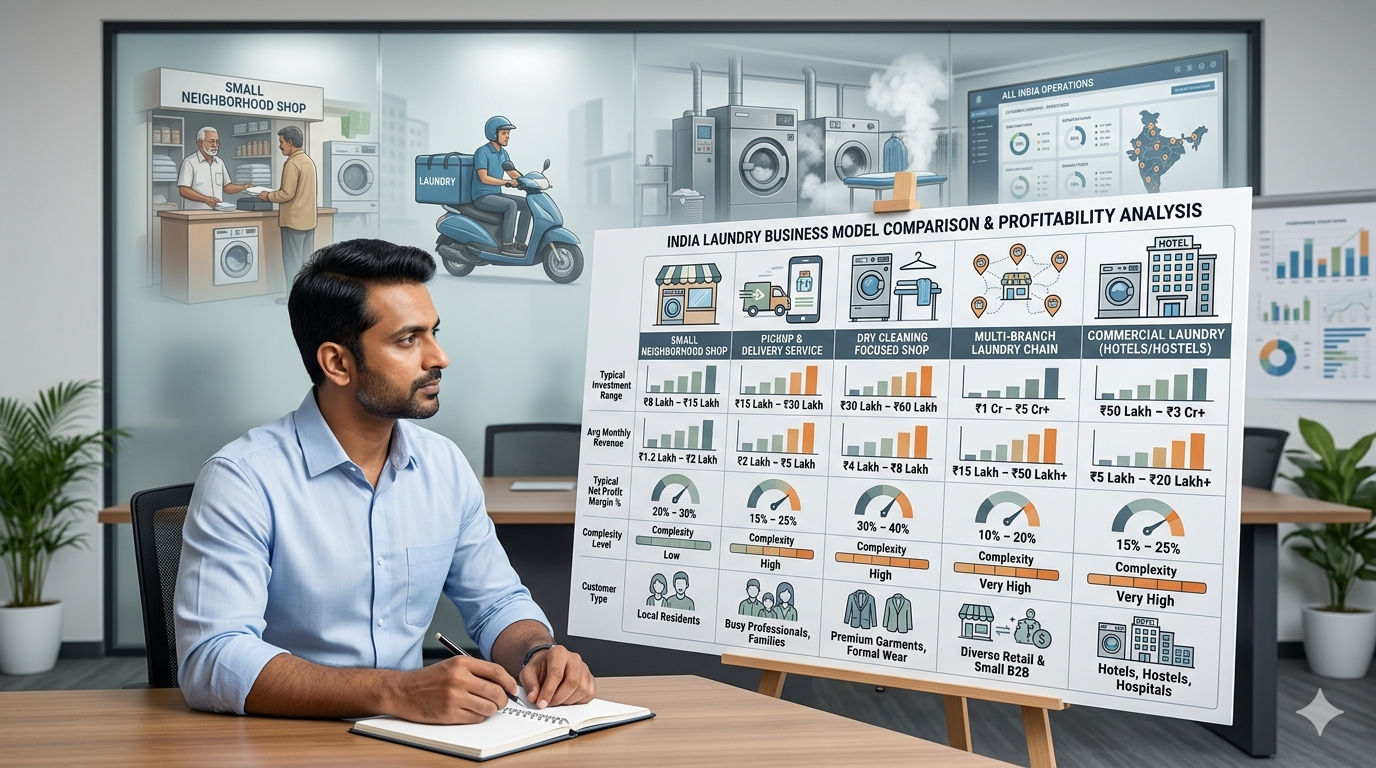
But profitability depends on your business model. A small neighborhood shop with 2 machines operates differently from a multi-branch franchise. Your margins change based on whether you handle dry cleaning, offer express services, or focus only on wash-and-fold.
Most profitable laundry businesses share three traits: consistent customer volume, efficient operations, and predictable monthly revenue. The shops struggling usually have billing confusion, missed pickups, or can't scale beyond the owner's daily involvement.
Initial Investment and Break-Even Analysis
Starting costs vary widely. A basic setup in a tier-2 city needs ₹3-5 lakhs. This covers:
- Commercial washing machines (₹80,000-1,50,000)
- Dryers and pressing equipment (₹50,000-80,000)
- Shop rent deposit (₹30,000-60,000)
- Initial inventory and supplies (₹20,000-30,000)
- Licensing and registration (₹15,000-25,000)
Metro cities push this to ₹8-12 lakhs due to higher rents and equipment costs. Dry cleaning adds another ₹2-3 lakhs for specialized machines.
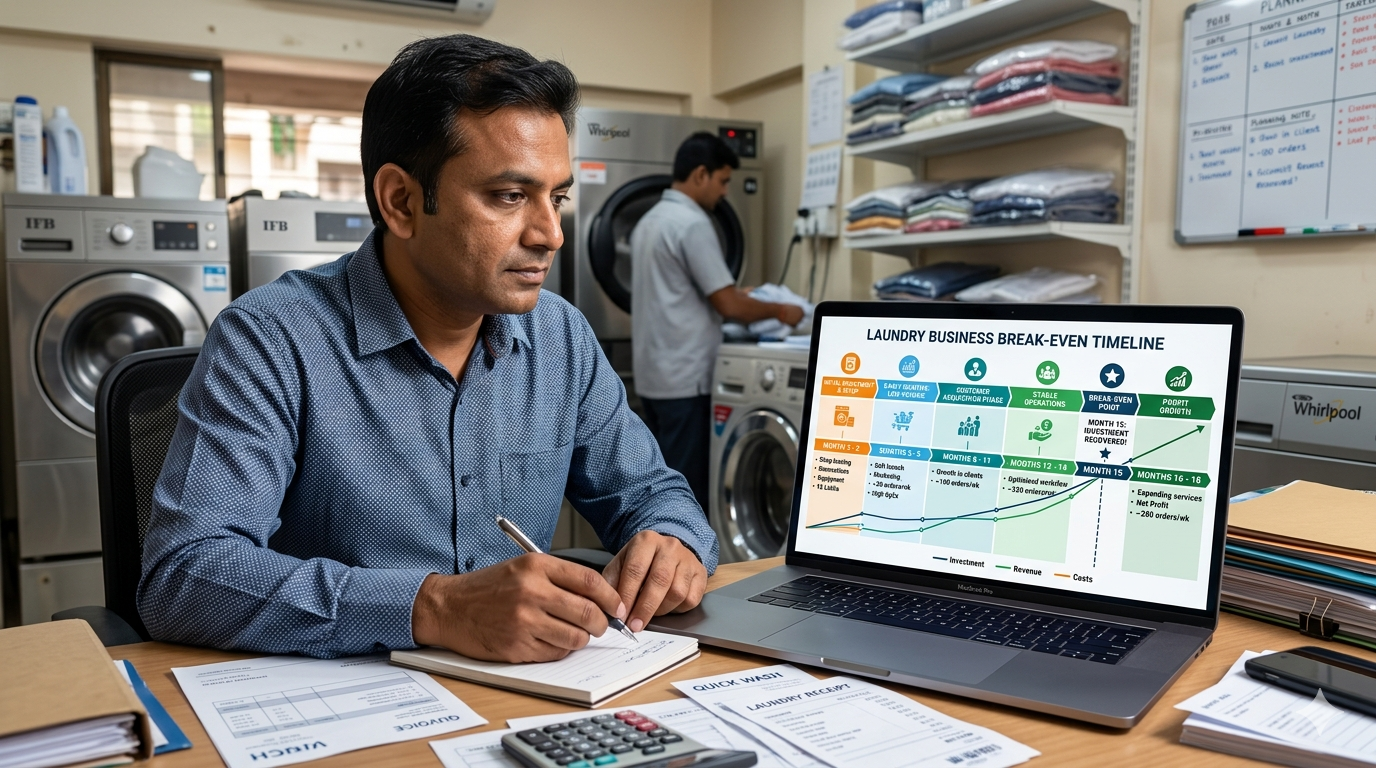
Break-even typically happens in 8-14 months if you maintain 60-70% capacity utilization. I've seen shops in Bangalore reach break-even in 6 months by focusing on bulk corporate orders. Others in smaller towns take 18 months because customer acquisition is slower.
The real question isn't just recovery time. It's whether you can maintain profitability after initial growth. Many shops hit ₹1.5-2 lakhs revenue in month 3-4, then plateau because they can't manage more orders without better systems.
Monthly Revenue and Profit Margins Explained
Average revenue per shop varies by location. A well-run urban laundry handles 150-250 kg daily. At ₹40-60 per kg for wash-and-fold, that's ₹1,80,000-4,50,000 monthly revenue.
Your actual margins depend on:
Direct Costs (40-50% of revenue)
- Electricity and water bills
- Detergent and chemicals
- Packaging materials
- Staff wages
Fixed Costs (15-25% of revenue)
- Rent
- Machine maintenance
- Software subscriptions
- Insurance
Net profit margins range from 20-35%. A shop doing ₹3 lakhs revenue typically keeps ₹60,000-90,000 as profit. This improves with scale because fixed costs spread across more orders.
Premium services boost margins. Express delivery commands 40-50% higher prices. Dry cleaning items give 45-55% gross margins. Bulk corporate contracts offer volume but tighter margins around 18-22%.
The shops making ₹2 lakh+ monthly profit aren't just processing more clothes. They've eliminated operational waste—no duplicate billing, no missed deliveries, no inventory loss.
Hidden Costs That Reduce Profitability
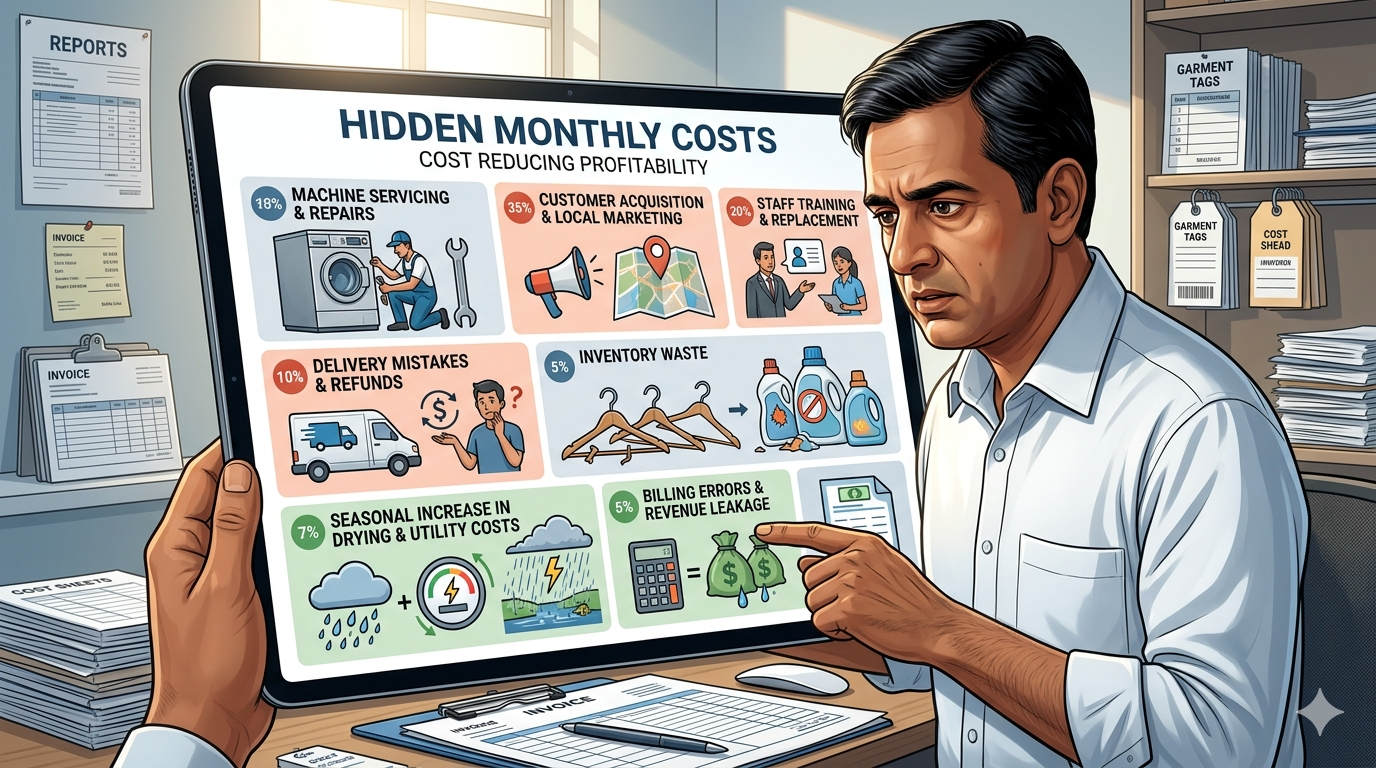
Unexpected expenses kill profit forecasts. Equipment breakdown repairs cost ₹8,000-15,000 and happen more often than vendors admit. A commercial washer needs servicing every 4-6 months at ₹3,000-5,000 per visit.
Customer acquisition gets expensive. Pamphlets and local ads cost ₹5,000-8,000 monthly. Digital marketing adds another ₹10,000-15,000 if done properly. But most shops see only 2-4% conversion from these spends initially.
Staff issues create hidden losses. Training new employees takes 2-3 weeks during which mistakes increase. One delivery mix-up costs you the customer plus ₹500-1,000 in refunds. Manual billing errors mean revenue leakage—I've audited shops losing ₹8,000-12,000 monthly from unbilled items or wrong calculations.
Inventory waste adds up. Damaged hangers, lost tags, expired chemicals. Small amounts daily become ₹3,000-5,000 monthly losses.
Seasonal fluctuations affect cash flow. Monsoons increase drying costs by 30-40%. Summer months see 15-20% lower volumes as people wash at home more. You need reserves to handle these variations without taking emergency loans.
How Laundry POS Software Helps in Profitability
Technology isn't optional anymore. Manual operations work until you hit 20-30 daily orders. Beyond that, chaos begins.
Modern laundry POS software solves the problems that eat into your profits:
Billing Accuracy Every item gets barcoded. No more "I thought we charged ₹200" conversations. GST calculations happen automatically. Monthly revenue reporting shows exactly where money comes from.
Order Tracking Customers check their order status on mobile apps. This alone reduces "where's my order" calls by 70-80%. Your staff spends time processing clothes, not answering phones.
Delivery Management Pickup schedules, route optimization, delivery confirmations—all tracked digitally. Missed deliveries drop significantly. Customer satisfaction improves, repeat orders increase.
Shops using proper laundry management systems report 15-25% higher productivity. The same staff handles more orders. Billing happens faster. Inventory tracking prevents waste.
The real benefit shows in scaling. You can open a second location without doubling your personal time. The system manages both branches. Reports consolidate automatically. You make decisions based on data, not guesswork.
How to Start Your Laundry Business in 2026: Complete Guide
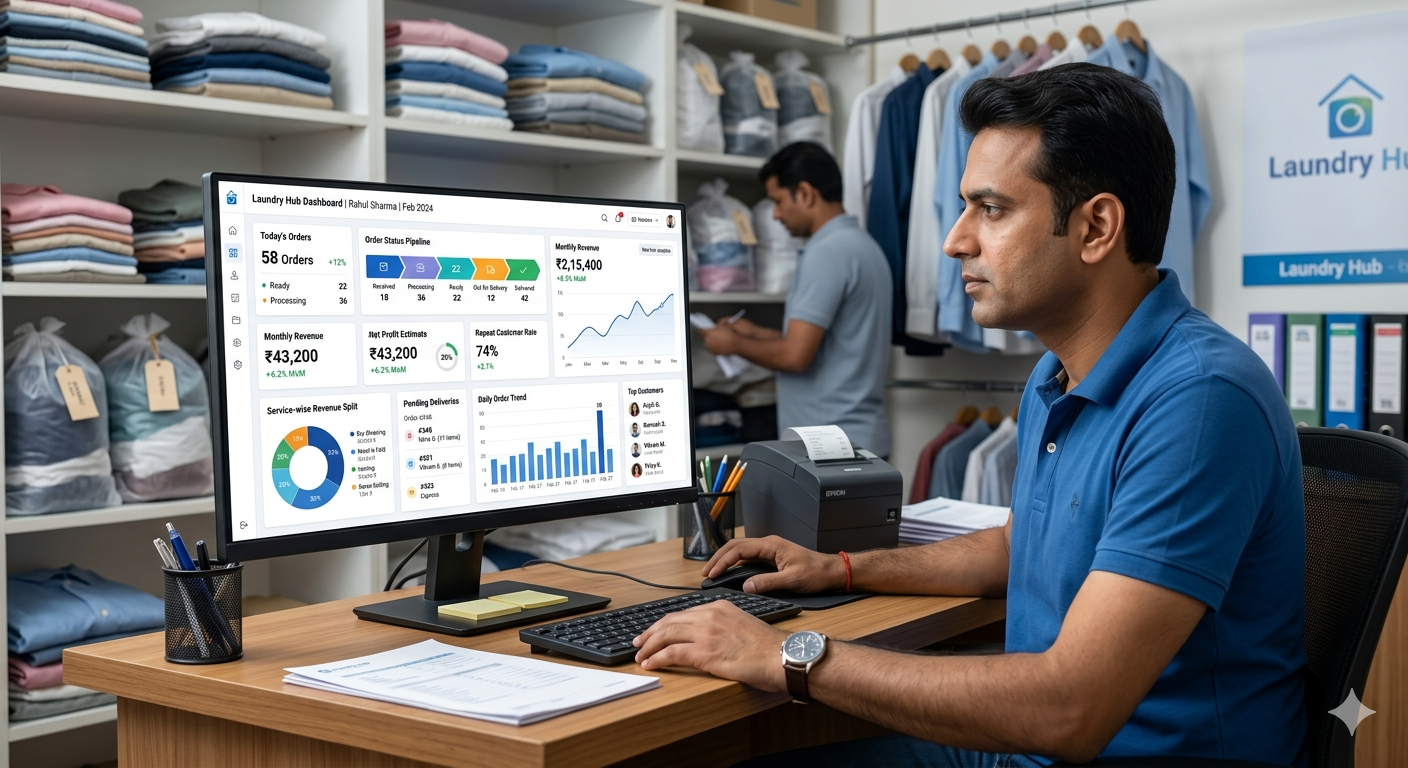
Ezer Laundry POS System
Streamline your laundry business with our comprehensive POS system. Features include smart billing, garment tracking, WhatsApp notifications, and cloud backup.
Customer Retention and Revenue Growth Strategies
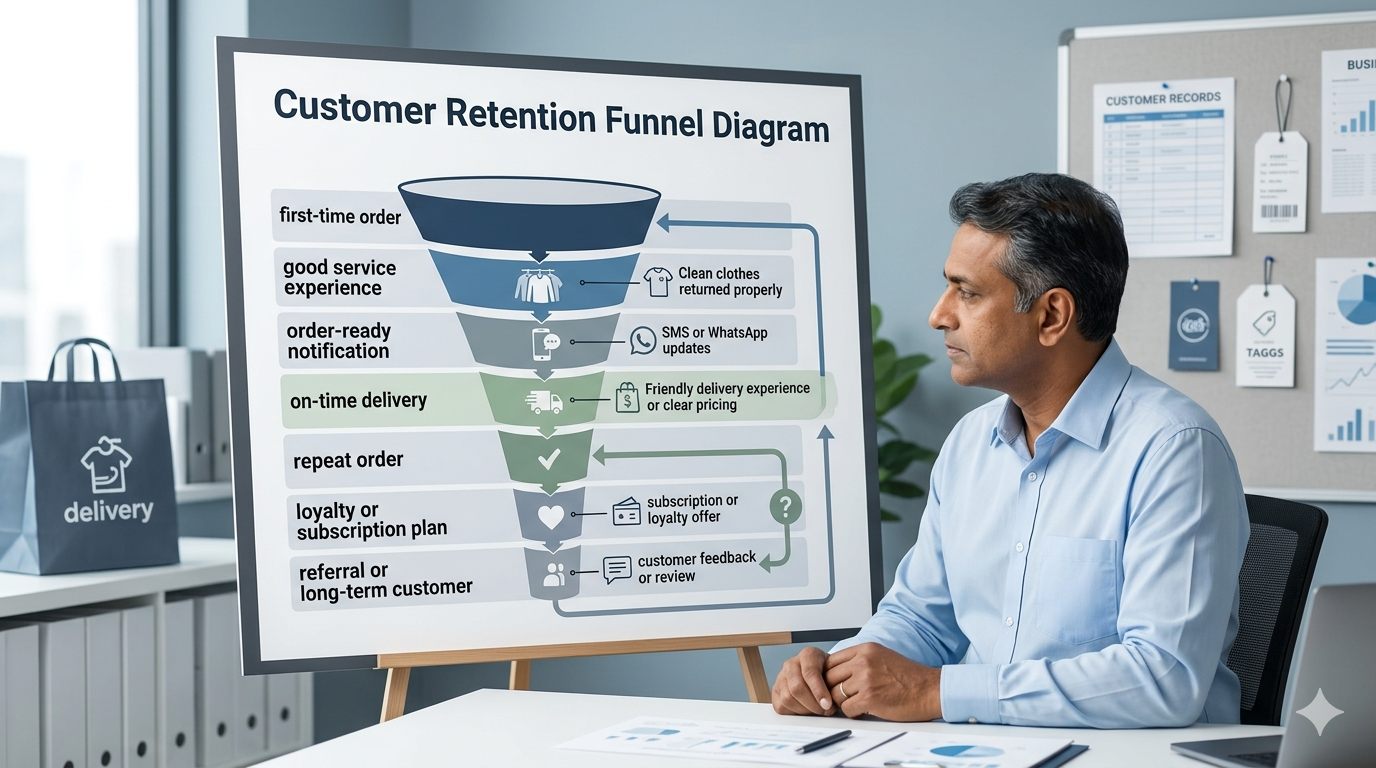
Acquiring new customers costs 5x more than retaining existing ones. But most laundry shops focus only on getting new business.
Smart retention starts with basic service quality. Clothes returned clean, pressed properly, on time. This seems obvious but remains inconsistent across the industry. One bad experience and customers never return.
Loyalty programs work if implemented correctly. Simple points systems confuse customers. Better approach: "Every 10th service gets 20% off" or "Spend ₹5,000 monthly, get free pickup-delivery." Clear, valuable, easy to understand.
Communication matters more than promotional offers. Send SMS reminders before pickup. Notify when orders are ready. Thank customers after delivery. These small touches build relationships that survive when a competitor opens nearby.
Subscription models create predictable revenue. Weekly or monthly plans where customers prepay for regular service. This guarantees cash flow and reduces customer acquisition cost to near zero after initial sign-up.
Corporate contracts transform profitability. One hotel or salon contract replaces 30-40 individual customers in terms of revenue, with much less operational complexity. Approach hotels, salons, spas, hostels, and corporate offices systematically.
Common Mistakes That Kill Laundry Business Profits
Underpricing destroys margins. New owners think competitive pricing means being cheapest. You end up working for ₹15-20 per kg when costs are ₹12-15. No room for problems or growth.
Overinvesting in equipment before proving demand. Buying 4 industrial machines when you need 2. The extra machines sit idle while you pay EMIs.
Ignoring quality control until customers complain publicly. One Google review saying "returned damaged clothes" can kill 6 months of marketing effort.
Poor cash flow management. Revenue looks good on paper but money is stuck in credit given to customers. Meanwhile, you can't pay suppliers or rent on time.
Hiring based on cost instead of reliability. Cheap labor becomes expensive when they make mistakes, don't show up, or steal. One good employee at ₹15,000 monthly beats two unreliable ones at ₹9,000 each.
Neglecting technology because "our customers are traditional." Your customers might be traditional but they're also using WhatsApp, Google Pay, and Swiggy. They expect similar convenience from laundry services.
Not tracking metrics. You should know your daily order count, average ticket size, customer repeat rate, and profit per order. Without this data, you're flying blind.
7 Critical Mistakes to Avoid When Starting a Laundry Business in 2026
Scaling Your Laundry Business for Higher Profits
Growth without systems leads to chaos. I've seen single-shop owners struggling with 100 daily orders, while others comfortably manage 3 locations with proper infrastructure.
The first scaling step is standardizing operations. Document every process—intake, washing, quality check, packaging, delivery. Train staff on these standards. Consistency becomes your competitive advantage.
Second location requires different thinking. Don't just replicate. Analyze what works at location one, what doesn't, why. Choose your second location based on different customer demographics to reduce risk. If location one serves families, make location two serve bachelors or working professionals.
Technology becomes essential when scaling. You cannot manually manage inventory, billing, and deliveries across multiple shops. Cloud-based laundry POS systems let you monitor all locations from your phone. Real-time reports show which branch needs attention.
Franchising is viable after proving your model at 2-3 owned locations. But franchising isn't easy passive income. You need documented processes, training programs, supply chain setup, and ongoing support systems.
Vertical integration improves margins. Some large operators manufacture their own detergents, saving 15-20% on chemical costs. Others buy delivery vehicles instead of hiring drivers with vehicles.

Is It Worth Starting a Laundry Business in 2026?
The straightforward answer: yes, if you approach it professionally.
Demand is growing, competition exists but isn't overwhelming in most areas, and entry barriers are reasonable. You don't need crores of investment or special technical skills.
But success requires treating this as a real business, not a side project. That means proper market research, financial planning, investment in technology, and commitment to operational excellence.
The shops making good profits share common traits: they use technology to eliminate manual errors, focus on customer retention over constant new acquisition, maintain quality standards religiously, and track metrics to make informed decisions.
Profitability is definitely achievable. Whether it happens in 8 months or 18 months depends entirely on your execution. The market opportunity exists. How you capture it makes the difference.
FAQs
What is the average profit margin in laundry business?
Most laundry businesses operate at 20-35% net profit margins. A shop generating ₹3 lakhs monthly revenue typically keeps ₹60,000-90,000 as profit after all expenses. Premium services and corporate contracts can push margins higher, while competitive markets with aggressive pricing might see margins around 15-18%.
How much investment is needed to start a laundry business?
Basic setup in tier-2 cities requires ₹3-5 lakhs covering machines, rent deposit, and initial inventory. Metro cities need ₹8-12 lakhs due to higher costs. Adding dry cleaning services increases investment by another ₹2-3 lakhs. Most businesses reach break-even within 8-14 months with consistent operations.
Do I need laundry management software for a small shop?
Software becomes essential once you cross 40-50 daily orders. Below that, manual operations work but you're building bad habits. Implementing software early prevents billing errors, tracks customer data properly, and makes scaling much easier. The monthly cost (₹2,000-5,000) pays for itself through reduced errors and improved efficiency.
How can I increase laundry business profitability?
Focus on three areas: reduce operational waste through better systems, increase average order value through premium services, and improve customer retention with loyalty programs. Using laundry POS software eliminates billing errors and delivery mistakes. Corporate contracts provide steady volume. Express services boost margins significantly.
What are the biggest challenges in laundry business?
Customer acquisition takes longer than expected, especially in the first 4-6 months. Staff reliability issues create operational problems. Equipment breakdown during peak season can halt operations. Cash flow management becomes tricky when offering credit to regular customers. Competition from new shops offering lower prices tests your pricing strategy.
Is laundry business profitable in small cities?
Small cities can be highly profitable due to lower rents and labor costs. However, customer volume builds slower and price points are lower. Success depends on becoming the preferred choice in your area quickly. Focus on reliability and quality rather than competing on price. Monthly profits of ₹40,000-70,000 are realistic in tier-3 cities.
How does technology improve laundry business margins?
Laundry POS software eliminates billing errors that cause 5-8% revenue leakage. Order tracking reduces missed deliveries and customer complaints. Automated inventory management prevents chemical waste and over-ordering. Staff productivity increases 15-25% when they're not handling manual paperwork. Multi-branch management becomes possible without hiring additional supervisors.
Conclusion
Laundry business profitability in 2026 depends less on market conditions and more on operational execution. The demand exists, the margins are reasonable, and the business model is proven. But sustainable profits require professional management, investment in technology, and consistent focus on quality.
Starting with ₹5-8 lakhs and reaching monthly profits of ₹60,000-1,20,000 within 12-18 months is realistic. The shops exceeding these numbers aren't doing anything magical—they're using modern laundry POS software, maintaining service quality, and building loyal customer bases systematically.
Ready to see how technology can transform your laundry business? Explore how cloud-based management systems eliminate operational headaches and improve profitability from day one.