
Laundry POS vs Manual Billing: Which One Actually Works in 2026?
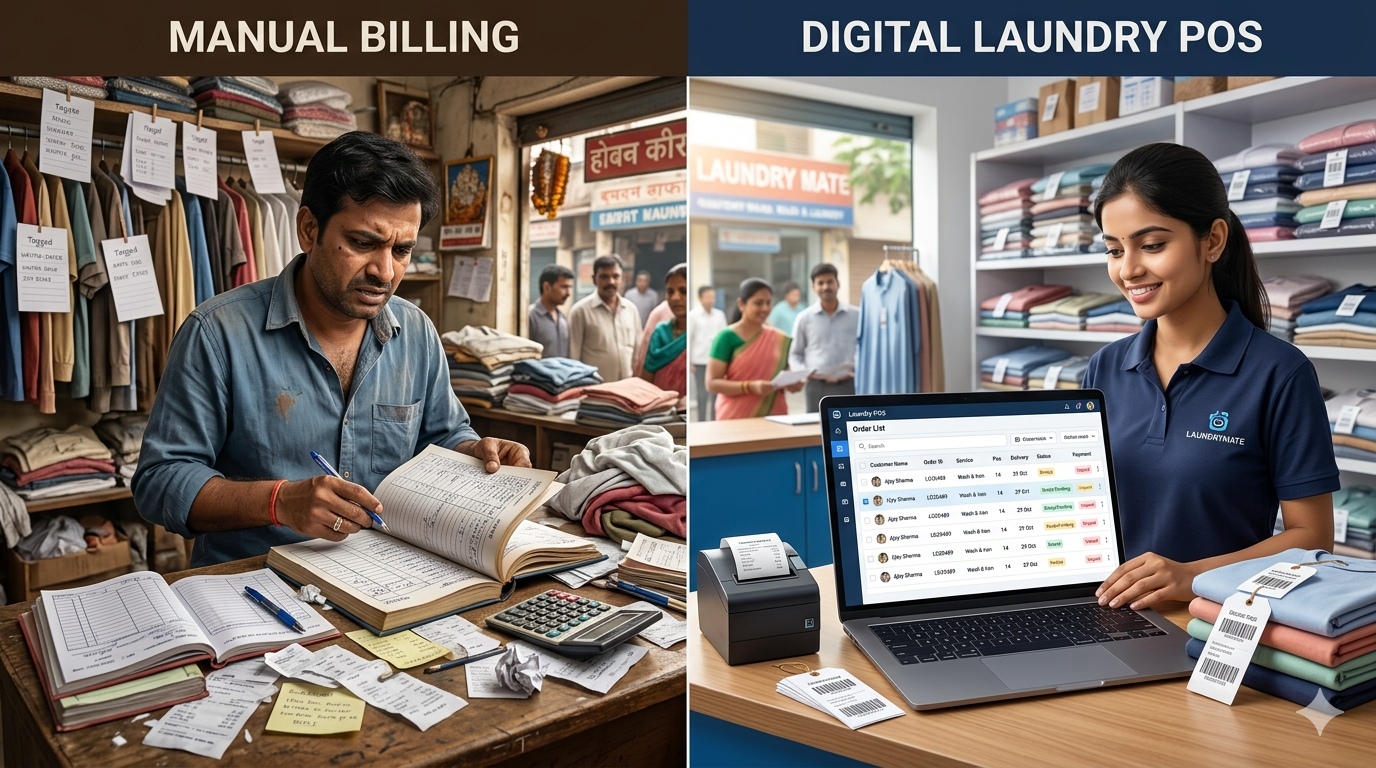
Walk into most laundry shops in India and you'll still see the same thing: a register book, a calculator, and someone frantically searching through pages to find a customer's order. It works. Until it doesn't. A missing receipt here, a billing dispute there, and suddenly you're losing customers you worked hard to get. The question isn't whether manual billing can run a laundry business—it's whether it can run one profitably in 2026.
This guide breaks down the real differences between traditional manual billing and modern laundry POS systems. Not the marketing fluff, but what actually happens on the shop floor.
What Manual Billing Really Looks Like
Manual billing means writing everything down. Customer name, phone number, items received, delivery date, pricing—all on paper or in a register. Some shops use Excel sheets. Others have those carbon-copy receipt books.
It's simple to start with. No software to learn. No monthly fees. Just pen and paper.
But here's what happens after six months:
Your register has 2,000+ entries. Finding Mr. Sharma's order from last week takes 10 minutes. Your staff member who "knows the system" calls in sick, and suddenly nobody can locate pending orders. A customer insists they paid, but you can't find the receipt. You've written the same customer's phone number wrong three times.
The real cost isn't the notebook. It's the time wasted searching, the orders missed, and the customers who don't come back because pickup took too long.
How a Laundry POS System Actually Works
A laundry POS system digitizes everything that used to happen on paper. When a customer drops off clothes, you enter their details once. The system generates a unique order number, calculates pricing based on services selected, and prints a receipt—all in under a minute.
The order sits in a digital queue. Your staff sees what needs washing, ironing, or dry cleaning. When it's ready, the system sends an SMS. Customer picks up, payment is recorded, GST invoice generated automatically.
Everything's searchable. Type a phone number, get their complete order history. Need to know how many shirts came in today? One click. Want to see which orders are overdue? The dashboard shows it.
Modern systems like EzerBiz Laundry POS run on tablets or computers, sync to the cloud, and work even when your internet drops temporarily. The data backs up automatically, so you're not losing everything if your register book gets damaged.
The Real Cost Comparison
Let's talk money, because that's what matters.
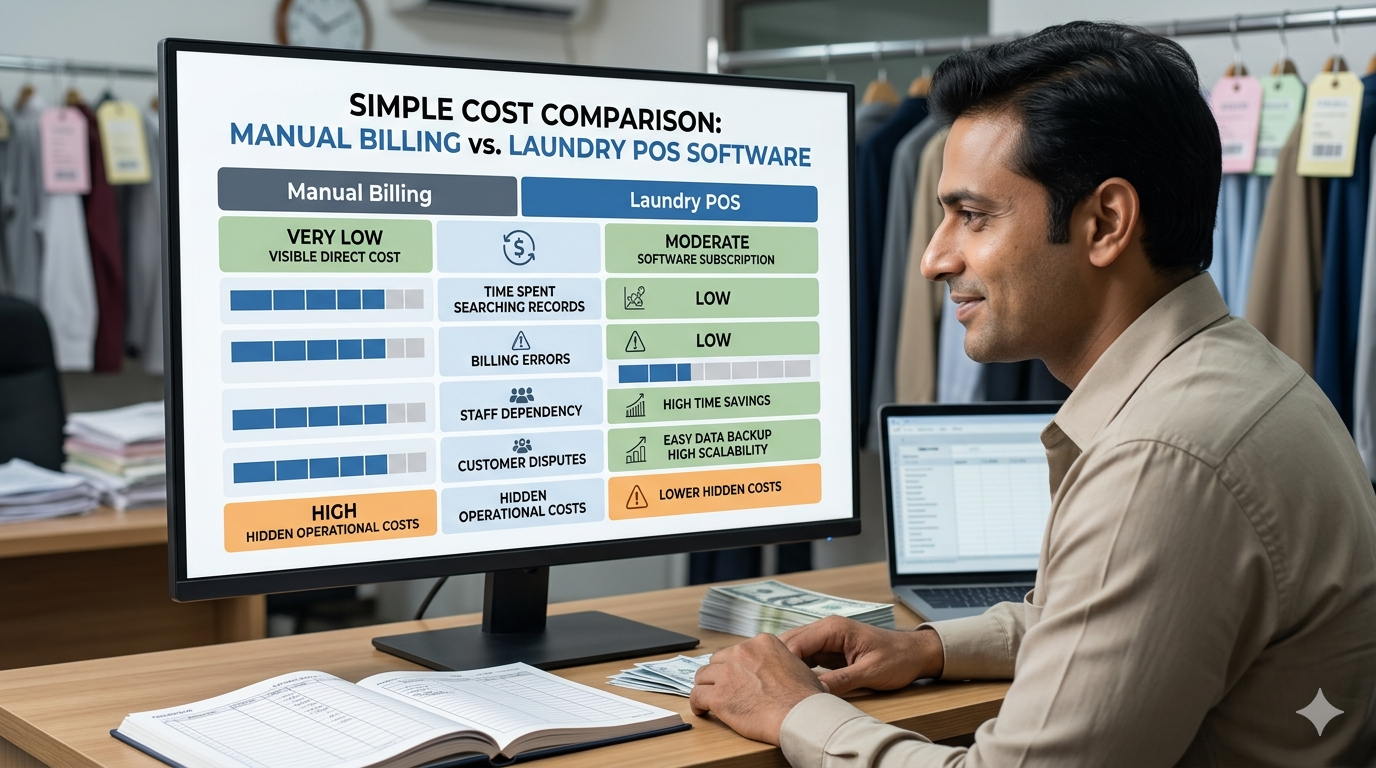
Manual Billing Costs:
- Register books: ₹500–1,000/year
- Printed receipts: ₹2,000–3,000/year
- Calculator: ₹500 (one-time)
- Time spent searching records: 1–2 hours daily
- Staff dependency: High (only certain people know the system)
- Billing errors: Variable losses
Laundry POS Costs:
- Software subscription: ₹500–2,000/month (₹6,000–24,000/year)
- Initial setup: ₹0–5,000 (if hardware needed)
- Training time: 2–3 days
- Time spent searching records: Near zero
- Staff dependency: Low (anyone can use it)
- Billing errors: Minimal
The subscription looks expensive until you calculate time savings. If you're spending 90 minutes daily managing manual records, that's 45 hours monthly. Even at ₹200/hour labor cost, you're losing ₹9,000 in productivity. The POS pays for itself.
Ezer Laundry POS System
Streamline your laundry business with our comprehensive POS system. Features include smart billing, garment tracking, WhatsApp notifications, and cloud backup.
Customer Experience: Where the Gap Widens
Your customer doesn't care about your billing system. They care about getting their clothes back on time, knowing what they're paying, and not arguing about receipts.
With manual billing, customers often face:
- No proof of order beyond a handwritten receipt (easily lost)
- Unclear pricing (different staff quote different rates)
- No delivery updates
- Long wait times at pickup (while you search for their order)
- Disputes about what was received
A POS system changes this:
- Digital record-keeping means orders don't "disappear"
- Automated SMS notifications for order status
- Consistent pricing across all staff
- Quick pickup (scan receipt or search by phone)
- Complete item-wise billing with photos (in advanced systems)
Real example: A shop in Pune switched to digital billing and saw pickup times drop from 8 minutes to under 2 minutes. Customers noticed. Google reviews mentioned it specifically.
Scaling: When Manual Breaks Down
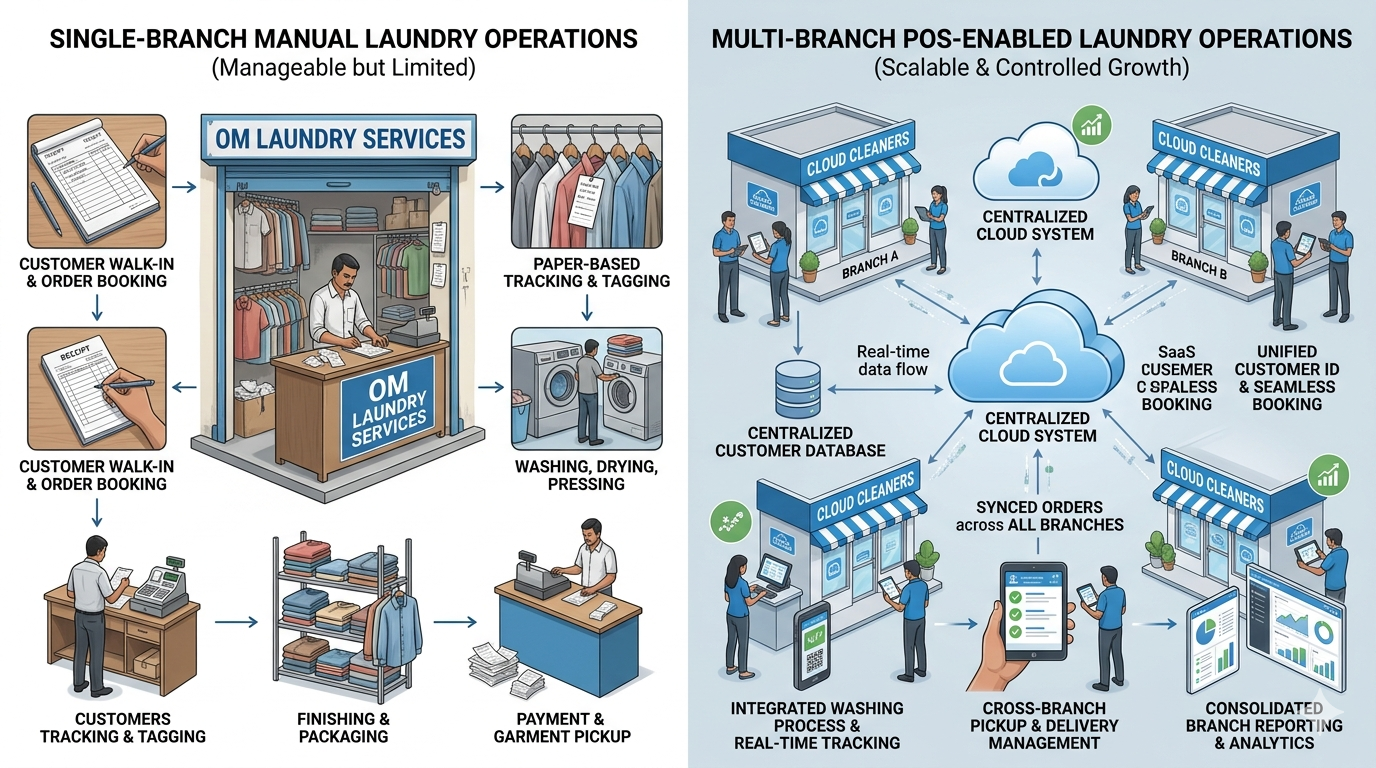
You can run a small laundry with 20–30 daily orders using manual methods. Tight operation, regular customers, you remember most faces.
Then you add a second location. Or start pickup-and-delivery. Or hire more staff. Manual systems collapse here.
With two branches, you need separate registers. A customer who drops clothes at Branch A wants to pick up from Branch B? Impossible without phone calls and confusion. Staff coordination becomes a nightmare.
POS systems with multi-branch support sync everything. One customer database. Unified inventory. Centralized reporting. You see both shops' performance on one screen.
Delivery tracking is another breaking point. Try managing 50 pickup-delivery orders on paper. Who's delivering what? Which orders are in the van? What's the status? You'll need a full-time coordinator just for this.
Cloud-based systems let delivery staff update order status from their phones. You see real-time locations. Customers get accurate ETAs.
GST Compliance and Record-Keeping
This is where manual billing becomes genuinely risky.
GST requires proper invoicing, record maintenance, and accurate reporting. Doing this manually means:
- Calculating tax for every transaction
- Maintaining separate registers for tax computation
- Generating monthly/quarterly reports by hand
- Storing physical invoices for years
- High error probability during filing
One miscalculation during GST filing can trigger notices. Penalties range from ₹10,000 to much higher amounts for repeated errors.
A laundry POS with GST integration handles this automatically. Every invoice is GST-compliant. Reports generate in the exact format needed for filing. Your CA gets clean data. Audit risks drop significantly.
Some business owners think they're too small for GST worries. But if you're crossing ₹40 lakh annual revenue (₹20 lakh in some states), GST registration is mandatory. Better to have systems ready before you hit that threshold.
Staff Management and Training
Here's something nobody talks about: employee dependency.
With manual systems, usually one or two people "own" the record-keeping. They know where everything is, how it's organized, who owes what. When they leave or take time off, things fall apart.
Training new staff takes weeks because there's no standard process—just "watch how Ramesh does it."
Digital systems standardize everything. New hire? They learn the software in 2–3 days. The process is the same regardless of who's working. Less dependency on individuals. Lower training costs. Easier staff replacements.
Also, POS systems have user-level access controls. Your delivery person doesn't need access to financial reports. Your accountant doesn't need to see operational details. Role-based permissions reduce errors and improve security.
When Manual Billing Still Makes Sense
Let's be realistic. Not every laundry needs a POS system immediately.
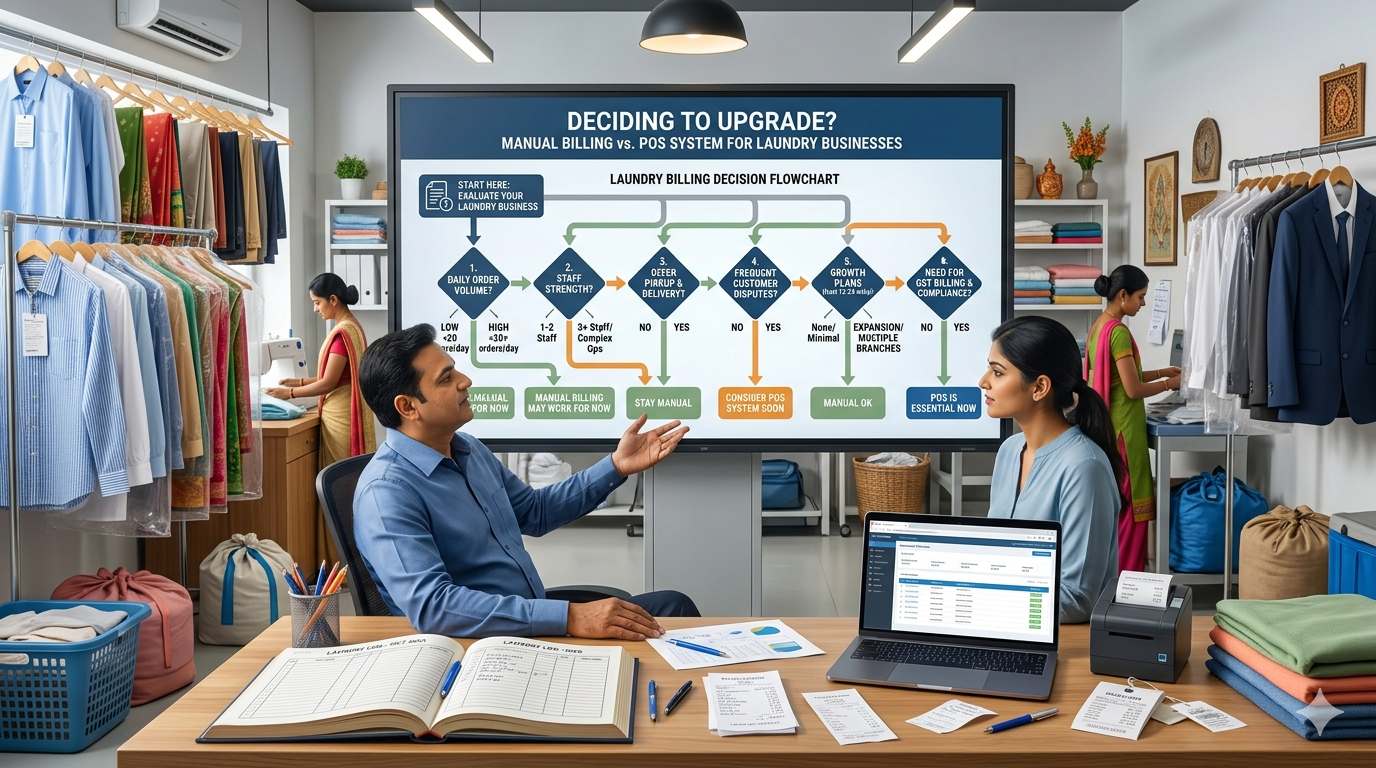
Manual billing might work if:
- You process under 15 orders daily
- You run alone or with one trusted partner
- Your customer base is extremely regular and small
- You're still testing the business viability
- Cash flow is very tight
But even here, consider this: most businesses that stay manual don't stay small by choice. They stay small because manual processes can't support growth.
If you're planning to grow, invest in digital systems early. Migrating from manual to digital with 5,000 existing customers is painful. Starting digital from day 100 is easy.
What to Look for in a Laundry POS
If you've decided digital is the way forward, here's what matters:
Essential Features:
- Quick order entry and billing
- Customer database with search
- Service-wise pricing setup
- Basic reporting (daily sales, pending orders)
- Receipt printing
- GST-compliant invoicing
Important but Not Essential:
- SMS notifications
- Pickup/delivery management
- Mobile app for customers
- Multi-branch sync
- Inventory tracking for supplies
- Staff performance tracking
Nice to Have:
- WhatsApp integration
- Advanced analytics
- Photo-based order verification
- Loyalty programs
- Integration with payment gateways
Don't get distracted by fancy features you won't use. Start with core functionality. Systems like EzerBiz Laundry POS focus on getting billing and order management right before adding bells and whistles.
Also check: Is it cloud-based? (so data isn't trapped on one computer) Can it work offline temporarily? (for internet disruptions) Is support available in your language?
Ezer Laundry POS System
Streamline your laundry business with our comprehensive POS system. Features include smart billing, garment tracking, WhatsApp notifications, and cloud backup.
Common Mistakes When Switching
Business owners mess this up in predictable ways:
Mistake 1: Not training staff properly
You buy the software, show it to your team once, and expect it to work. It won't. Dedicate 2–3 days for proper training. Everyone should be comfortable with basic operations.
Mistake 2: Trying to replicate manual processes digitally
Just because you wrote customer names in a certain format on paper doesn't mean the software needs to match that exactly. Let the system work how it's designed.
Mistake 3: Not migrating existing customer data
You switch to digital but don't enter your regular customers' details. Now you're running two systems—old register for old customers, new POS for new ones. Do the migration work upfront.
Mistake 4: Choosing based on price alone
The cheapest POS might lack critical features or have terrible support. The most expensive might be overkill. Match features to your actual needs.
Mistake 5: Waiting too long
"We'll switch once we're bigger." By then, you have thousands of records to migrate and deeply ingrained manual habits. Switch early.
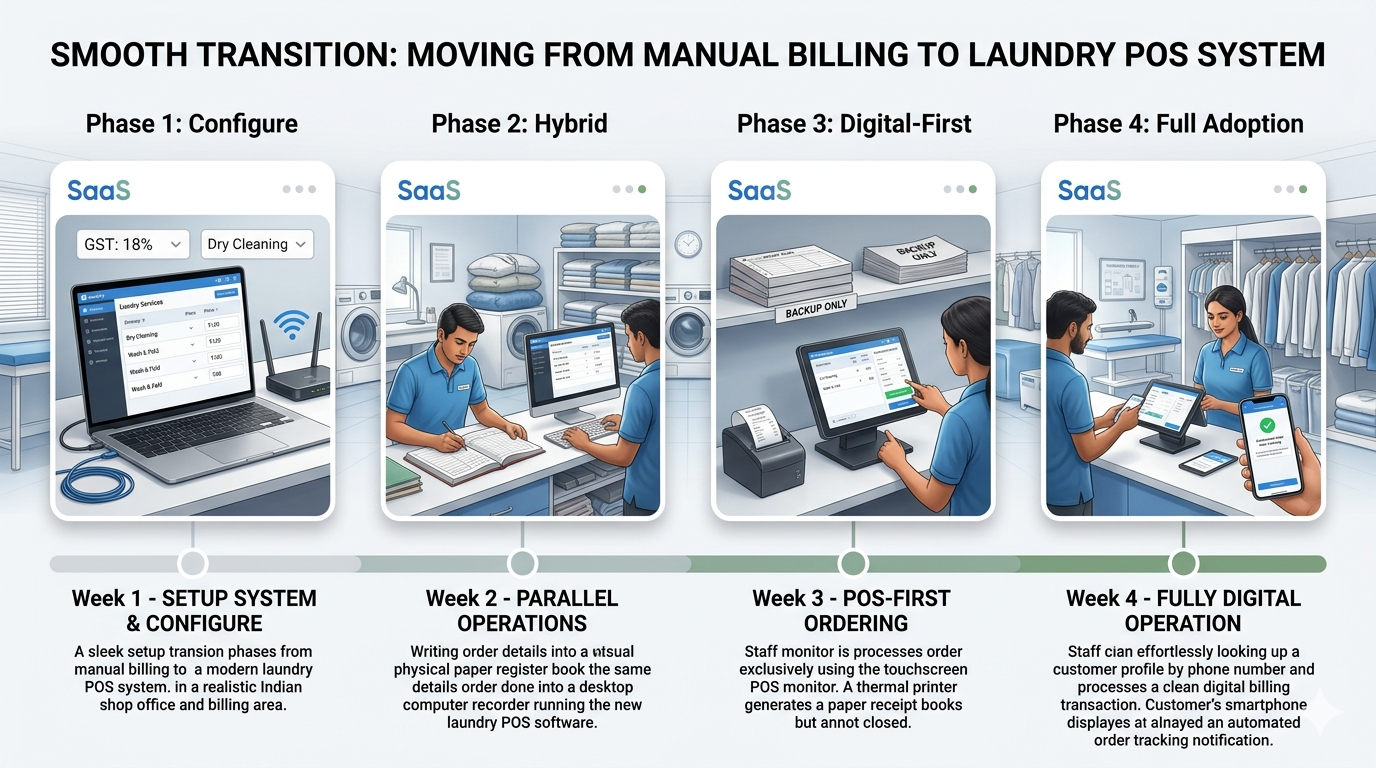
Making the Transition Smooth
If you're moving from manual to digital, here's a practical approach:
Week 1: Set up the system, enter your service pricing, configure GST settings. Don't take live orders yet.
Week 2: Run parallel systems. Take orders manually as usual, but also enter them in the POS. Compare outputs. This helps catch setup issues.
Week 3: Start entering all new orders only in POS, but keep manual backup for a few days. Print both receipts if it makes you comfortable.
Week 4: Fully digital. Manual system becomes backup/archive only.
Most businesses are fully comfortable by Day 20–25.
For existing customers, gradually add their details as they come in. No need to enter 2,000 contacts in one day. Within 2–3 months, you'll have your active customer base digitized.
FAQs
Is a laundry POS system difficult to learn?
Not really. Most modern systems are designed for non-technical users. If you can use WhatsApp, you can use a laundry POS. Initial setup takes a day or two, and staff training typically needs 2–3 days. After that, daily operations are actually faster than manual billing. The learning curve is much shorter than people expect.
Can I use a POS system without internet?
Most cloud-based systems work offline temporarily and sync when the connection returns. You can take orders, generate receipts, and record payments without internet. However, features like SMS notifications, cloud backup, and multi-branch sync need connectivity. Check with your provider about offline capabilities before choosing.
What happens to my data if the POS company shuts down?
This is a valid concern. Choose providers that offer data export options—usually CSV or Excel files of all your records. Regular backups are standard with cloud systems. Also, established companies with good track records are safer bets. Ask about data portability during the evaluation phase.
Is manual billing better for very small laundries?
It depends on your definition of "small." If you're doing 5–10 orders daily and have zero growth plans, manual might suffice. But even small shops benefit from organized record-keeping, quick search, and customer history. The cost difference is minimal—₹500–1,000 monthly—while time and accuracy improvements are immediate.
How much does a good laundry POS cost?
Basic systems start around ₹500–800/month. Mid-tier solutions with delivery management and multi-branch run ₹1,200–2,000/month. Enterprise systems with advanced analytics can go higher. Hardware (if needed) adds ₹5,000–15,000 one-time. EzerBiz Laundry POS offers plans across this range depending on features needed.
Will my staff resist switching to a POS system?
Some might initially. People resist change. But once they see how much faster customer lookup is, how billing errors drop, and how they're not hunting through pages anymore, most adapt quickly. Involve them in the decision, provide good training, and be patient during the first week.
Can I integrate a POS with my existing billing software?
Depends on what you're using now. Excel sheets? You can usually import customer data as CSV files. Standalone accounting software? Check if APIs or export options exist. Generic billing software? Probably better to switch entirely to a laundry-specific POS rather than maintaining two systems.
Conclusion
Manual billing isn't wrong. It's just limited. You can run a laundry business with register books, just like you can travel long distances on a bicycle. But when better tools exist, why make things harder?
The real question is about where you want your business in two years. If "exactly where it is now" sounds good, manual works fine. If you're thinking growth, multiple locations, or just less daily chaos, digital systems aren't optional—they're essential.
The initial switch feels like extra work. It is. But three months in, you won't remember why you waited so long.
Want to see how a modern laundry POS works in practice? Check out EzerBiz Laundry POS for a free demo—no credit card needed, just 15 minutes to see if it fits your business.
How to Start Your Laundry Business in 2026: Complete Guide
How to Manage Laundry Orders Digitally in 2026: A Complete Guide